Thomas Ernst: Restoring Scarlatti.
The following suggestions for restoring the texts of Domenico Scarlatti’s sonatas and restoring original pairings are based on musical evidence and counter the continuous musically never founded editorial prejudice as to what constitutes a “control source”. It is an ongoing project, and my time is very limited. It is an attempt to counter with as much forensic musical detail as possible the many false generalisations about Scarlatti’s texts and his pairings, but compiling every last detail of musical proof for every sonata and all sonata-companions would be and endless task. Hopefully there will be enough for someone to fill in the rest. Scarlatti’s music has been with me for over fifty years, the following observations have been assembled in the past eight years. No autographs of Scarlatti’s sonatas are known, but a proper Urtext of almost all of his sonatas can be easily established if one understands why and how scribes of the most comprehensive collections Münster (M), Parma (P), Venezia (V), Zaragoza (Z), Cary (Ca) copied his music. Editors since Kirkpatrick have elevated the textually most compromised set of Scarlatti’s sonatas, the Venezia-volumes, to “control-status” for reasons which are not musical: “I have taken the Venice manuscripts as the principle basis for reference because they represent the official versions prepared for the Queen of Spain, and they were probably with the knowledge and approval of Scarlatti himself.” (Kirkpatrick, p. 138). This unfounded prejudice continues: “Venezia is the most complete [set], comprising […] four hundred and ninety-six sonatas, and the presence of royal emblems on the binding (the Spanish and Portuguese coats of arms crossed) proves that it must have belonged to the Queen of Spain.” (Ricordi, 7, 1989, p. VII). It is unclear how royal provenance or quantity determine musical textual authenticity. Scarlatti demonstrably corrected neither texts nor order of any sonata copied into P and V. The fifteen Venezia volumes belong together in appearance only, as has been known for a long time ago. V42 and V49 were two independent copying projects assembled before the actual collection of Scarlatti’s “Collected Works” in double execution (Parma and Venezia) began in October 1751. The thirteen Venezia-volumes proper contain 393 (if I counted correctly) sonatas, fewer than Parma’s 463. Quantity cannot warrant for textual authenticity. No musical proof for the preference of Venezia has ever been provided. Textually it is the most corrupt source as a measure-by-measure comparison shows. Currently primary and secondary sources are not distinguished from secondary sources. It has been known for a long time that Vienna A-F constitute copies of Münster, but all Ricordi-volumes include every variant reading from Vienna, although they are not by Scarlatti. It was Kirkpatrick who literally condemned Münster to be “of subsidiary importance” (Kirkpatrick, p. 139), without providing a musical reason; Boyd echoed almost the same wording, “of secondary importance” (Boyd, p. 150). Münster keeps being explicitly discredited as a primary source (here regarding K490): “these critical notes will cite only those differences in appoggiaturas found in the two principal sources, Venice and Parma.” The practical effect has been that editors consider M as a last recourse where both P and V fail, but that, at the same time, all of Münster’s divergent readings are summarily relegated to the commentary section (if they are noted at all) and are never integrated into the main text, even if they are demonstrably correct. Münster, rhythmically, harmonically, polyphonically and even notationally provides the truest account of Scarlatti’s sonatas available, but it has many lacunae, and its own mistakes. Trying to understand why P and M and Ca made mistakes for example in the final four measures of K140 is forensically more rewarding than elevating one source and condemning another for no musical reason at all. Scarlatti did not participate in the assembly of his “Collected Works” from 1751–1757, the texts of Münster, Parma, Zaragoza and Cary were copied from the autographs. Venezia, with the possible exception of V52a, has no primary source value. The copyists of Ca, M (collective for several copyists), P, V, Z (collective for various copyists) copied by different standards. Their “methods” can be discerned by comparing the same music measure by measure. Amassing quantities of comparative readings without distinguishing between primary and secondary sources, and suggesting that there never was a definitive version of any sonata by Scarlatti sends the player back to Czerny and Bülow and Longo: source A has an f♯, source B an f, source C a rest, source D an a – all must be variants by a composer who was not able to produce one bipartite keyboard sonata without constant revisions. It is absurd. If Bach’s fugues had been traded down in a comparable scribal allegro di confusione, musicologists would quickly point out what notes are scribal errors and what notes are not, and why. Musical quality would not be determined by quantity or royal burgundy morocco provenance, as Scarlatti’s has been since Longo. To compile a critical apparatus for each sonata for its own sake without distinguishing between primary and secondary sources is a disservice to Scarlatti and to the performer. An analysis of each source should precede any judgement of its musical value. Currently the player of K25 – a random choice – is supposed to cut through a thicket of some 53 (?) unnecessary variants which, with an understanding a) of secondary sources b) of mistakes typical for a given source, for instance Cary, can be reduced to five, behind which K25 re-emerges as one sonata. Scarlatti wrote one K2 and one K202 and one K206 and one K555 but the possibility that he did is currently negated. The emendations of K2 in the Cary-ms. have elicited the “conclusion that these were the results of the composer’s retouching, not an outside intervention. As it seems, each time Scarlatti had a chance to write down one of his sonatas, he provided a different copy, always rethinking the previous one, sometimes slightly, sometime in greater depth.” (Ricordi, vol. 10, 2020, p. XLIX). No musical reason reason is given for it. How did Scarlatti supply copyists and printers with his latest insights? How was Ca supplied with a different antigraph than Boivin or E:2? This approach implies that Scarlatti intentionally disregarded his own polyphony in K2 (see below). A close reading of Münster, Parma, Zaragoza and Cary and Albero’s copy and not sweeping prejudices about source-value and preconceived notions about the possibility and impossibility of Urtexte reveals how and why each of these copyists worked differently from eachother. Whoever Sheveloff’s copyists “M1” and “M2” were, they preserved numerous rhythmic, harmonic and polyphonic details which P omitted or smoothed out. Z (vols. 3 and 4 likely copied by Santis[s]o) is as valuable as M – vide for example K202 and K226. P was copied by a professional paid scribe, perhaps mainly Santis[s]o (initials K521, 522), whose goal was efficiency and a clean textual appearance. He regularized rhythmic details if the sonata contained no precedent for them, frequently turning 16th notes followed by an eighth note and similar rhythmic combinations into triplets (K163, K170, K454, K466, K488, many others), smoothed 32nds into 16ths (K226). P often simplified or discontinued voice leading details such hemiolic ties (K510), omitted notes (K474), sometimes cut text (end of K304). The Cary ms. does not contain variants composed by Scarlatti, but all its alterations were intentionally effected by the composer-scribe. They are fascinating for the Scarlatti reception by the scribe, but they contribute nothing to the original text of Scarlatti’s sonatas. Marguerite-Antoinette Couperin’s Pièces de Clavecin from the mid 1730s, in turn, contain superior readings of K125 and K179 and K180 which are not scribal variants. The missing hand disposition indications in K1 and the missing B♮ in m. 7 and possibly missing hand indications in K2 suggest that Scarlatti did not oversee the print of his Essercizi as closely as François Couperin was able to do with his Ordres. A form of textual criticism which lines up as many different notes from as many different sources as possible and first ascribes every change to the composer rather than to a scribe or printing compositor turns Scarlatti into a composer who was not able to write one comparatively short piece of keyboard music without constant revisions. It seems Scarlatti’s music lends itself to being deconstructed by default because no autographs survive and so few items were printed. “Modern textual criticism has moved on from the recovery or reconstruction of the author’s or composer’s original urtext. Contemporary practice is more pluralistic, allowing for multiple versions and compositional second thoughts.” Does this apply to François Couperin and Rameau and every movement of a sonata by Haydn or Dussek, too? What is “contemporary”? What constitutes “modern textual criticism”? Why did I not hear it “move on”? What are the musical justifications and credentials of this doctrine? The logical conclusion is: if you restore one version of K99 or K234 or K260 or K426 or K497: you are wrong. You have not “moved on”. The same totalitarian tone informs a current “modern” Chopin edition: “The editorial concept for the series is based on two premises. First, there can be no definitive version of Chopin’s works: variants form an integral part of the music. Second, a permissive conflation of readings from several sources should be avoided.” What is a “permissive conflation”? While Chopin variously emended popular pieces such as his Nocture op. 9, no. 2, and while these emendations ought to be included as ossia in modern editions, it is quite possible to establish one definitive text of his Rondo op. 1. If “recovery or reconstruction” of an Urtext and “permissive conflations” are not allowed, or if important sources are preemptively removed from the commentaries (AI-Chopin) no modern edition is necessary. Copyists and printing compositors, whether of Trithemius’s Steganographia, Shakespeare’s Sonnets – the work of just two compositors, who made numerous mistakes – Scarlatti’s Sonatas, or Chopin’s Rondo op. 1 left, for lack of a better word, forensic fingerprints in their work. They can be deciphered, if one considers handwritten and printed sources first as the product of a certain copyist or printer. All Scarlatti copyists had their own “style” and their own reasons of how they went about their work.
Some examples for reconstituting an Urtext. More can be found in the notes to the sonata-companions further below. Instead of RISM nos I have simplified the sigla: Al = BL Add. ms. 31553, Ay = Ayerbe, B = Boivin (6 prints), Bo = Bologna (2 mss.), Ca = Cary (3 sections), CF = Cambridge-Fitzwilliam (mss. 12 and 13), E = Essercizi, Li = Lisbon, M = Münster, Na = Napoli, NH = New Haven, P = Parma; PdC = Pièces de Clavecin (3 sections), V = Venezia, WQ15114, 15115, 15116, 15118 = the four L’Augier-volumes, Z = Zaragoza (volume count after YN); and some prints: Haffner, Johnson, Vernadez, Venier. Proven secondary sources, such as the Vienna copies A-F of Münster, are not included. All fifteen Parma-volumes except the first one have volume numbers and are dated. The explicit volume-count begins on the title page of vol. 2. Volumes 2-7 have copying dates in the index, vols. 8-15 on the title page and in the index. The first Parma-volume is undated, but since vols. 2-6 were apparenty copied by 1752, the largest number of volumes of either Parma or Venezia to be copied in one year, 1751 may tentatively be assigned as copying year for Parma-I. [the copyists of the Real Capilla José Lombart, José Domingo Santis[s]o entered royal service 17511002; salary increase 17561030 (YN p. 389); Lorenzo de Almón separate employment roster]. To indicate the ascending order of the multi-volume years 1752, 1753, 1754, 1756 I have added letters: Parma I = P51, II = P52a, III = P52b, IV = P52c, V = P52d, VI = P53a, VII = P53b, VIII = P53c, IX = P54a, X = P54b, XI = P54c, XII = P55, XIII = P56a, XIV = P56b, XV = P57. The year dates which Kirkpatrick assigned to the Venezia-volumes past V42 and V49 (which do not belong to the series of “Collected Works”) I have adjusted accordingly: Venezia I = V52a, II = V52b, III = V53a, IV = V53b, V = V53c, VI = V53d, VII = V54a, VIII = V54b, IX = V54c, X = V55, XI = V56a, XII = V56b, XIII = V57. – I have randomly chosen K99, 125, 132, 133, 135, 148, 163, 167, 179, 180, 182, 202, 226, 236, 405, 433, 440, 454, 466, 474, 488, 489, 499, 500, 506, 510 to illustrate how the copyists worked.
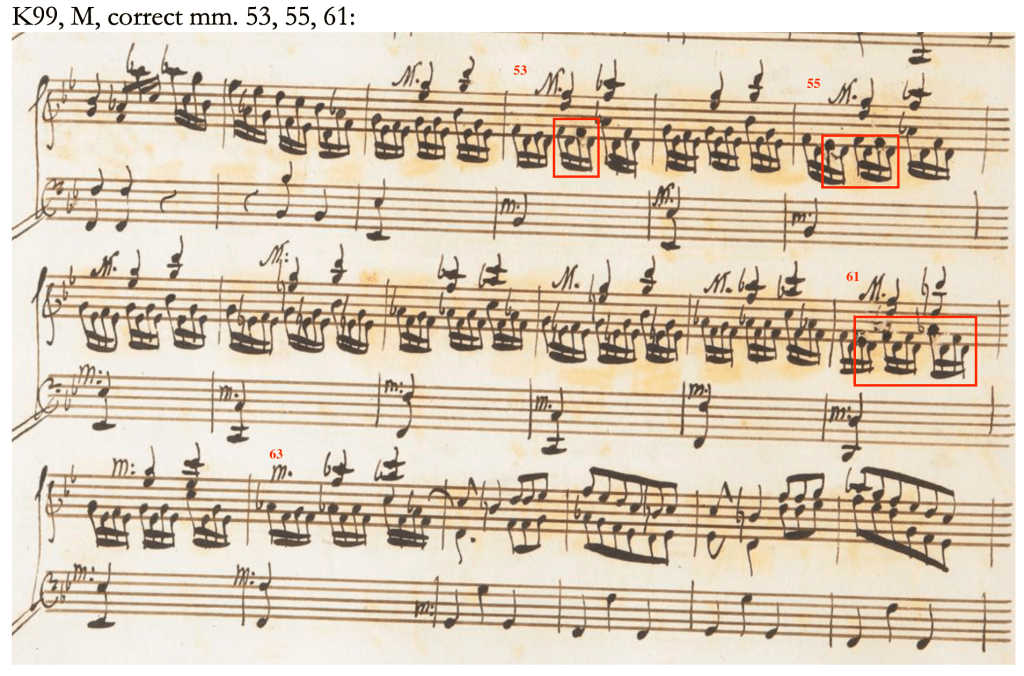
K99C-c3 (Sources: M3:19/P52b:18 → V52b:14/V49:2/Al:31). Second half, passage with crossed hands, mm. 52-63. An analysis of the tenor 16ths suggests that in mm. 53, 55, 61 M renders the correct version while P and others “derailed”: first on the seventh 16th note in m. 53 (the e♭1 serves as a lead note to the f1 between first and second beat), then in m. 55 not only on the 16th note c1 but again on the e♭1 which should have been a f1, then in m. 61 with the third 16th f1, and by copying the second and third beat 16th-groups backwards:
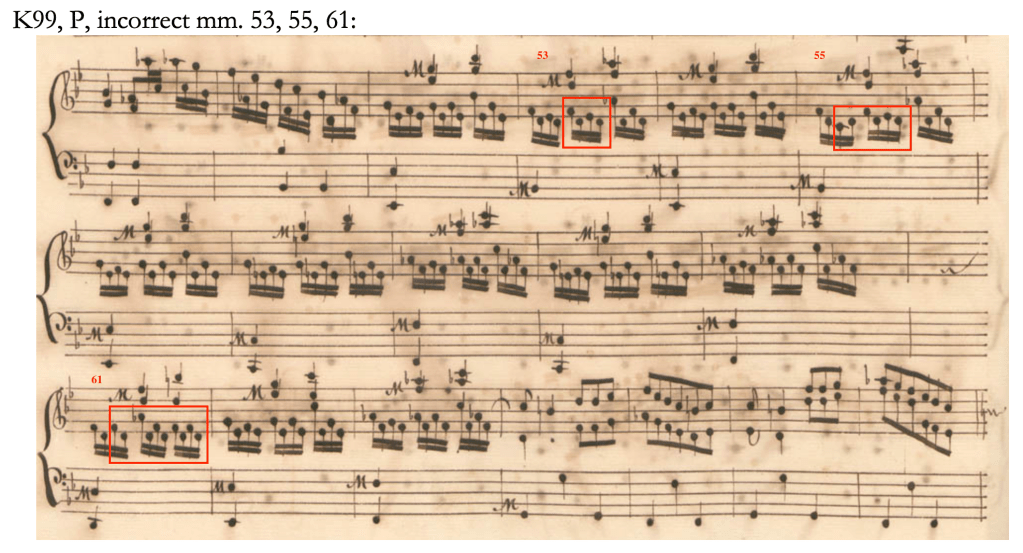
V52b contains the same mistakes because it was copied from P. – V49 and Al contain the same mistakes as P; here from V49:
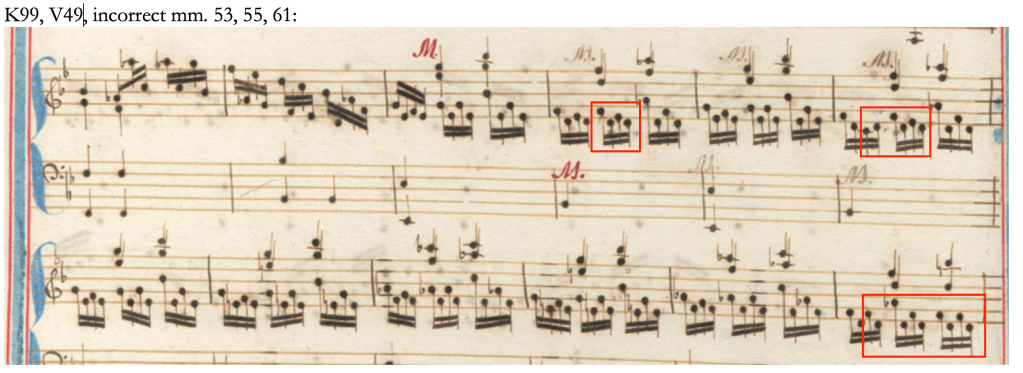
While V52 is dependent on P, the relationship between V42 and V49 and the early Parma volumes requires further exploration; so does their relationship with Al (see K68 below).
The six notes framed in red, superimposed on Gilbert, are scribal errors. The melody of the tenor is established in m. 52 and repeats through m. 63:
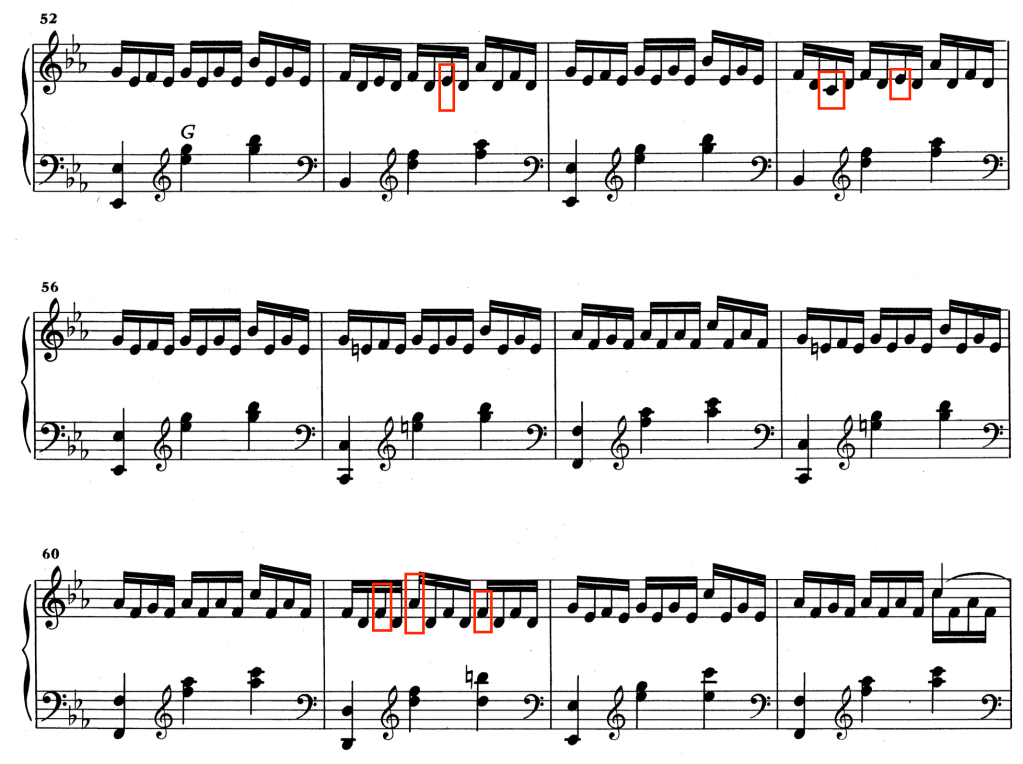
The voices of K99 are of equal polyphonic value. If the distinct melody of the tenor can no longer be perceived, K99 is being played too fast. See “historical tempo” below.
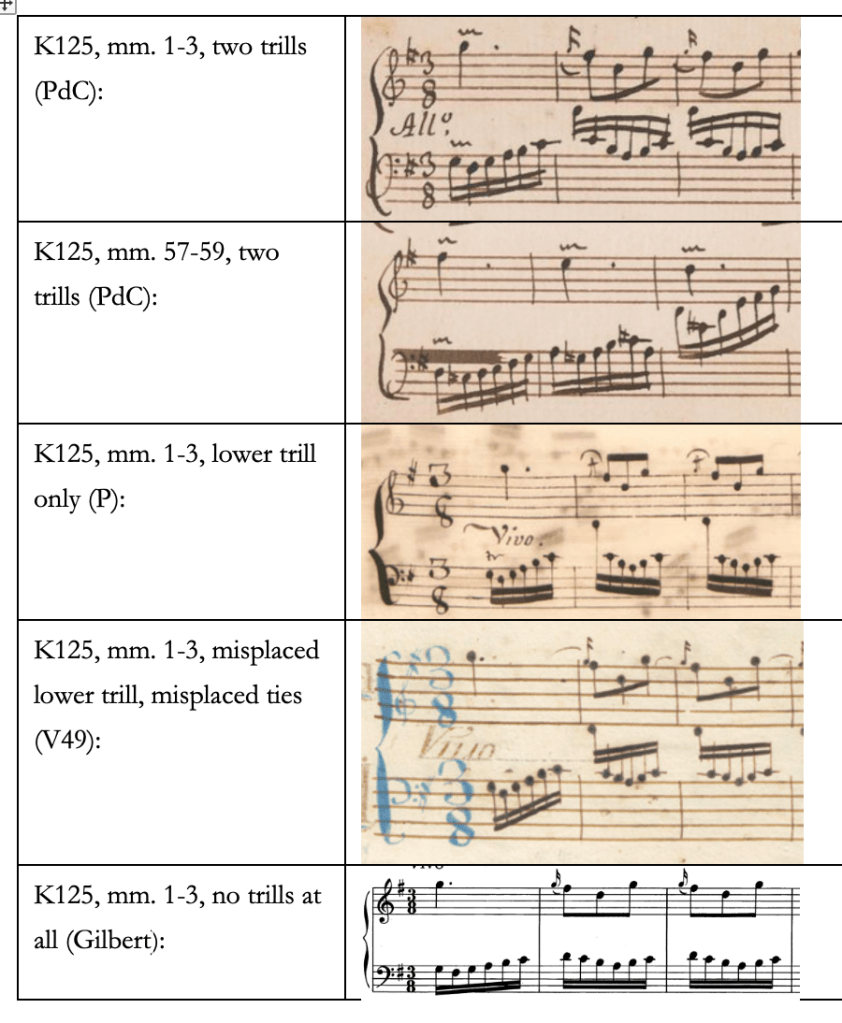
K125 (Sources: PdC2:2/M3:11/P52a:4/Z3:3/V49:28/CF13:15/WQ11517:17/ Li:45/Vernadez:2/Ha:1). Textual deterioration. M. 1, trills. PdC preserves the trill on the g2. The trill compliments the corresponding opening of the second half. In M, P, V49 the trill above the g2 was omitted. Gilbert overlooked the trill on g in V49:
K132C-d3 (Sources: M4:54/Z4:2/P52d:5/CF13:20/V49:36/WQ15116:5[=L’Augier:31]):
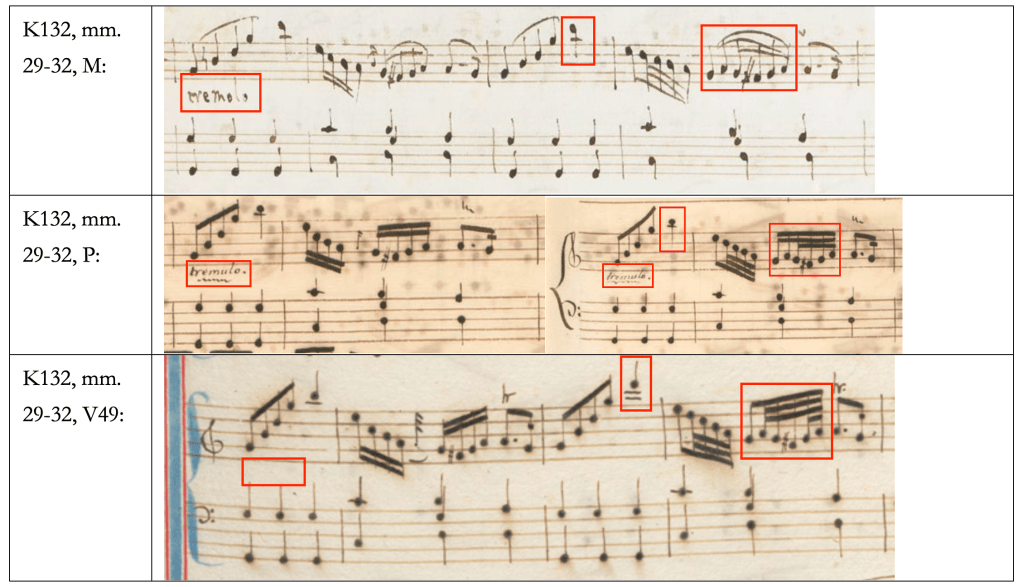
K132, mm. 29, 31: the Italian tremolo in M4 is authentic, Scarlatti indicated it only in m. 29. The Spanish scribe of P52d rendered it as tremulo and added an explanatory wave underneath (the double notation is editorial since it is redundant), and he added it also explicitly to m. 31. V49 omitted Scarlatti’s tremolo in m. 29.
V49, m. 31: neither m. 29 nor the parallel mm. in the second half, nor the melody justify a d3. The high note in m. 31 is a b2, confirmed in all other sources.
V49, m. 32: a1 m. 32 second beat is part of the melody g1-a1, not the first note of the turn which begins on the second g1. To include the a1 in the turn shortens the melody. s a ghostly voice that comes from nowhere and goes nowhere. It has “footnote value” only. It should not be played. However, the mistakes in M, P, Ca are extremely valuable as a possible glimpse at Scarlatti’s notation, and as a record of scribal notational practice.
K133C-d3 (Sources: M4:55/Z4:3/P52d:6/CF13:21/V49:37/WQ15116:6[= L’Augier:32]/Ca1:54). K133, mm. 105-108 are in c minor, not C major; they constitute a reprise of mm. 24-28 of the first half. The music does not return to C until m. 109 ff., in M indicated with an explicit ♮. M preserved the correct e♭ and e♮, V49 and P52a omitted them:
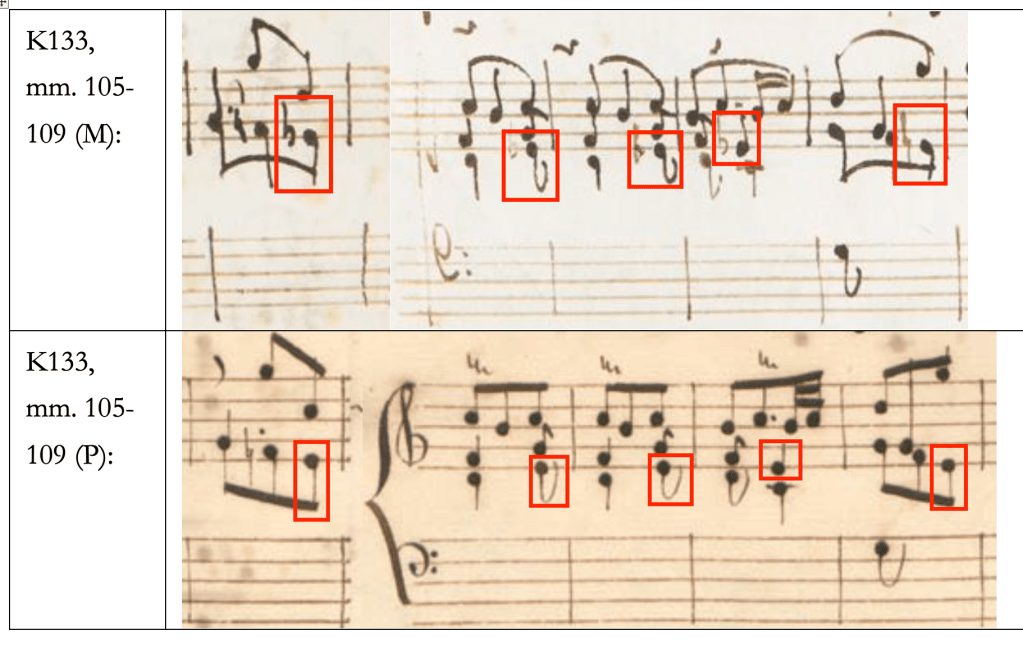
The loss of c minor in mm. 105-108 and the harmonically premature return to C undermine the dramatic structure and harmonies of K133. Since the musically never questioned “control sources” V and P omitted four ♭, K133 loses much of its intense chiaroscuro. – For the reason why K132•133 were copied in P52a but omitted in V52b see below.
K1351B-d3 (Sources: M3:12/P52a:8/Li:14/WQ15116:371752/V49:39). In m. 88 K135 begins a long excursion in minor which lasts through m. 101. M correctly concluded the episode in e not until m. 102 by adding eight ♮ signs to the various notes c and g (only two g2 overlooked, perhaps for lack of space). P omitted the ♮ signs in mm. 98-101 and returned to E four mm. too early:
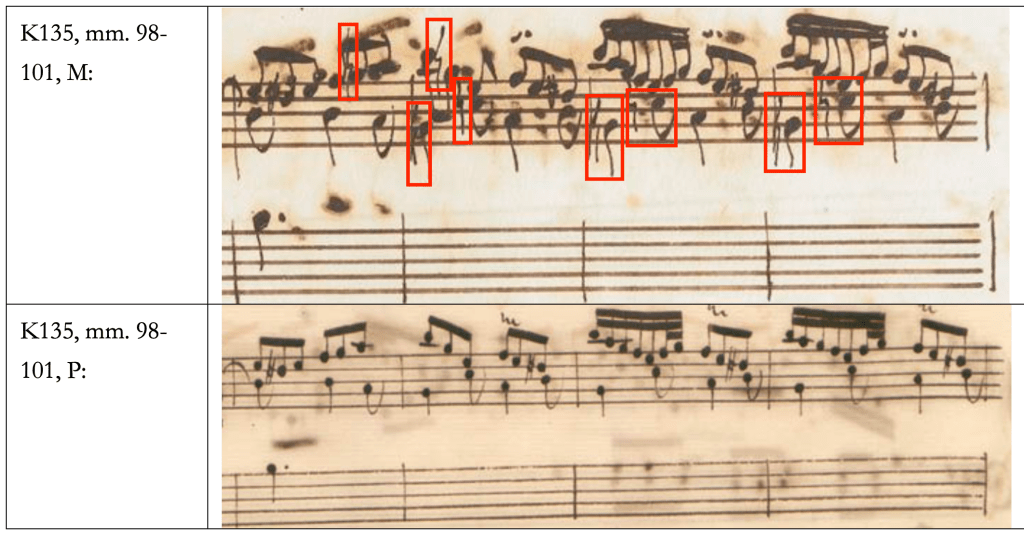
The key of E is not re-established until the three consecutive mm. 102-103.
K148D-d3 (Sources: V52a:1/P51:1D-e3/Z4:39Andante amoroso R.na/Bo1:12Andante amoroso/Na:5Andante amoroso), mm. 72-79. An inventory of the actual compasses of all sonata-pairs shows that sonata-pairs with a ceiling past d3 do not occur until the acquisition of the transposition harpsichord with the range of 1G-g3 / 1F-f3, in terms of K-numbers first with K356•357. Z and V copied soprano and alto according to Scarlatti’s original. The scribe of P51, at the very outset of the “Collected Works”, in the first sonata of the first volume, stumbled over the drop from d3 to a2 and hyper-corrected the melodic climax of the sonata, likely because he considered the interrupted ascent b2-c3-c♯3-d3 | a2-b2-c3 musically faulty, by replacing it with the long uninterrupted arch b2-c3-c♯3-d3-d♯3-e3-d3-c3. He inserted the d3 on the third beat of m. 77 in order to avoid a two-step drop onto the c3 of m. 78:
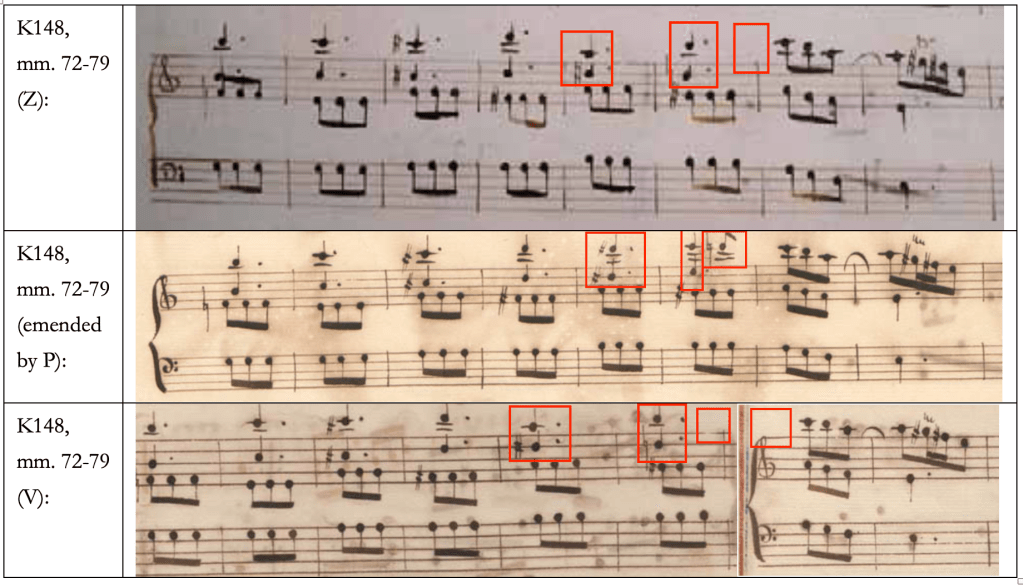
V52a may have restituted the two mm. by cross-checking the autograph against P51. Other textual deviations between P51 and V52a, however, were initiated by María Bárbara. – In the index of Z4 the ten sonatas K148, 149, 152, 153, 154, 158, 159, 164, 165, 166 are marginally marked “R.na”. In Z4 these sonatas are dispersed between Z4:11 and Z4:44; here K158, 159, 165, 166 (Z4, f. 130r, from YN, p. 545):
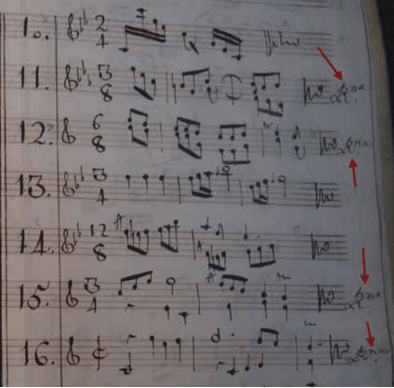
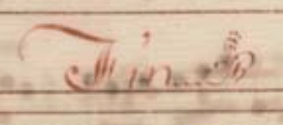
All sonatas marked “R.na” in Z are contained – without such marks in the index – within the first nineteen sonatas of P51 and V52a. In V52a the last “R.na”-sonata, V52a:19 (K166), concludes with a “Fin” followed by what could be be a triple-crowned “R” (V52a:19, f. 39r); the other “Fin” in V52a do not have this “signature”:
The likely explanation for the Reína-references in Z4 coinciding within the span of the first nineteen sonatas in P51 and V52a appears to be structural: that MB oversaw the initial copying process through K166 or had provided the texts for them or approved their order. These “checkmarks” were not integrated into the professional copies P51 and V52a but vestiges survive in Z4. Coincidentally, although K164 is the first singleton, after K168 the pairings in P51 and V52a disintegrate: K169 through K176 are all singletons.
K163E-d3 (Sources: M4:27/P51:16/V52a:16). Rhythmic pattern of 16ths followed by 32nds mm. 17, 19, 21, 23, 25, 27, 29, 31, 49, 51, 53, 55, 57, 59, 61, 62, 63: M rendered all correctly. P erroneously reversed the rhythmic pattern in some mm. V smoothed out all occurences in all seventeen mm. into 16th-triplets, which removes the stress from the second beat:
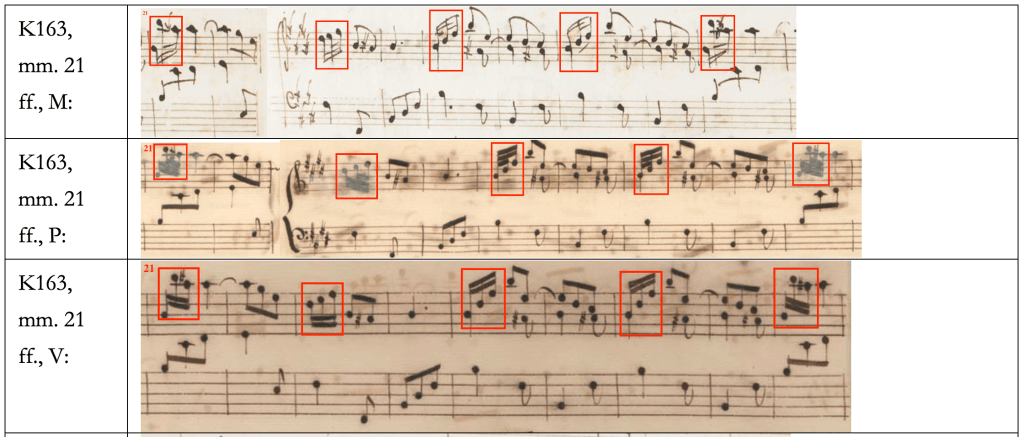
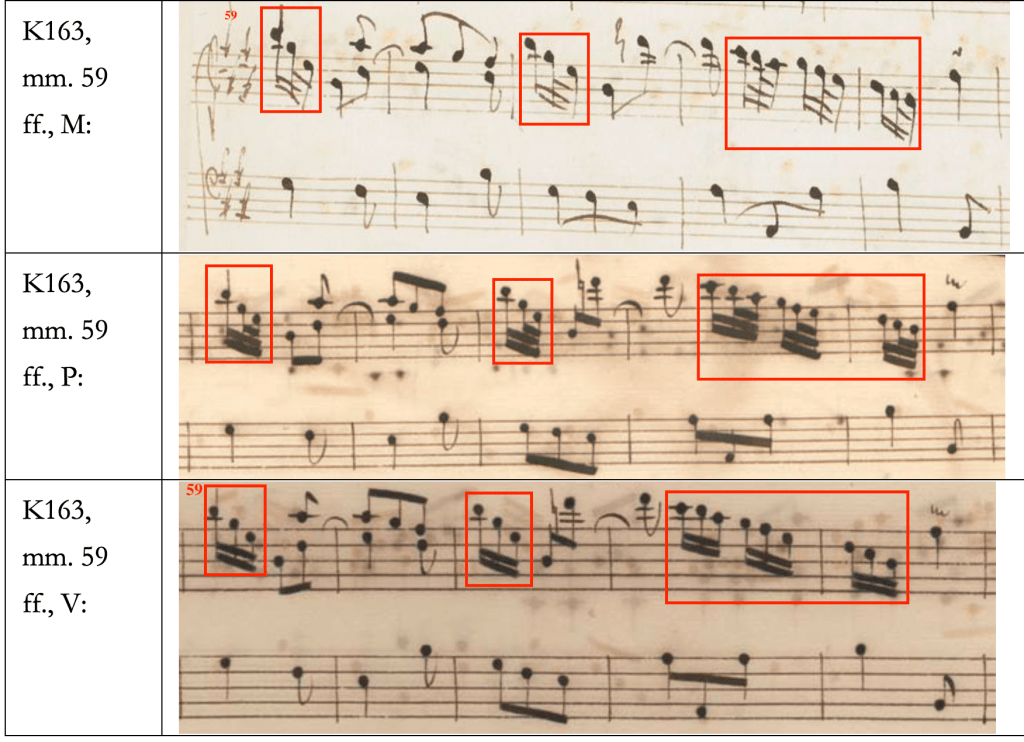
M copied from the autograph, so did P51. The changes in V52a could not have been effected by another look at the autograph. Possibly V found them unnecessary. However, there are numerous other alignments of similar rhythmical “irregularities” in other sonatas, for example K167, K226, K454, K466, K474, to list only a few. As improbable as it may sound, the scribe of V52a must have edited the text at María-Bárbara’s request. As late as K454 V turned P’s accurate rendition of the note values into triplets. Such comprehensive rhythmical surgery in seventeen mm. of musical text that consists of only sixty-four mm. is too intrusive to have been effected by the scribe independently, especially from P51 to V52a. María-Bárbara may have been more interested in musical appearance or executability than accuracy. Scarlatti demonstrably had no part in the faulty copying and pairing of his sonatas in P and in V.
V52a was copied in a different layout from P51, here the change from “16.” to “SONATA XVI.” The design change from P51 and V52a was likely requested by María Bárbara, who wanted her handwritten sonatas to look like the printed Essercizi which were dedicated to her father:

From V52b onwards the scribe changed to lower case letters and Arabic numerals, while P continued with Arabic numerals only.
K167C-c3 (Sources: M4:31/P51:21 → V52a:21/Z4:57|K167). Mm. 1-5: V52a omitted measure 3 (or 4) from the five-mm opening phrase of K167. M and P preserved it. V is the version in print:
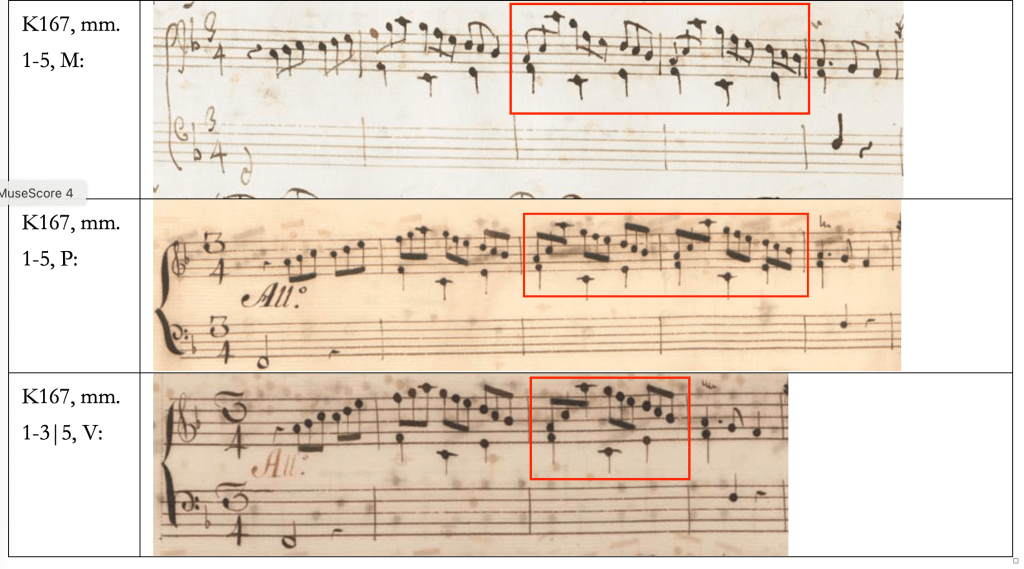
Rhythmic smoothing into triplets both in P51 and V52a, here mm. 34-36:

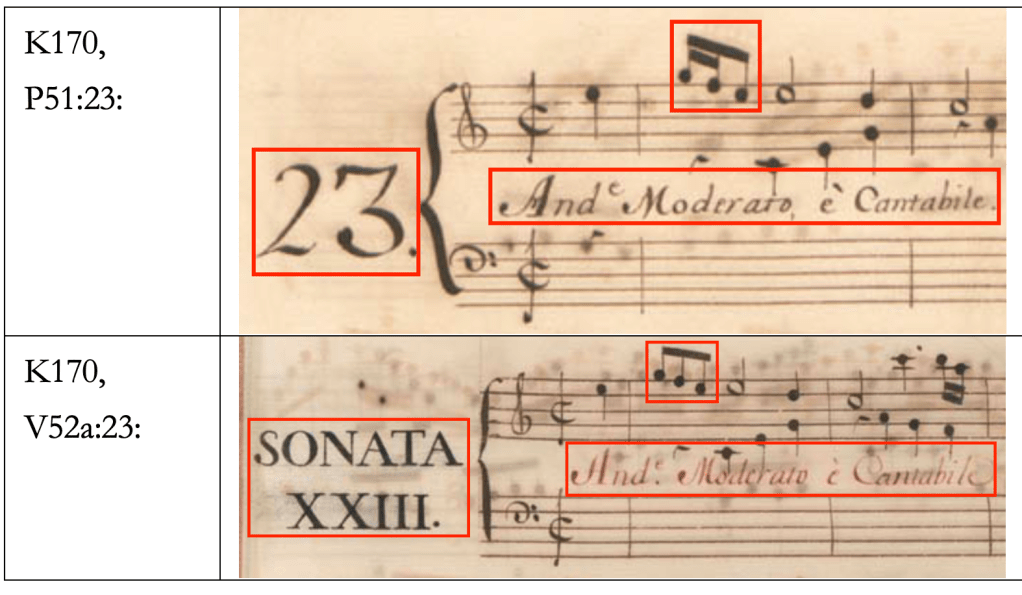
K170 ¢ Andante moderato è cantabile – 3/8 AllegroC-d3 (Z4:53/P51:23/V52a:23Fin|K170).
María Bárbara’s exacting design for her sonata-set becomes very evident when comparing the beginning of K170 in P51 and V52a, which were copied by different scribes (capitals “A”, “M”, “C”). As a matter of fact, the complete sets P51-P57 and V52a-V57 were copied by two different scribes (cf. “Allegro” in P57:2 and V57:2). The plain Arabic “23.” is replaced by Essercizi-style “SONATA XXIII.”, the 16ths + eighth are smoothed out again into triplets (also in K170’s companion K174), and the black ink tempo indications “Ande Moderato, è Cantabile.” are adjusted grammatically to “Ande. Moderato è Cantabile” (added period for the abbreviation, no comma, no period) as well as colour-wise: P’s drab black text is rendered in burgundy red ink. The same carnation-red the Queen chose for the binding of all her volumes and the Essercizi, the famous burgundy morocco:
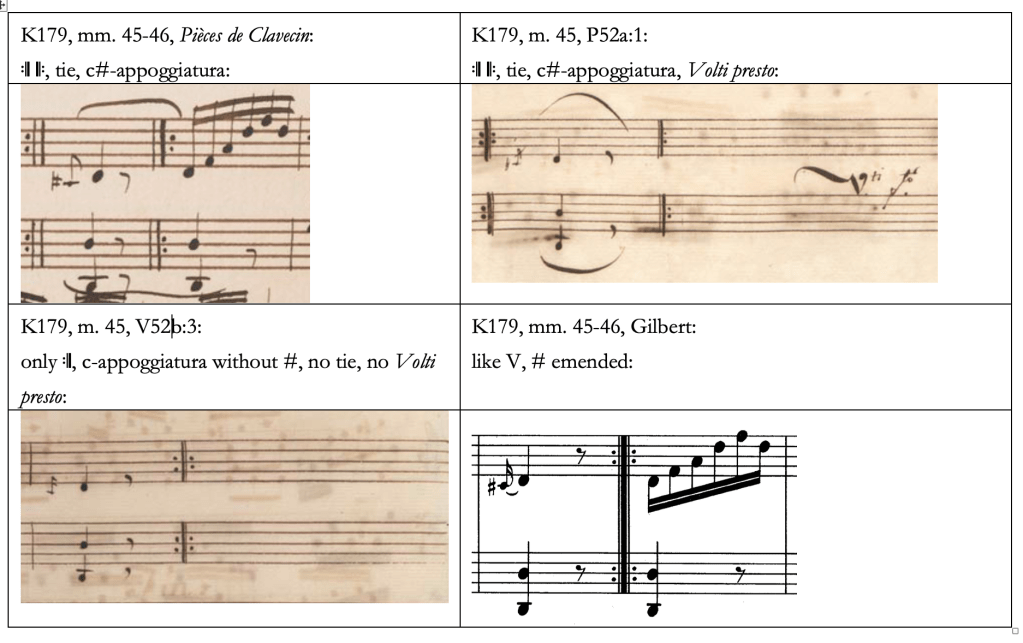
K179D-d3 (Sources: PdC3:4/P52a:1 → V52b:3/[M5:17]/Z3:20/Ay:16/Li:34/Ha1:6). PdC has m. 45 between 𝄇 𝄆, with a tie leaning into m. 46, and the c#-appogiatura. P centered the repeat tie because the second half continues on the verso, P has the c#-appogiatura, and added Volti presto, likely copied from Scarlatti’s autograph who usually layed out his sonatas v-r-v-r (possible exception K356•357). V, copied from P, shows significant textual deterioration: the first repeat bar has been omitted, accordingly there is no repeat tie and no Volti presto, and the # before the c-appoggiatura has likewise disappeared. If we take the “textual variant”-approach, Scarlatti could not make up his mind about the seconda volta and sometimes applied accidentals, sometimes omitted them. Despite the musical evidence in P, V’s defective version is in print, with added sharp. Instead of continuing directly into the second half, as Scarlatti intended, the player takes a Sitzbad on a measure which deflates the music. It is not a variant but a copying mistake:
K1801A-d3 (Sources: PdC2:3/M5:37/Z2:2/P52a:2 → V52b:4/Z3:19/Na:2/Vernadez:XIII). Like M and Z (Z2:2, Z3:19), PdC has no extra half note g in m. 5. It was first accidentally added by P who, copying upper and lower staves separately (see K190, 192 below), had missed that he had copied a half note g already. V copied P’s mistake. Both by precedent (m. 3) and for voice-leading there should be no extra g in the bass: it comes from nowhere, and it resolves nowhere. – Like M and Z, PdC has the correct c♯2 in m. 22. It was first omitted by P and accordingly not copied into V (depicted on the right). Gilbert and Fadini, despite M, which they considered to be an inferior source, retained the superfluous g, Gilbert even beamed it as an octave with the g1 above:
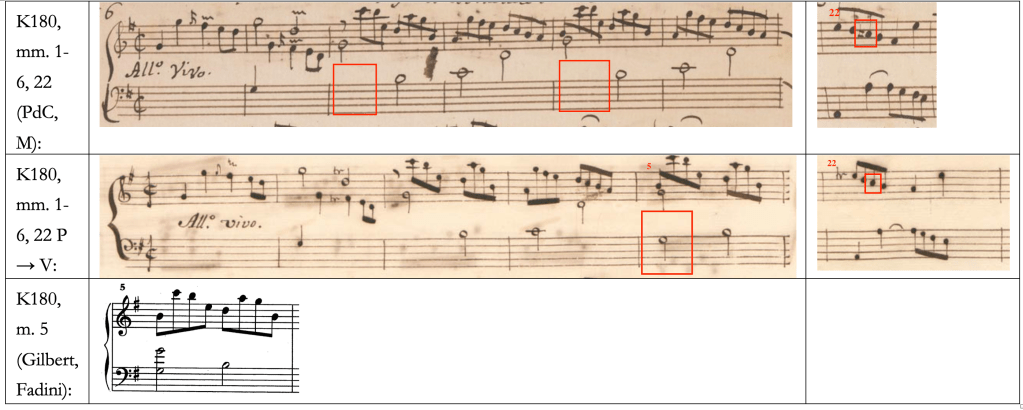
P added a superfluous g in the lower stave because he copied upper stave first, lower stave second, overlooked the g1 from the upper stave, and added the half note g in the lower stave. The half-note BT-progression is […] c1-d1-g1-b-c1-d1 […]. P provides the parallel progressions […] c1-d1–g1-b-c1-d1 […] and […] c1-d1–g-b-c1-d1 […]. Recognizing the cause for for P’s mistakes and how they were transferred into V facilitates detecting others. The g in P and V is an obvious copying error, and not the composer’s.
K1821A-d3 (Sources: M4:34/PdC3:5/Z2:6/Z3:17/P52a:11 → [V52b:6]/Li:21), mm. 2, 7. PdC is titled “Sonata per cimbalo del Sigr. Scarlati”. In mm. 2 and 7, third beat, PdC has d2-a1, i. e. D major instead of a D7 which corresponds harmonically to the beginning of the second half, third beat e1-a1 (m. 58), i. e. an E-chord followed by an A-chord, but also to the beginning of K181, A|D; all other sources have d2-b1 in mm. 2, 7:
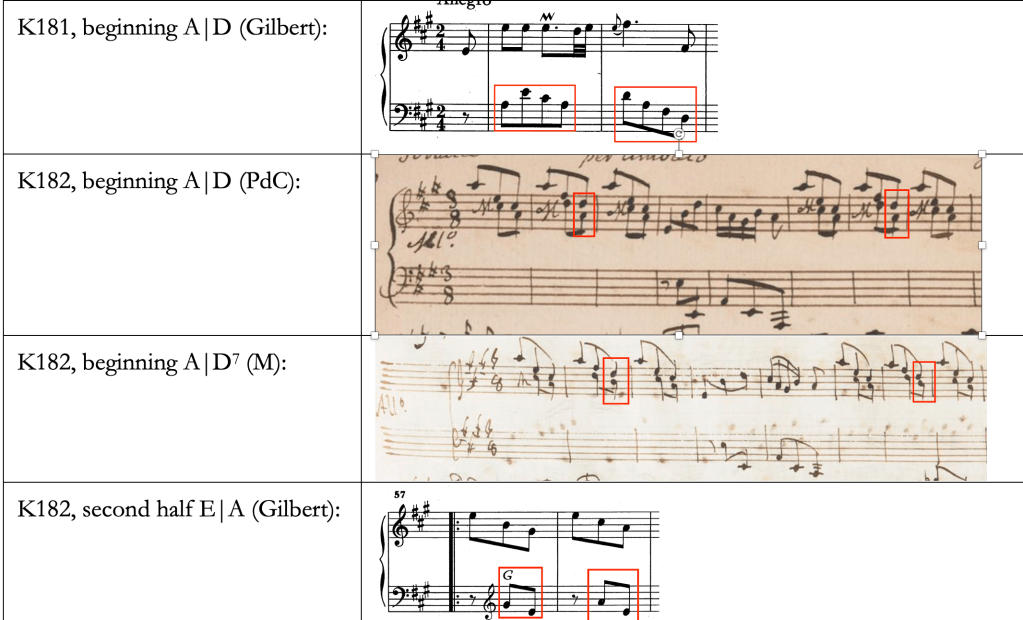
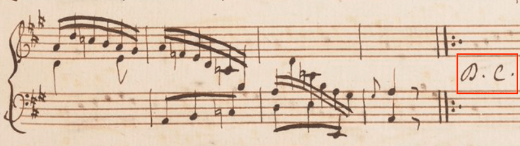
The b1 likely occurred by precedent, group of thirds on the third beat. Why would PdC have altered it twice? – PdC has all the hand disposition signs. PdC ends with “D. C”, which features frequently in V42, thus it was not unique to that source. The “D. C.” may have been an instruction to the performer, or the composer, to encore either the set or the secunda, perhaps with improvisations:
K1901Bb-d3 (Sources: M5:33/P52c:11 → V52b:19/Z4:14/Ay:14), m. 34. In P52c:11, 20v the scribe left the lower stave blank (he did the same in K192, m. 6). V52b:19, f. 36v copied the blank stave from P. María Bárbara filled it in unconvincingly (lighter ink, smaller note heads; see the crosses in K433). Ay:14 has the composer’s 7th chords in m. 34:
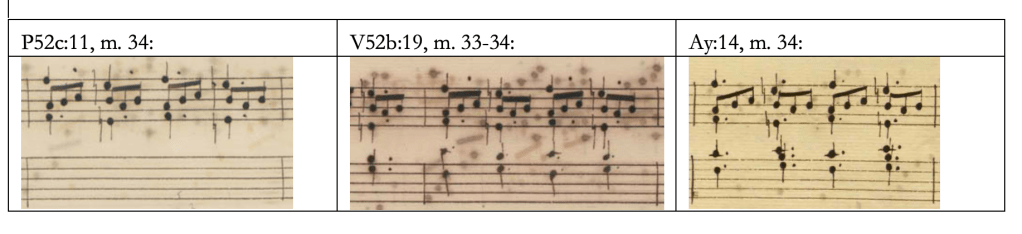
María Bárbara’s corrections are in print, not M or Ay.
K202C-d3 (Sources: M5:39/Z4:56/P52c:12). K202 is the first of a group of five sonatas not copied from P into V. – P omitted m. 74 which is present in M and Z:
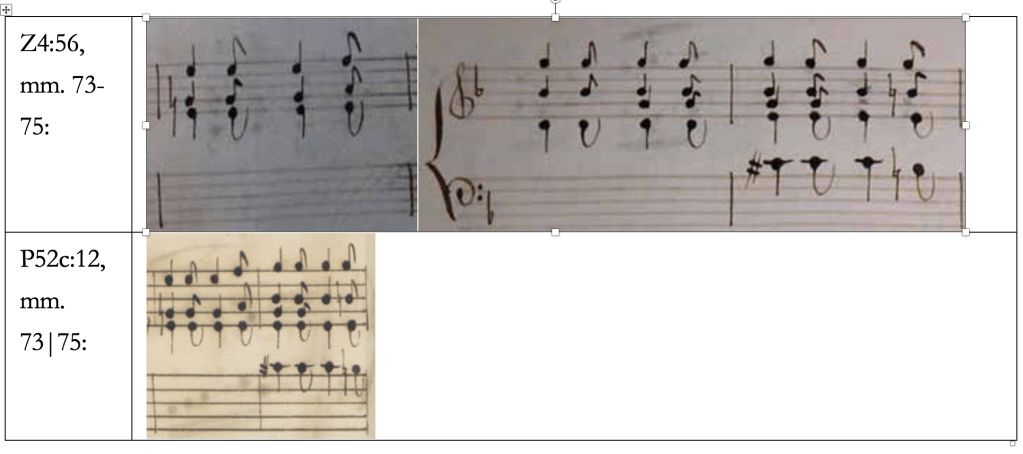
The scribes of M and Z had no reason to invent this polyphonic measure. They copied what they saw in the autograph. The missing m. is necessary because it continues the stepwise progression of the bass, e-[d]-c♯, and transits with four-voice chords to the five-voice chords. Since Fadini considered M not a primary source (Z not included in her variants), she relegated the correct text to the commentary and, like Gilbert, printed a defective main text.
K226C-d3 (Sources: Z2:29/P52d:10 → V53a:21). Mm. 48-49 show textual deterioration from Z (quoted from YN, p. 335) to P to V. Z preserved the 32nds in m. 48 with the the melodic a2 and the appoggiatura in m. 49. P, who copied from the same source as Z, regularized the rhythm into continuous 16ths (cf. K466, 488 below) and omitted the a2, but kept the appoggiatura. When V copied P, he overlooked the appoggiatura:
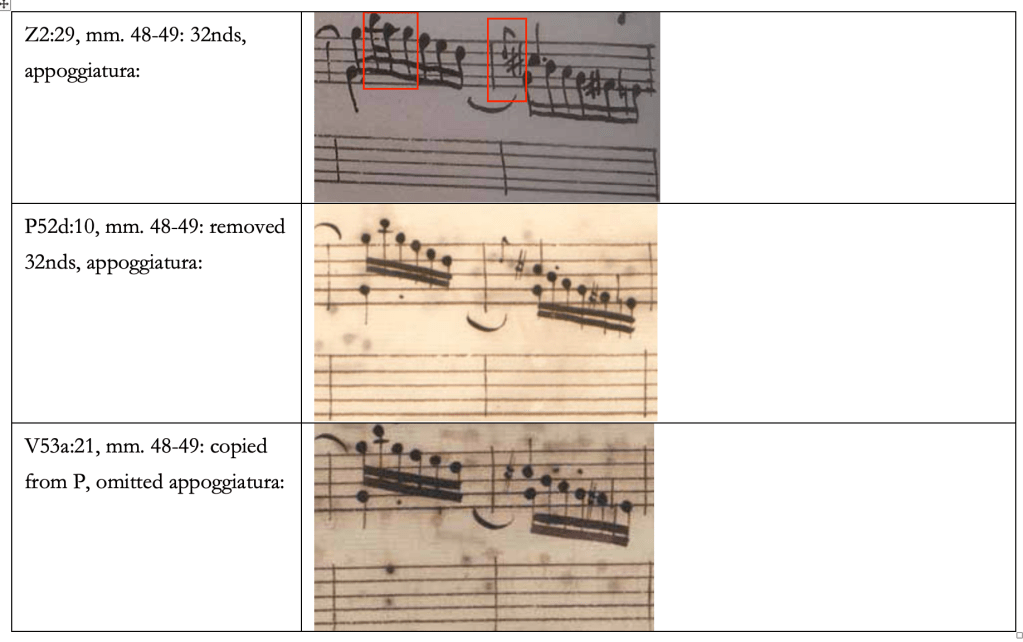
Why would Z have changed the rhythm and added a note to the soprano unless this is what he saw in the autograph? The 32nds are melodically justified because the ascending and descending melody moves in scale steps. The 32nds are rhythmically justified after the climactic “long breath” of the tied-over g2 from m. 47. Parallel to m. 48 in the first half, m. 101 in the second half requires two 32nds e♭2-d2. While Z (depicted below) does not have them, the presence of the 32nds in m. 48 justifies rewriting m. 101. An editor should at least provide this option:

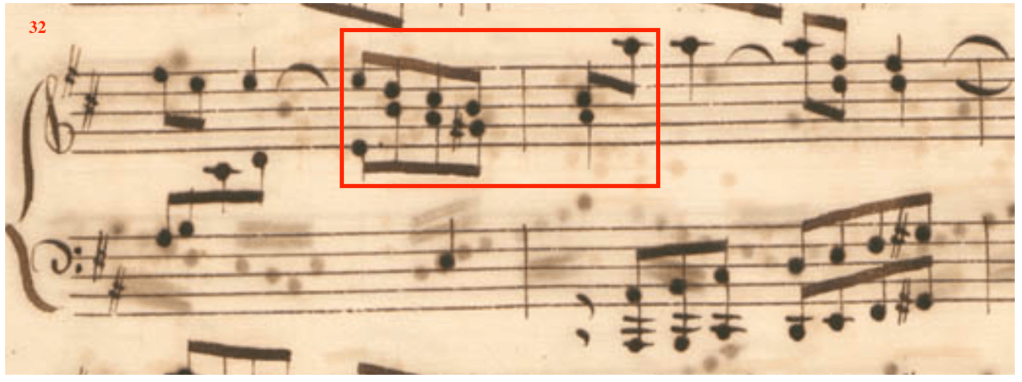
K236 (Sources: M3:26/P53:a3 → V53b:1/Z2:38). In the first half mm. 32-33 the descending middle voices thicken into thirds to prepare the entrance of the left hand octaves:
In the second half, mm. 65-66, Scarlatti does the same. M (top) copied the thirds, P (below) copied only the top-line (V identical):
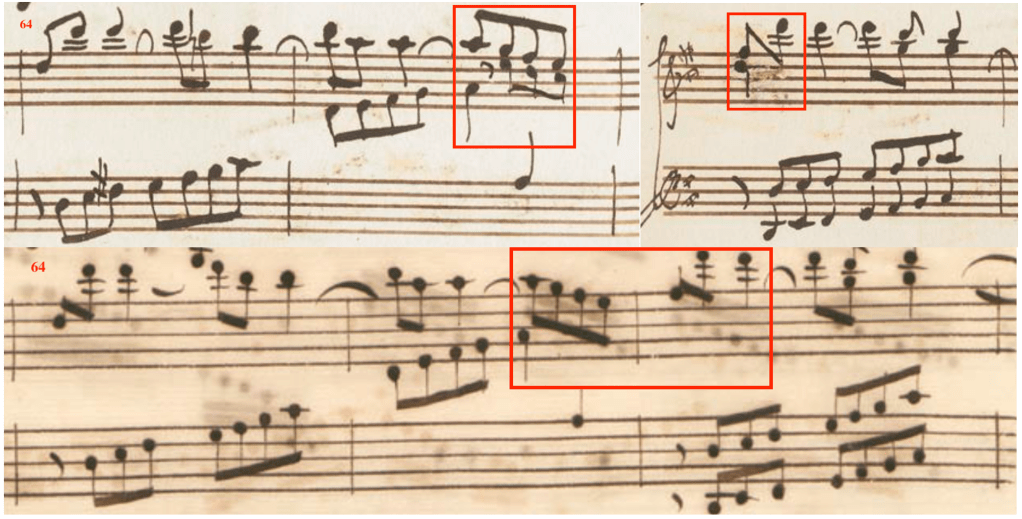
Even if no source had thirds, they are clearly required. – The faulty version is in print.
K260D-d3 (Sources: M2:26/P53a:16 → V53b:25). In m. 23 (unlike M) P → V suppressed the harmonic progression by omitting the a over the f in the bass, in m. 24 (unlike M) by omitting the b♭ over the f (cf. the corresponding mm. 156 f.): two mm. of vibrant bass turned into static! In m. 70 P → V (unlike M) introduced a harmonically senseless a♮ in the bass instead of repeating the correct a♭ (mm. 69 and 70 repeat the bass, just like mm. 65-66 and 67-68 before). V’s obviously defective text is in print. K260 is one of Scarlatti’s most refined harmonic creations, and it was copied more correctly in M than in P → V, but because of over one hundred years of musically unjustified preference of V it is not played the way Scarlatti composed it. Furthermore, It is usually rattled of much too fast, in a hammered frenzy, and at speeds at which the harmonic progressions in each measure (as the ones quoted above, for example) can no longer be enjoyed with the true surprise and delight they originally produced in player and listeners. Ricordi filled their commentary with 48 variants from secondary sources where 6 would have sufficed: the three above, and three variants between M and P mm. 77, 118 and 164 which can be easily settled. Scarlatti composed one K260, and to create the false illusion that he tinkered with his own harmonies in this gem is incomprehensible.
K4051A-c3 (Sources: M3:50/P54c:18 → V54c:18). Mm. 71, 73 are correct in M, wrong in P → V, where the two e♭ at the end of the descending “flamenco”-scale are omitted ,which is carried across four mm. The scales begin with e♭1 on the second eighth of mm. 71/73, and “land” on the first d of mm. 72/75. The defective versions are in print. K405, mm. 71, 73:
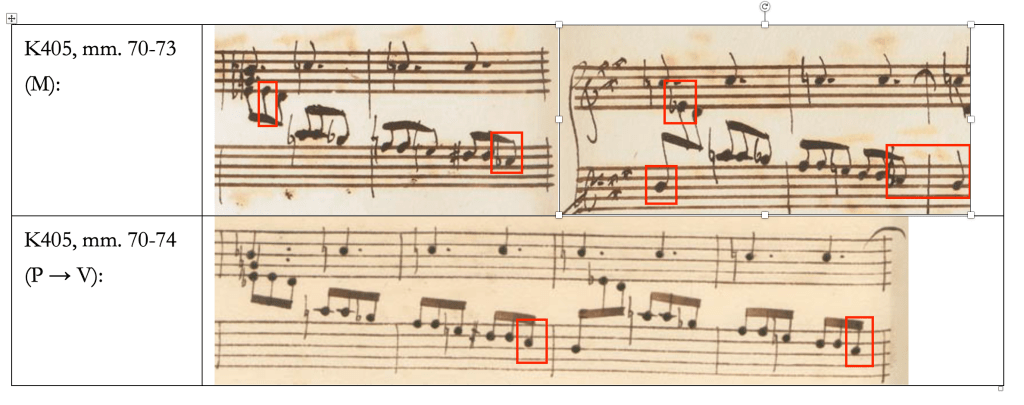
To consider the e♮ of the “control texts” P/V as a “variant” by Scarlatti suggests that Scarlatti was not able to compose scales. – Here too, speed will destroy an awareness of the subtle rhythm and harmony.
K433. The unexplained crosses in seven sonatas in V, here K433, V55:16, mm. 39, 76, are assumed to be scribal:
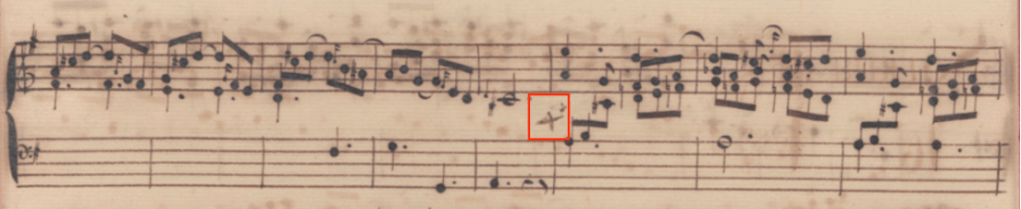

Why would the scribe deface his text with crosses? These marks in faded burgundy ink likely are María Bárbara’s. It is the same ink with which the left hand in K190, m. 34 was filled out. She had worked on those sonatas and marked her progress on them. In particular the stop at a fermata suggests such a “continue-from-here” moment. In K190 she emende m. 34. The unexplained symbols in K409 also appear to be annotations by MB. She must not have played K192 because the left hand in m. 6 remained blank. Many other pieces she will have played without marking them up, but in K433 and a few others she just happened to document her progress with crosses. These markings also prove that MB played from V as late as 1755 (if the copy year is accurate). It is unlikely that Scarlatti still instructed her playing from V because then he would have emended at least some of the most glaring harmonic and rhythmic errors and the many missing notes in V. Unless he was in no position to criticize, and was forced to quietly assist the deconstruction of his own music at the Queen’s will.
K4401Bb-f3 (Sources: M3:66/Z5:30/P55:11 → V55:23). In M only a hand indicates the seconda volta. Because the proportions of the five-measure seconda volta of K440 are unique in the sonatas, P added an explanatory note. When V copied P, he clarified the vague formulation “omite” for MB. The hand directing the players attention to this unexpected codetta is authorial. The Spanish annotations are scribal. M, P. V in comparison:
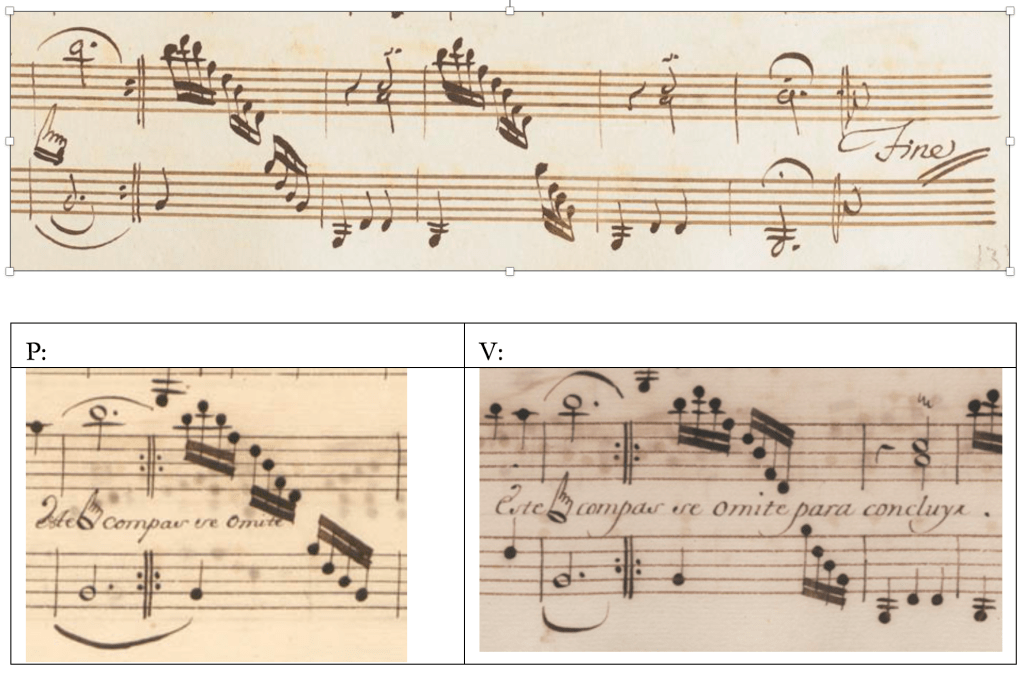
The extensive Spanish text has been editorially “used” to downplay the veracity of M. The text is not by Scarlatti.
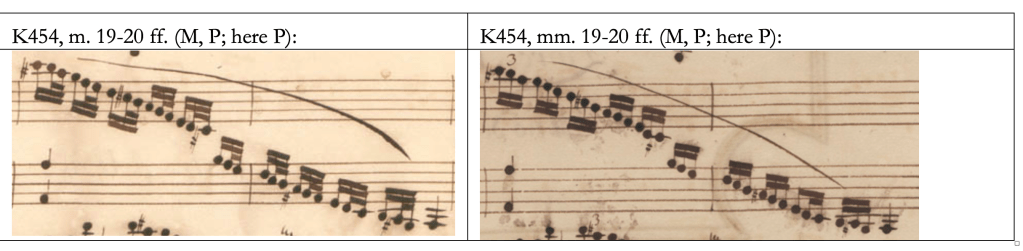
K4541G-g3 (Sources: M2:47/P56a:1 → V56a:1). An extreme case of rhythmic smoothing, evident since V52a, occurs at the very beginning of V56a:1 with the descending cascades of notes in K454. P, also at the beginning of his P56a:1, copied the original 16ths and 32nds (so did M). P may have forgotten to smooth out the text. V adjusted 16ths + 32nds into continuous 16th-triplets. Not only that: he topped them off with a “3”, which makes this an intentional falsification. Since this is such a persistent and continuous feature throughout P, but more so V, the copyist must have done so by royal suggestion. María Bárbara either stumbled over these rhythmic patterns or did not like them (see K163), but the copyist of V could not have so insistently and independently interfered with the text of so many sonatas without some sort of instilled expectation that he was supposed to do so:
K4661G-eb3 (Sources: M1:1/P56a:13 → V56a:13/Li:18/Ca2:20). M preserved the correct eighth note g1 followed by two 16ths on the fourth beat of mm. 35 and 37. P smoothed the ascending notes into triplets. From there they were copied into V. M had no reason to invent a rhythmic pattern that occurs nowhere else in K466 and to repeat it. The g repeated on the fourth beat and followed by two 16ths adds dramatic tension by “jumping” onto the first beat of mm. 36/38. Because of their musically unjustified prejudice against M, modern prints have suppressed the original readings:
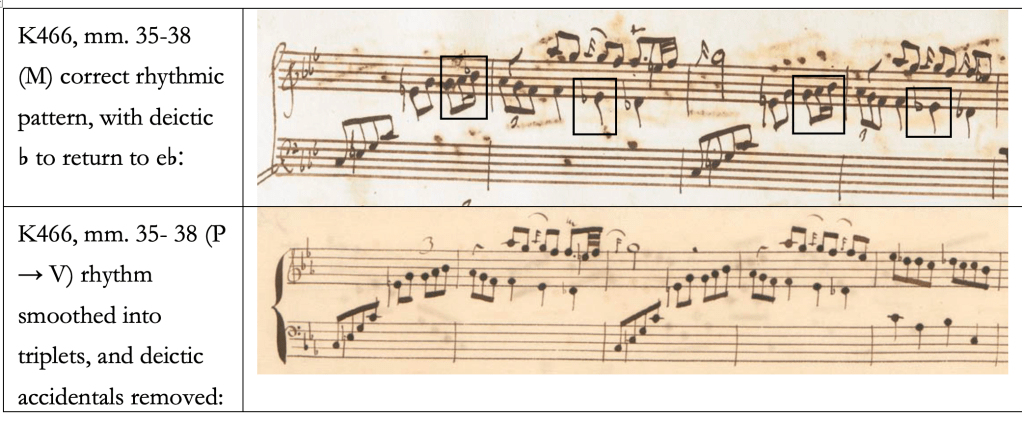
P repeatedly smoothed out rhythmic deviations by textual precedent and such “emendations” were always copied and often amplified in V (see K163 and others). Here, as with K405, the inability of the ear to perceive such rhythmic changes destroys the music. If triplets are played on the fourth beat, tension turns into sentimental mush. Please try it out yourself: Scarlatti vs. his editors.
K. 474Eb-eb3 (Sources: M1:9/P56a:21 → V56a:21/Ca2:13/Li:33[a]/WQ15114:1). In m. 17 of the first half the bass line continues f1-f-B♭. In the parallel m. 46 of the second half, the E♭ is present in M and Ca, but it was omitted in P and accordingly in V:
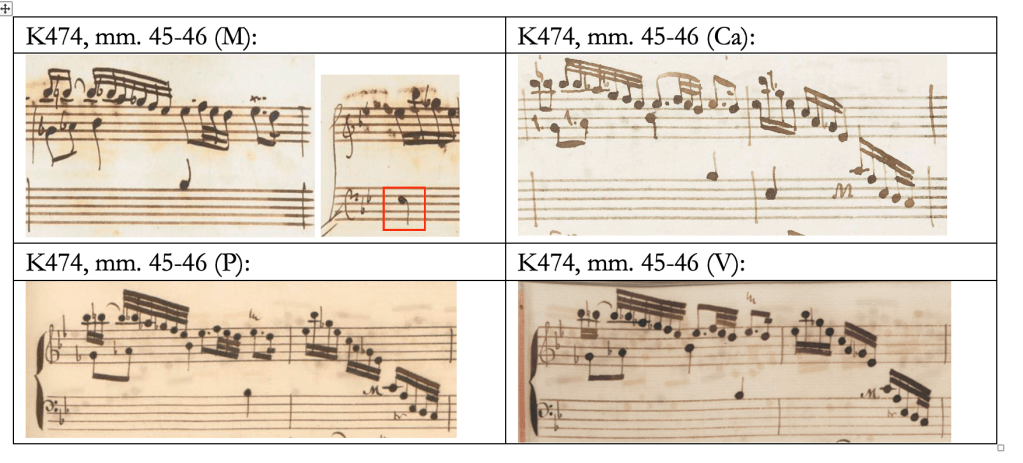
P and V are defective, but since they have control-status, the bass line is printed without E♭, and performers play m. 46 over a musical pothole. If the missing E♭ is a “variant”, then Scarlatti forgot to finish a bass-line.
The concluding mm. of K474 were manipulated by the scribe of P in order to conform with the parallel mm. of the first half. K474 has 56, not 54 measures. P, analogous to the ending of the first half, compressed mm. 51-54 into two mm. of 16ths, but without the repeats of the first half, and, by doing so, amputated the soprano voice. M and Ca render the passage in four mm. of eighths, with the expressive melodic turn a♭2– f2 in the soprano (in Ca erroneously g2). Why would M and Ca rewrite this passage in eighths and invent a melodic turn for which there is no precedent in the first half unless it originated with Scarlatti’s autograph? M and Ca also affixed the necessary ♭ before the a1 (key signature ♭♭) which P omitted while rewriting the text:
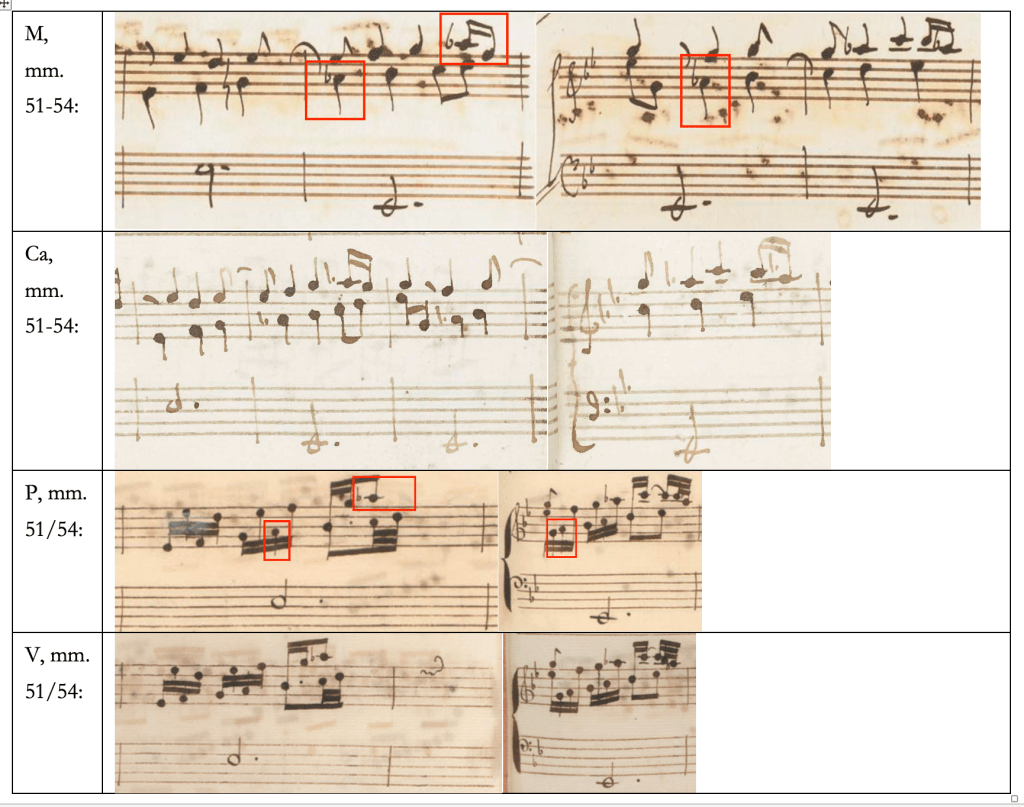
Gilbert and Fadini substituted the supposedly missing a♭ in small print. Fadini, without musical explanation, called the four mm. in M “sostituite” for the two false compressed mm. in P and V. It is musically evident that the readings of M and Ca are correct, and that P melodically and rhythmically regularized the text by compressing it to mirror the mm. of the first half. At the end of the first half the 16ths are musically necessary because they lead into the agitated development at the beginning of the second half. To conclude the sonata Scarlatti restored the calm by returning to the initial syncopated eighth notes of the first three mm. and by ending on ornamented quarter notes which echo the initial trills. The music begins on two quarter notes, changes to syncopated eighths on the third beat, and initiates the movement of 16ths not until the third beat of m. 3 (mm. 1-3, from M):
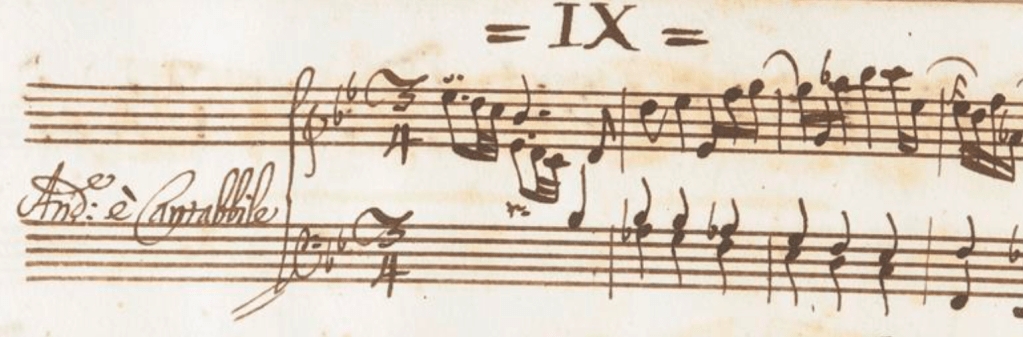
The four mm. of eighths at the end of the second half do not require a repeat. Although every editor since Kirkpatrick has seen the correct version in M, based on their collective musical prejudice, they have printed the nonsense from P/V.
K488C-c3 (Sources: M1:23/P56b:5 → V56b:5/Ca2:26), mm. 10 et sim.: M preserved Scarlatti’s incisive rhythmic pattern of two 16ths + one eighth throughout the piece (see K163, 167, 466, 454), which P, throughout the piece, regularized to conform with Scarlatti’s original triplets which do not enter as a rhythmical pattern until m. 18 et sim on the second, third and fourth beat, and not the first. Scarlatti wanted two different rhythms, why would M invent them? Kirkpatrick associated the first theme of K488 with a “bugle-call”, and indeed with m. 10 enters a toy soldiers’ parade. P assimilated two separate rhythmical patterns into one, and destroyed the parade:
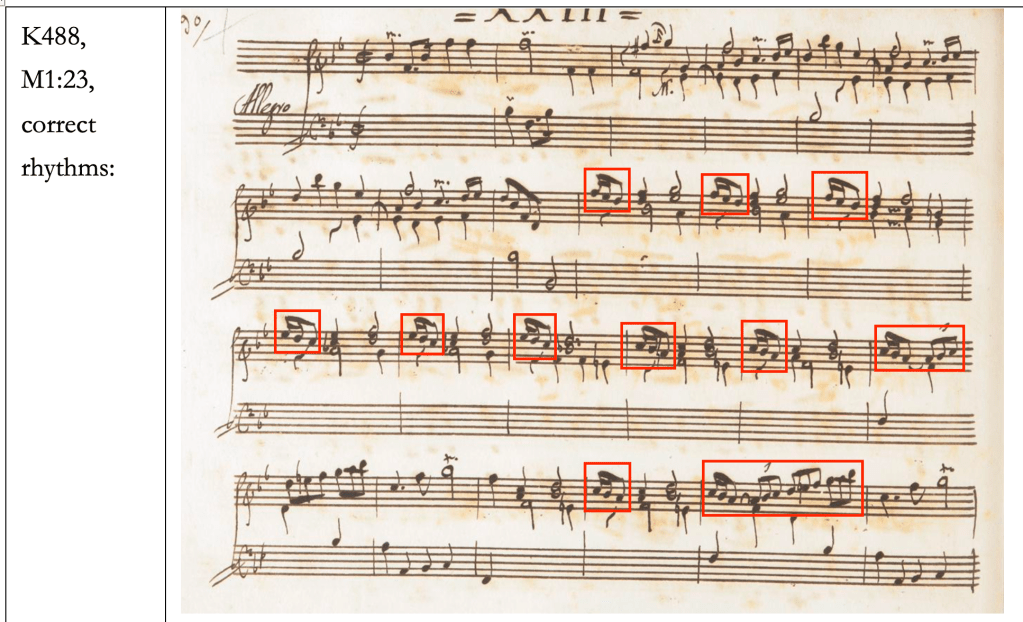
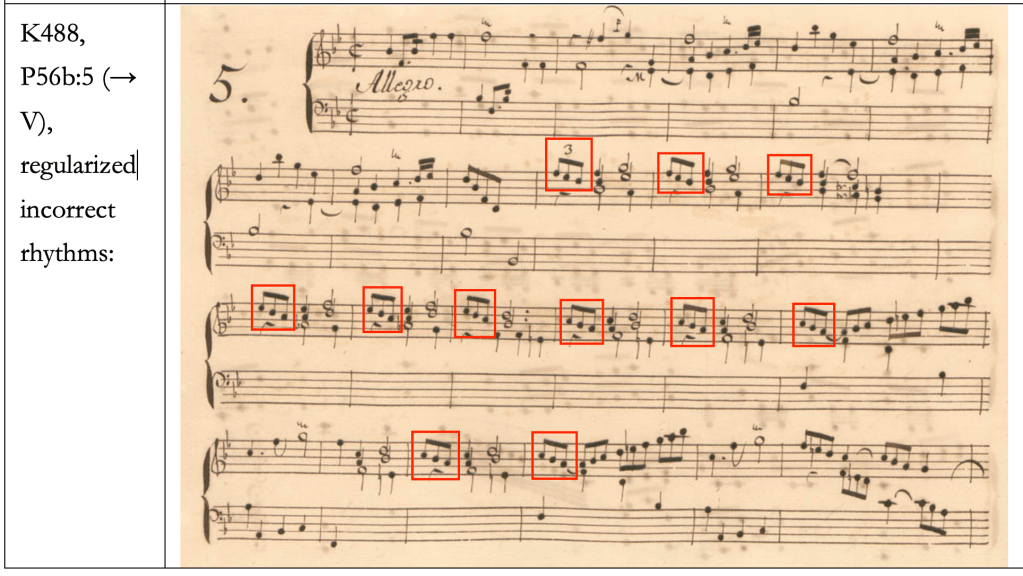
The effect of how the “strict” 16ths + one eighth” dissolve into triplets on the following beats is one of many of Scarlatti’s rhythmic marvels. P destroyed it:
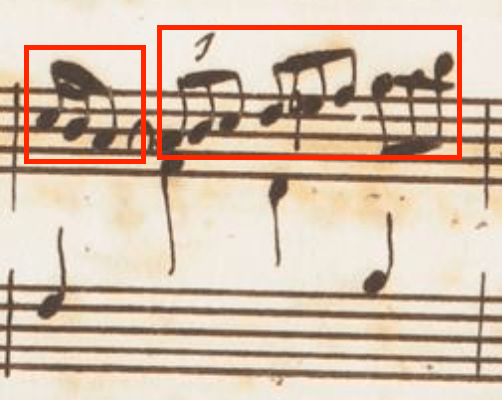
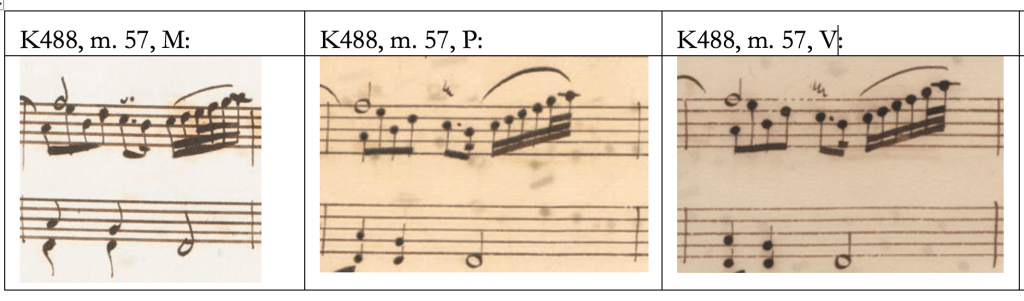
P’s, more so V’s only reason for continuously regularizing musical text here and in so many other sonatas could have been by the Queen’s expectations. The scribes were intent on creating a product without rhythmic crags or unusual patterns. V remembered María-Bárbara’s corrections of V52a. Quoted above are just eleven of regularizations from K488. Once the over seventy-year-old, musically unfounded “control status” of P and V is defunct, performers may actually play Scarlatti’s rhythms again instead of triplet-mush. K488 luckily survives in M. Many sonatas only survive in P, such as the seemingly innocuous K200 (only source: P53a:30) and raise similar rhythmical doubts. […]. Returning to K488, m. 57 et sim. may be of lesser rhythmic importance than the above, but they bespeak M’s effort at accuracy. Despite the availability of M, the faulty version V is in print:
K4891Bb-d3 (Sources: M1:24/P56b:6 → V56b:6/Ca2:27), m. 109: M preserved the upper voices d1-c1 (parallel to m. 105), P omitted them, accordingly V. The decapitated version is in print, not M. There is no need to even look at M in order to notice that in m. 109 the upper voice is missing:
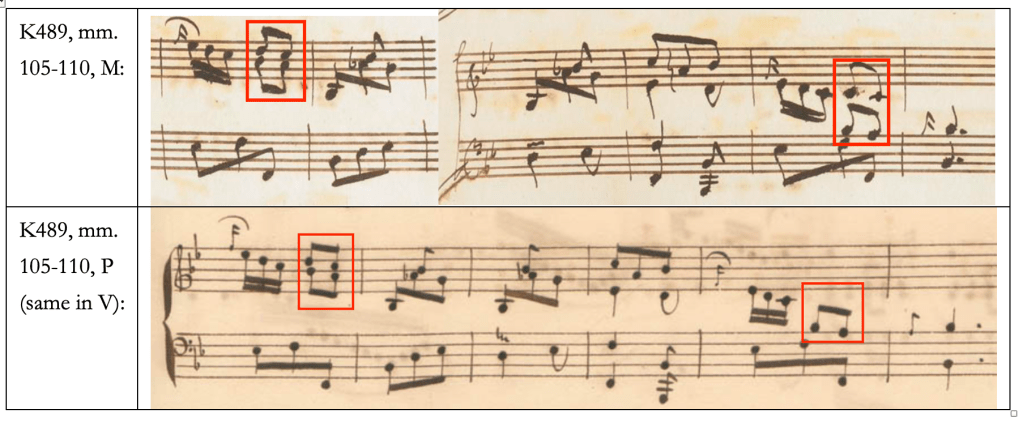
K499 ¢ Andantino1A-e3 (Sources: M1:34/P56b:16— → V56b:16And.e).
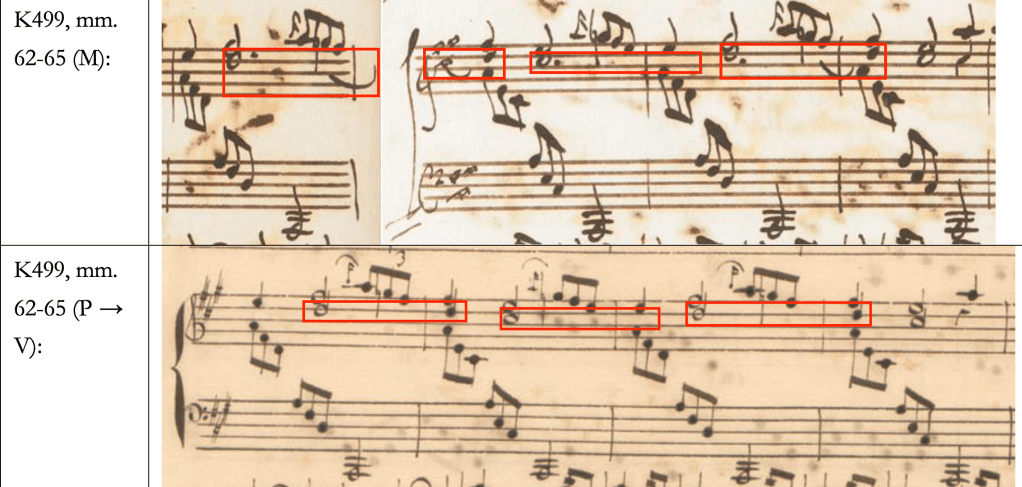
Since P left out a tempo and V did not want to leave a blank, he guessed “And.e” because of the dotted rhythm of the beginning of K499. M’s correct Andantino is rare, but occurs in K211 and K507. In mm. 62-65 M has the correct alto-ties, omitted in P → V (cf. K510 below). A similar tie connecting the first c2 on the second beat to the following c2 on the first beat occurs in mm. 56-57. M did not invent them. The alto supports the soprano at a rhythmic shift. Fadini mentioned neither the dotted d2 nor the dotted c2 of M in her commentary, the player has to figure it out for himself; it is time to print all of M in facsimile. Both M and P lack the quarter note c2 on the first beat of m. 64, but from M one at least knows that it should be there. This omission may go back to Scarlatti himself. The ugly sounding nonsense with the two d2 played on the first beat is in print:
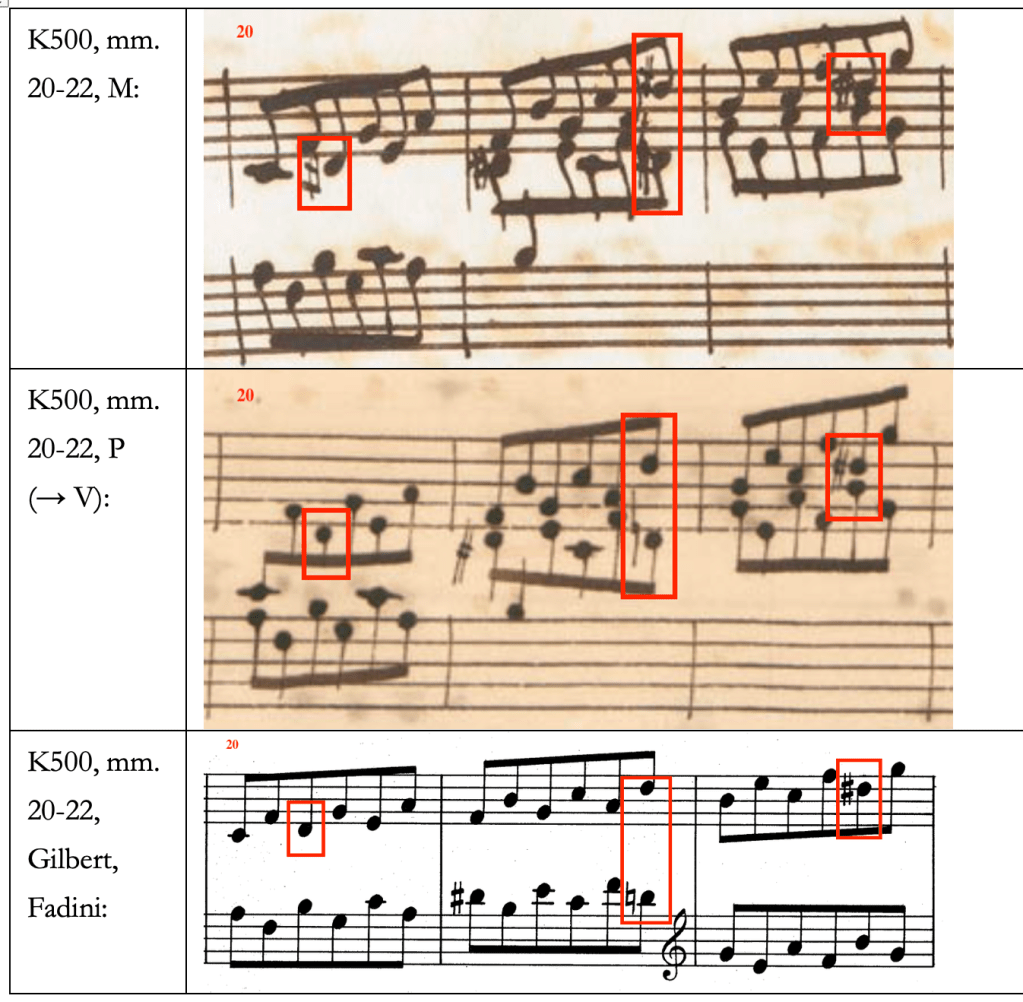
K5001A-f♯3 (Sources M1:35/P56b:17 → V56b17), mm. 20-22: the harmony changes on every beat, ascending the scale of A, through the keys of f♯, g♯, A | B, c♯, D | E, f♯, g♯ . In m. 20 M correctly prefaced the d1 with a ♯ (key of g♯), but in m. 21 he misread the D♮ (key of D) as a D♯ and doubled it at the octave. In m. 20 P forgot the first d♯1 but copied d♯2 correctly in m. 22. V copied his text from P. Both mistakes are easily corrected, but in blind deference to V the missing ♯ in m. 20 appears in print. If K500 is played too fast, no one will notice anyway. It needs to be played slow enough so that the tension of each harmonic change on each beat can be perceived:
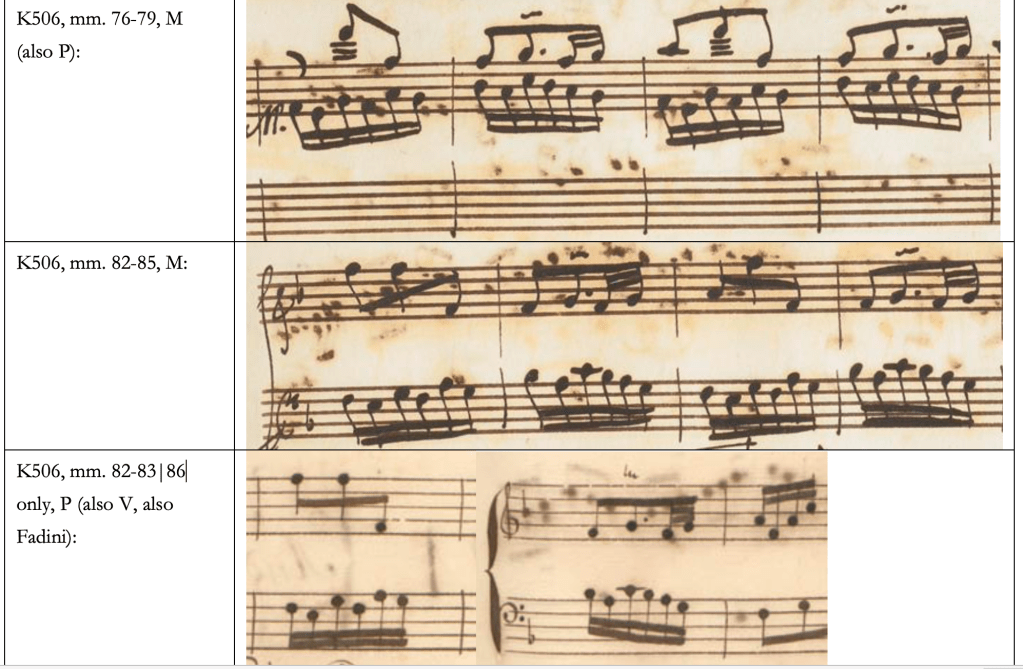
K506C-f3 (Sources: M1:43/P56b:23 → V56b:23). In the second half of K506 the four mm. 76-79 are transposed an octave lower in mm. 82-85. M has mm. 82-85 complete, P omitted mm. 84-85, and are accordingly are missing in V. Gilbert tacitly added the missing mm. but Fadini relegated the correct version in M to the commentary, calling the mm. “aggiunte” (!), and adopted the abbreviated version of V56b for her main text:
K5101A-e3 (Sources: M1:33/P56b:27 → V56b:27) is polyphonically complex. M copied correctly all the tied hemiolas held over from weak beats to strong beats across three bars, as in mm. 6 ff., 36 ff., 41, 46 ff., 49 ff., 100, 102, 105 and elsewhere. P repeatedly shifted the accents back to the first beat. Only M copied mm. 5-7 correctly, as the parallel bars 9-12 prove, while P copied nonsense which was carried over into V. The d2 is held over from the second beat of bar 5 to the first beat of bar 9, as the repetition shows. Gilbert quietly corrected the mistake, Fadini did not: in her m. 7 you play a d on the first beat, because V said so:
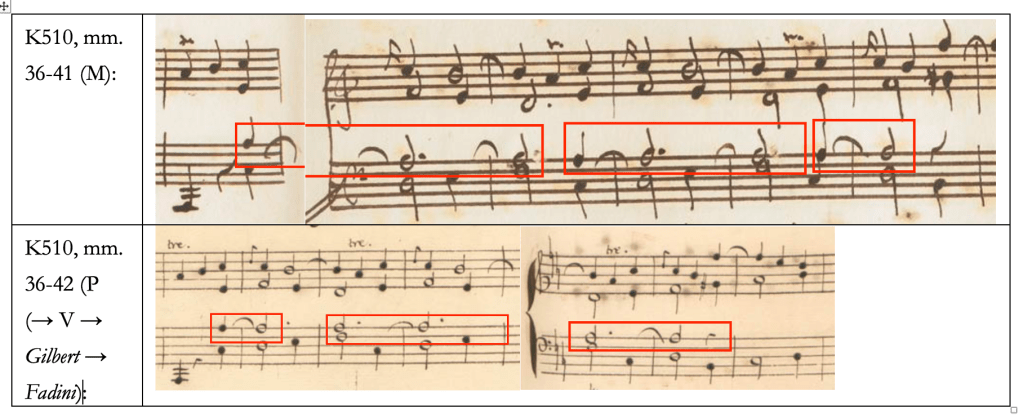
Likewise P disregarded the held over hemiolic tenor notes “a” in mm. 36-39 and sim. M holds each “a” on the third beat of mm. 36, 38, 40. P (→ V) kept the rhythmic pattern intact only from m. 36 to 37, and had it fall apart at m. 38. Both Gilbert and Fadini integrated the mistake into their main text:
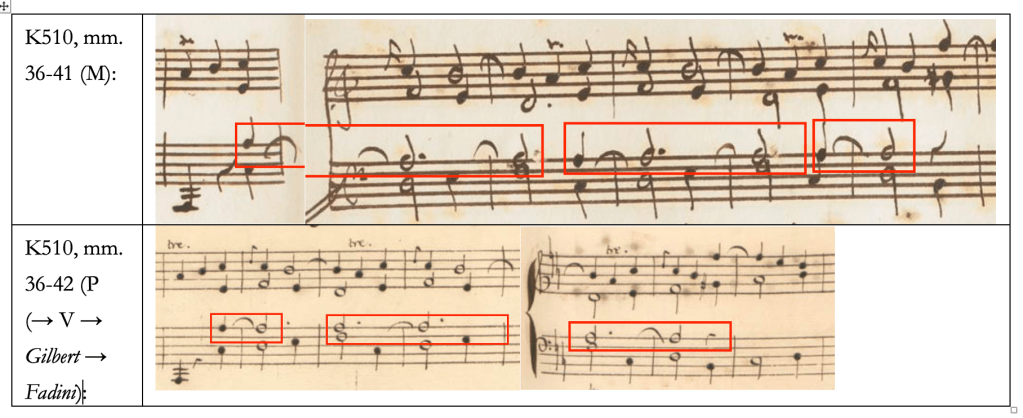
The same applies to all similar passages in K510. P regularized and simplified these rhythms perhaps because of inattentiveness and copying fatigue. K190 and K192 (see above) suggests that P copied right hand first, left hand second. P’s tied dotted half notes on the first beat are rhythmically meaningless. However, they were printed according to P/V because they occur in the “control-source”.
K515 makes it clear that the entire sets P51-P57 were copied by different scribes (Santis[s]o and perhaps Lombart) than V52a-V57. P57:2 on the left, V57:2 on the right, letters “[…]ro”:
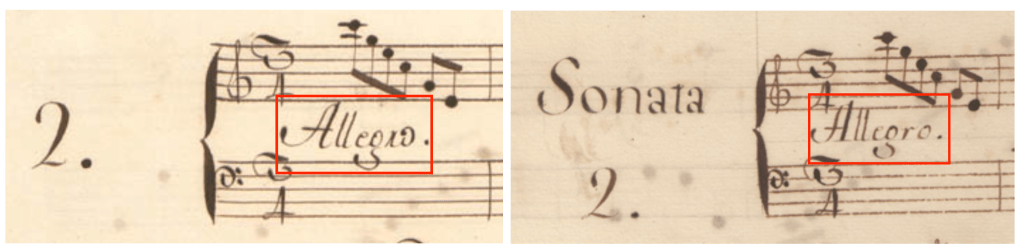
The Queen’s scribe was someone else than Lombart or Santis[s]o, and was paid not by Fernando but by Marís Bárbara. Someone will have figured out his name.
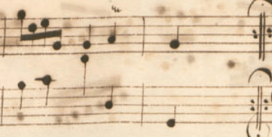
From these few examples given above, and more given below, my assumptions about the copyists M, Z, Ca, P, V – they may be proven better by someone else – are: The collection M was initiated by someone who was intimately familiar with Scarlatti’s musical language, that is with his harmonies, his rhythms, his polyphony, and his musical orthography. M was a “family project” with the goal to rescue and preserve as much of Scarlatti’s keyboard music as possible. Scarlatti may have been aware of the project, but was no longer able to contribute to the verification of all pairs. Rhythmically, harmonically, polyphonically, orthographically M’s texts should serve as “control-source”. Many mistakes and omissions by M can be rectified by comparison with Z (where available) or P, or musical common sense. – Z originated with José de Nebra and his family, possibly after he had gained access to the Capilla Real in June 1751, perhaps via Santis[s]o who may have copied P. The middle volumes 2-4 aimed at completeness, despite duplications; many of the copies were sold off after Manuel’s death in 1784. Z is as important a “control-source” as M and P. – P was a professional paid scribe hired by Fernando, with limited interest in the music he had to copy. He followed certain formal and textual copying instructions: move tempo indications inside the first measure instead of having them stick out on the left side, number the sonatas as a left indent, not centered, render key signatures in circles of fifths, not staggered; write out repeats, avoid disfiguring corrections, copy no unusual rhythmic patterns, regularize the text, keep the appearance of the written page smooth and clean. P copied the upper stave before the lower stave. He overlooked notes, overlooked dots after notes. P had only general notions of pairing – vide the corrections of the sequence of K53 and K258. P was likely copied “for the record”, not for performance. – V was copied and “designed” from P by Marís Bárbara’s scribe […]. Ca was copied from the autographs by a composer-scribe who emended the text he copied to suit the range of his instrument; he also made harmonic and polyphonic changes; Ca apparently performed the music he copied (see the two “Fernando”-annotations). The few pieces in PdC which were copied more accurately than even in M speak for an early distribution in Paris. PdC (a source never before collated) was, not unlike Ca, a performer’s copy. Marguerite-Antoinette Couperin – my suggestion for the scribe (see below) – gathered popular, mostly French and Italian “repertoire pieces”; in some cases she changed Couperin’s original titles to present sth. old as new. PdC assembled her repertoire from manuscripts and from prints. – V was copied explicitly for María Bárbara; in that sense, it constitutes another performer’s copy, only that it was not copied by but for the performer. In design, layout and number the volumes of V were to resemble the printed Essercizi. With perhaps a few exceptions in V52a, all of V52a-V57 was copied from P. P51 and V52a contain the same sonatas, afterwards V copied text from P often in a different order. P was always copied ahead of V, some times several volumes. V occasionally emended P, but mostly copied P directly, and compounded P’s errors by adding more of his own. The presentation of the contents of V52a-V57 was guided by the Queen regarding the layout of the text and rhythmical features of the text. There are dozens of rhythmic and harmonic interventions in P and more so in V in all the sonatas, many are not listed in the Ricordi-Edition. The player will find many of them by a side-by-side comparison of M and Z and P. Sheveloff, obsessed with the unfounded conviction that M was copied from P, wondered why K452•453 only survived in M: many more sonata pairs, especially in the middle K-numbers, only survive in P (V just being a copy of P). Occasionally P edited out notes, such as at the end of K304. In P (and V) K304 in ¢ ends on one quarter note. It is not scribal forgetfulness, it is an emendation:
Sonatas in P also contained in V42 and V49. Four volumes of the Parma-series integrate sonatas already copied in V42 and V49. P52a (“P II”) contains 18, P52b (“P III”) contains 30, P52d (“P V”) contains 3 (K108, 132, 133), P53a (“P VI”) contains one (K53). A close textual comparison of these 52 sonatas should clarify their interdependence.
The omission of K202-205, K356•357 and K544-555 in V. These omissions were the (indirect) consequence of the Queen’s instructions and expections of what and how V was supposed to copy.
1) K202-205 missing in V53a. In order to understand why V53a did not copy the five sonatas K202 B♭, K203 in e, K204a, b, 205 in f/F from P52c, one needs to revisit the contents of P52b. The scribe of V52b copied consecutively the five sonatas V52b:12-16 from P52b:5, 6, 19, 20, 25 (= K49, 139, 99, 98, 140). Since these five are already contained in V42 and V49, the Queen must have asked the scribe of V not to copy any more sonatas from P52b into V since they duplicated material from V42 and V49. And indeed: after those five “duplicate” sonatas from P52b the scribe of V did not copy any other sonatas from P52b into V. Since these five “extra sonatas” unbalanced the count of 30, from his next volume onwards, V53a, in order to even out the totals of 30, the scribe of V finished copying all of P52c which he had begun in V52b, but omitted the five sonatas K202-205. – The Queen may have also asked her scribe V to put more order into his copying. Within the limit of 30 thirty paired sonatas V52b constitutes the greatest disorder the copyist produced: it contains one quintuplet in f (K183-187) and six singletons (K188, 191, 196, 197, 198, 201). By comparison the third Venezia-volume, V53a, proceeds in much more orderly fashion than the two preceding two volumes: it contains 14 companion-pairs, and only two singletons (K210, K227). Accordingly the scribe of V53a made his choice of five sonatas to omit from P52c: P52c:21 in B♭ (K202) because it was a “left-over” singleton from the triplet P52c:10-12 in B♭, P52c:21 (K203 in e; in P52c erroneously paired with K198) because it was another “left-over” singleton, and the erroneous triplet P52c:22-23 = K204a, b, 205 in f/F). This is why V did not copy any more sonatas from P52b past V52b, and why he copied only twenty-five sonatas and not thirty from P52c.
2) V omitted K356•357 for appearance’s sake. In Münster the set was copied near the end of volume 4, ff. 116v-120 v, 121r-125 v, with f. 126 r blank, before continuing with K343•344 in the usual v-r-v-r layout. Parma copied the set at the end of P54a ff. 57v-61v, 62 r-66 v whereby he avoided beginning a new sonata on a recto. Instead he was able to begin the index on f. 67r. Venezia did not copy the set, in my opinion, because of its unique double-stave layout and because of the verso-recto problem:
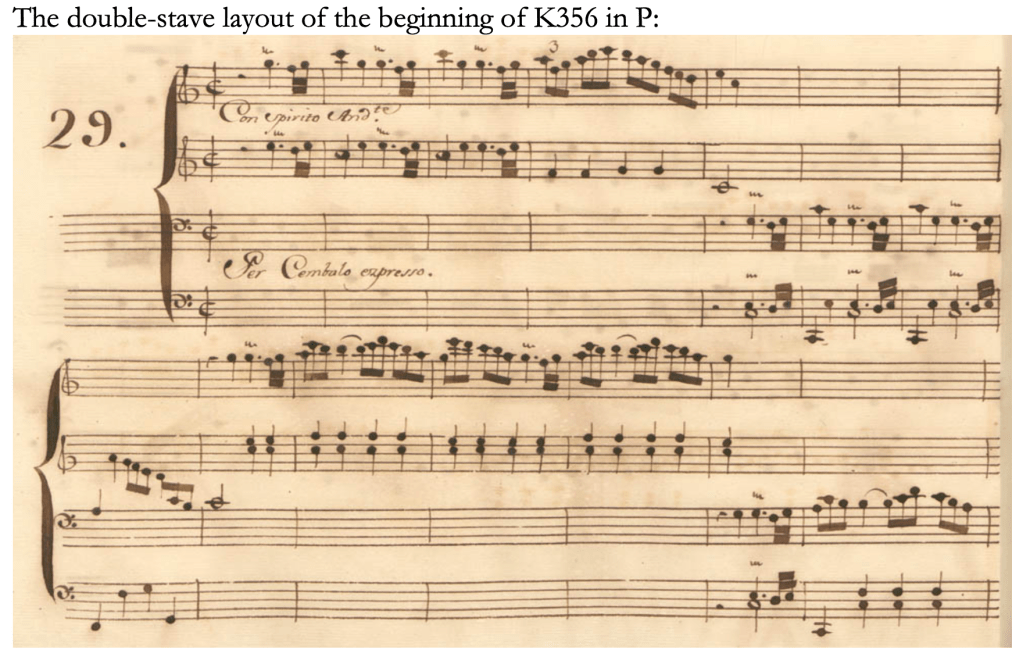
Both companions finished on a verso, and in P the index begins early on a recto. The Queen would have disliked at least the page distribution, if not the the unusual appearance. We cannot impose modern editorial standards on María Bárbara. While she may have been devoted to her music teacher, she also had very specific expectations about the design and contents of “her” collection. The scribe of V left out the set at his own discretion to avoid any conflict with María Bárbara over these expectations and preferences (see V52b and V53a). Since V54a was compounded from P53c (beginning with nos. 27 and 28, K326•327) and continued with P54a, the scribe of V had no problem with correctly closing out his set of 30 with K354•355, and beginning his index on the expected verso.
3) K544-555. V was copied according to the Queen’s standards. While he added four additional sonatas to V55, with the last three volumes he returned to the usual 30. Twelve sonatas would not have completed a new volume. Hence the scribe of V stopped copying with V57:30, i. e. K543.
Pairing.
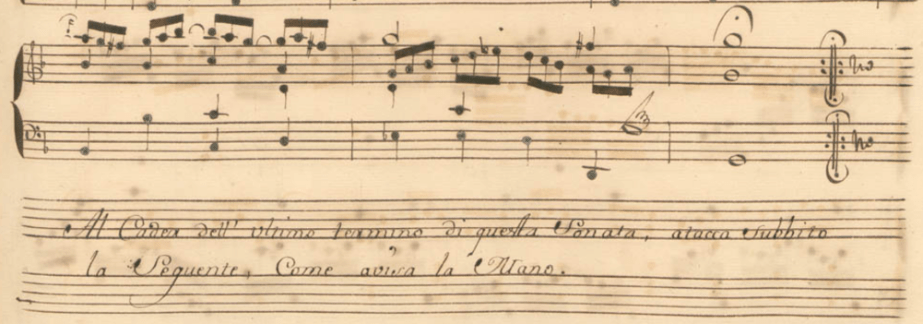
That Scarlatti composed sonatas in pairs is not only inherently evident from the music itself, but occasionally so from Scarlatti’ s instruction, as at the end of K347 (quoted from P54a:20): “Al Cader dell’ ultimo termino di questa Sonata, atacca subbito la Seguente, Come avisa la Mano.” P copied the instruction from Scarlatti’s autograph, because his wrote his own emendations in Spanish:
During the sonatas’ archived state many pairs survived intact, especially in the upper K-numbers, but just as many were disturbed, i. e. they had been performed again, or copied before 1751, and were reshelved in the wrong order. While copyists were aware of sonata pairings as early as V49, it is apparent that by 1751 many original pairs had become separated and that copyists were neither able nor necessarily motivated to try to restore their original order and had only a general notion of what used to be long together. K126 and 129 in c, K127 and 130 in A♭, K128 and 131 in b♭ belong together, but K126•129 remained intact only in Z3 (K129 missing in M), K127•130 only in Z3 and P52a, K128•131 only in Z3 and P52a (K131 missing in M), and none in V49, from which Kirkpatrick drew his unfortunate numbering system. K53 in D, Presto, and K258 in D, Andante, had been separated into singletons, they do not share the same instrumental compass (avoidance of d3 in K53), and when P53a came to copying the singleton K258, he arbitrarily chose K53 as a partner, removing the latter’s “wavy lines” on the first bass notes (the only source to do so). He noticed that he had copied a fast compañera before a slow one, and corrected the mistake by noting above the beginning of P53a:13:

The scribe of P had a general understanding that pairs were in the same key, that duple time often preceded triple time, and that slower preceded faster. Because Scarlatti was still alive during the assembly of his “Collected Works”, he is expected to have overseen the copying process, but he could not have done so not only because of the numerous copying errors in P and V, but more so because of the numerous pairing mistakes in all collections. Nor did María Bárbara care much about correct pairing, as her corrections to V52a indicate. In 1772, the 73-year-old composer and singer Johann Adolf Hasse admitted to Charles Burney that his “Cantatatas, Serenatas, Intermezzos, and Duets, for voices; his trios, quartets, and concertos, for instruments, were so numerous, that he should not know many of them again, if he was either to see or hear them. […] he […] had more pleasure in producing, than in preserving his offspring.” (Burney II, p. 108). Haydn made a similar remark about his early compositions. Scarlatti was 66 when María Bárbara initiated the offical assembly of his “Collected Works” in 1751. At that time, Scarlatti’s sonata pairs had been archived for a considerable time. The sonatas were likely premiered at various of João’s and Fernando’s different residences and animal killing grounds [https://link.springer.com/article/10.1007/s10344-026-02066-y] and we do not know how and where and on what principles they were initially archived: by instrument, at the location of their premieres, or topically by liturgical and secular occasion. The focus has been on the annual rounds of the Spanish court, not on those of João V. K259 and K260 in 3/4 do not belong together, K386 “Presto” and K387 “Veloce è fugato” are fast seconde. Singletons with missing companions in most sources include: K98, 101, 102, 103, 108, 111, 112, 117, 120, 121, 122, 123, 139, 140, 164, 169, 170, 171, 172, 173, 174, 175, 176, 187, 188, 196, 197, 198, 201, 202, 203, 210, 227, 258, 265, 293, 328, 333, 334, 351, 430, 451, 484, 513. Triptychs (one too many), looking from V49 to V57: K134-136, 204a-205, 274-276, 431-433, 434-436, 481-483, 485-487, 490-492. In P agglomerates vary; there are fewer in M and Z; see Sheveloff’s statistics for M, P, V. The quintuplet K183-187 in f is unique to V52b, it is broken up in P and elsewhere. Scarlatti was absent from, not a participant in the assembly of the royal “Collected Works”. He may no longer have been able to put companion-pairs together which he had composed decades earlier, even had he been consulted. A close reading of the music makes it possible to restore the original texts of almost all of Scarlatti’s sonatas, but also their original pairings. Many sonata pairs in G/g have been preserved intact, mostly those composed for the 61-key transposition harpsichord, past the crucial pair in C, K356•357, with which Scarlatti likely debuted the new instrument, but almost just as many pairs have been severed. K259•235 in G are a pair of Scarlatti’s topical sonatas, in this case composed for Christmas. Topical sonata pairs can be documented for Christmas, Easter, Corpus Christi and a few other liturgical and secular calendar events. It needs to be added that, just as sonatas K542•453 only survive in M, and many others only in P, some pairs were also separated for good, which means that some sonatas have been lost. It is difficult to find a companion, for example, to the fado-like K451, a singleton in all sources: it has all the melodic and structural elements of a prima, but its original secunda likely was lost in the archiving process.
The incomprehensibility of or indifference to the pairings has persisted from 1751 through today. In 1933, the notion of pairings was revisited by Walther Gerstenberg: “Ein Teil der handschriftlichen Quellen […] stellt die Sonaten in auffallender Weise zusammen: es folgen hier in der Regel zwei Werke aufeinander, die sich in ihrer Taktart wie Tanz zu Nachtanz verhalten und die gleiche oder die variante Tonart aufweisen. […] Ob eine solche Ordnung, die die Sonaten paarweis zusammenfaßt, vom Komponisten selbst beabsichtigt oder ob sie nur eine ad hoc getroffene Kopisten Maßnahme ist, die der Übersichtlichkeit dient, bleibt offen.” (“Some of the the manuscript sources” – Gerstenberg was familiar with M, P, V – “combine the sonatas in a conspicuous manner: in these instances two works usually follow eachother whose time signatures are related like a dance to an after-dance, and which share the same tonality, whether major or minor. Whether such an order, which pairs the sonatas, was intended by the composer himself, or whether it was only an arbitrary decision by the copyists for the purpose of clarity, remains open.” (Gerstenberg, p. 99.) Gerstenberg acknowledged the majority of duple/triple pairings and the common tonality passim but did not elaborate, perhaps because he was the first to assume that the pairing could have originated with the copyists.
In 1953, Ralph Kirkpatrick moved the pairing of sonatas into the limelight: “[…] the pairwise arrangement is so consistent in the Venice, Parma, and Münster manuscripts as to make it absolutely clear that it was intentional” (Kirkpatrick, p. 141). However, his only proof were scribal remarks and some notational procedures. He found structural parallels in two-movement keyboard sonatas by Alberti, Durante, and Paradisi (Kirkpatrick, p. 141). “The relationship between the sonatas of a pair is either one of contrast or compliment. The sonatas that bear a complementary relationship to eachother may share a certain overall unity of style or of instrumental character or they may be composed in the same harmonic color. For example, Sonatas 106 and 107, although in F major, both hover around F minor and its related tonalities.)” (Kirkpatrick, p. 143). K106 and K107 are a false marriage, and the analysis remains impressionistic. So is the following: “In the contrasting pairs, a slow movement may be followed by a fast (Sonatas 544 and 545); a simple movement, generally slow, may serve as an introduction to a more elaborate (Sonatas 208 and 209); or an elaborate and concentrated movement may be followed by a simpler and lighter movement, for example a Minuet, which serves as a kind of Nachtanz (Sonatas 470 and 471).” (Kirkpatrick, p. 143) He never elaborated his observation: “There is evidence that some sonatas might have been arranged in pairs or rearranged at some date posterior to their composition, but by and large the pairwise arrangement predominates and must be accepted as a requisite to any intelligent and adequate approach to the Scarlatti sonatas.” (Kirkpatrick, p. 143) Like Gerstenberg he noticed the identy of the tonic: “One [sonata] may be in minor and the other in major, but both members of a pair always have the same tonic.” (Kirkpatrick, p. 142) He pointed out the complimentary ranges of the instrument: “Frequently the members of a pair demand roughly the same keyboard range […].” (Kirkpatrick, pp. 141-142) Kirkpatrick sought in particular to redress the sonata-suites arranged by Alessandro Longo. (Kirkpatrick, p. 142) However, besides intuitive impressions, Kirkpatrick never presented actual musical proof, although there is plenty to be uncovered. Had he elaborated more on the musical reasons for pairing, many pairs would not continue to be performed as singletons, or mismatched. Despite his emphasis on the pairings, Kirkpatrick was so beholden to the Royal burgundy morrocco of the 15 Venezia volumes that in his reckoning of the sonatas, which was supposed to replace that of Longo, he separated K126•129 in c, K127•130 in A♭ (he structurally only analysed K127) and K128•131 in b♭ because they were copied in this ruptured sequence in V49.
In 1957 Hermann Keller took the erroneous composition date 1753 as reason that Scarlatti would not have composed singletons as contained in V42 and the Essercizi, only to switch to pairs after 1753 (Keller, p. 34).
In 1963 William Newman picked up Kirkpatrick’s pairing idea but suggested that the similar beginnings of K307•308 and the group 490•491•492 did not suffice to establish pairings with certainty. He observed that in “well over half the two-movement groupings the typical association of a duple and a triple-metered movement obtains”. Since no one knows about Scarlatti’s liturgical sonata pairs he claimed that K170 consists of “2 separate movements no different in relationship or extent from those in the paired sonatas” (Newman, p. 267).
In 1967, Pestelli rejected the concept of pairing because there were single sonatas between paired ones which countered his superimposed stylistic chronology (Pestelli, p. 96). No one has ever given a reason for the importance of establishing a chronology of the sonatas, which Kirkpatrick initiated in 1953 and which persists to this day.
Sheveloff reacted negatively to the notion of pairing. In his dissertation of 1970 he posed five rethorical questions: “Are the groupings really a scribal convenience after all? Were the sonatas conceived separately and later joined in pairs, even tryptichs? Were the earlier scribes confused? Is the pairing an arbitrary matter left to the scribe or even the performer like so many other features of eighteenth-century performance practice? […] How are we, on the basis of such all-encompassing musical possibilities for the relationship of a pair, to test this ‘true meaning’?” (Sheveloff, 316-317). He concluded: “It would not be difficult, almost at will, to yoke together two sonatas in the same key, but from different places in the sources, and find many kinds of ‘musical justifications’ for this pair at least as good as the ones suggested by Kirkpatrick and Newman. (Sheveloff 1970, p. 317). There is plenty of musical justification for pairing one specific set of sonatas and no other.
Boyd acknowledged the high incidence of pairings, the similar compass of some pairs, the scribal annotations quoted above, but left the pairwise arrangement as “an option for the player” (Boyd, p. 166). He could find no musical connection between pairs: “Attempts to trace thematic connections between paired sonatas have not been very convincing, but it is possible to sense some kind of unity at a more subliminal level” (Boyd, p. 166). He recognized similarities between a few non-paired sonatas, elaborated on those between K528 and 529, but summarized: “One is led to the conclusion that even if the pairing was not part of the original conception it was nevertheless done creatively when the works were brought to their final form.” The meaning of that conclusion is unclear.
A few pairing principles: by key, by tempi, by themes, by motifs, by rhythm, by topic.
The majority of Scarlatti’s keyboard sonatas were originally paired by the composer. A slower partner is almost always followed by a faster one. The main exception are minuets, which are always in end-position; if Portuguese or Spanish pieces are contrasted with an Italianate answer, the latter always defers. Slow partners are never paired with slow partners, fast ones never with fast ones. All partners of a pair are thematically or motivically linked. When using the same theme in the secunda, it is always altered rhythmically. Paired sonatas beginning with a single voice often begin in contrary i. e. complimentary motion, i. e. entry SA versus BT. The same melodies sometimes re-appear in different voices. Except for three companion-sets Scarlatti does not pair identical time signatures. Several companion-pairs indicate that they were originally combined: the pairs in A♭ and b♭, for example, were composed and performed together because one quotes the other. Though Longo discovered the Christmas-siciliano in K513 in 1913, no one since has continued the thought: if Scarlatti composed one Christmas-pair he must have composed others, and if he composed sonata pairs for Christmas, he must have done so for Easter, and likely for Corpus Christi. Scarlatti’s musical symbolism in his sonatas is as identifiable as that of Bach in his cantatas and oratorios. In his Easter companions, for example K252•253, K528•529, Scarlatti typically depicts the twelve Stations of the Cross, the lament about Christ’s death, and the joy over the resurrection. Scarlatti’s Christmas sonatas, for example K189•202, K259•235, depict human rue and penitence,a plea for redemption, the birth of Christ (siciliano), a recessional of the players, and the joy over Christ’s birth, a final Kehraus. Scarlatti’s Corpus Christi pairs, for example K380•381, K420•421, K443•444, K518•519, begin with the depiction of a passing procession always followed in the secunda by extensive, perhaps staged and theatrical street dances in closely related minor keys. The liturgical companions suggests that Scarlatti also composed sonata-pairs for secular events, though their occasion remain guesses. It is possible that his “Portuguese pairs” beginning with a fado or saudade (K246•247, K394•395, K426•427, possibly K466•467) were tributes to King João’s name day (June 24) or birthday (22 October). The many “minuet-pairs” which always begin with a thematically and technically complex companion in duple time, like K470 and K435 and end with a minuet or “ballo” (K430) must have likewise been composed for a recurring festive calendar-event. […].
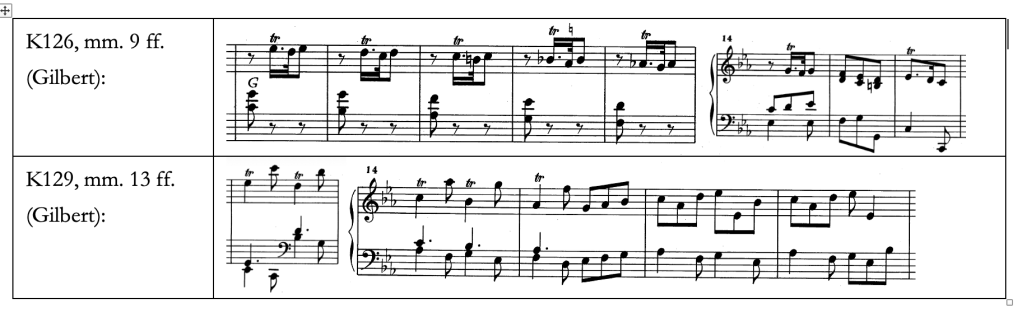
K126•129 are thematically and motivically linked. They are musically closely intertwined. Performing one without the other is playing amputated music. One motivic link: the same descent of trills e♭-d-c-b♭-a♭-g shifted rhythmically from weak to strong beat over the same bass (K126) and tenor (K129), c-b♭-a♭-g-f, with 3/8 doubled to 6/8:
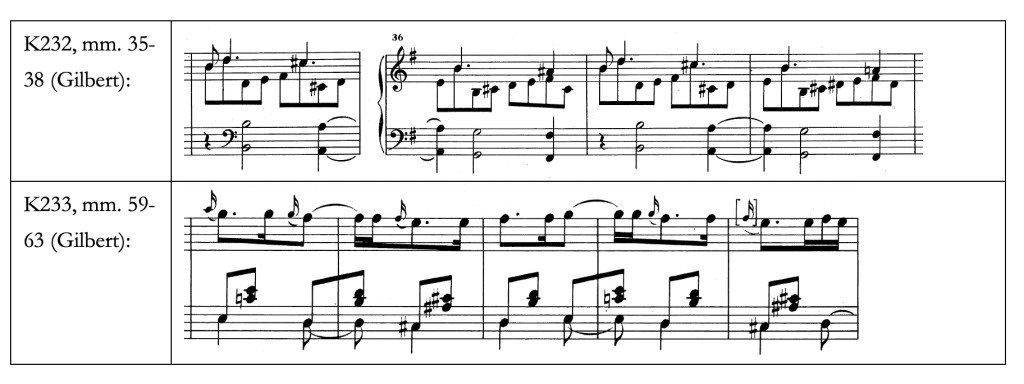
K232•233 are united by the same 4/5 rhythmically and figuratively altered crossrhythms and syncopations, which are unique to this pair:
K246•247 are linked by their halved and mirror-inverted themes a rovescio. The first theme of K246 is mirrored in the first theme of 247. K246 first theme g♯2 f♯2 | e2 d♯2 c♯2 b♯1 c♯2 g♯1 c♯2 d♯2| e2 d♯2, then imitation an octave below mm. 3-5 → K247: c♯2 g♯2 e2 | d♯2 c♯2 b♯1 c♯2 d♯2 | e2 c♯2 g♯1:
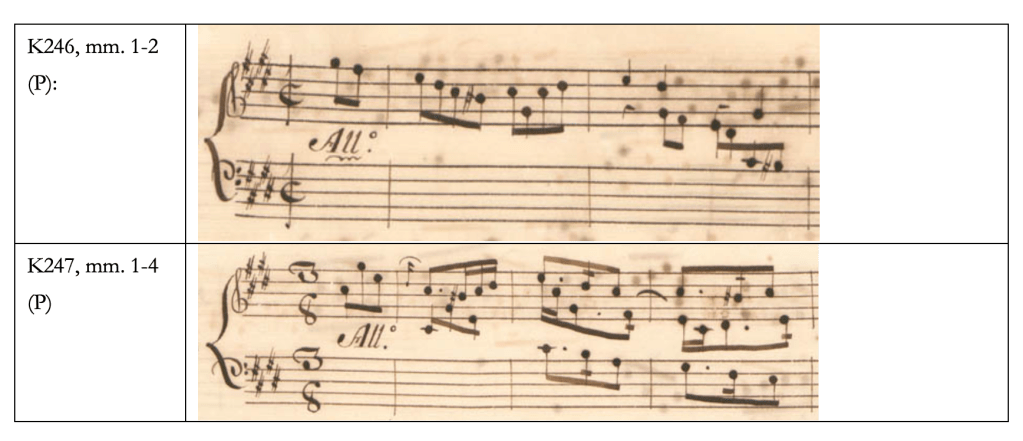
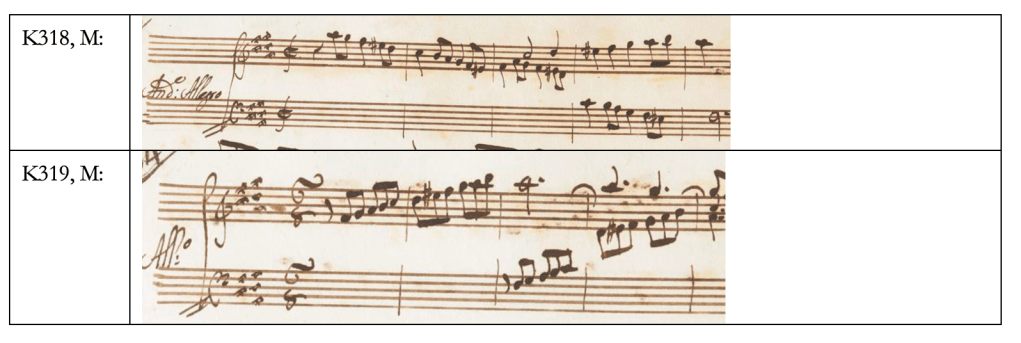
K318•319 are a pair not only because they are the only sonatas in F♯, but because they proceed in contrary motion and with rhythmic alterations: K318 mm. 1-4 descending scale SAT a♯2-f♯1 with imitation, two eighths + one quarter → K319 ascending scale TAS f♯1– a♯2 with imitation mm. 1-5, continuous eighths:
K497•498 vary the descending 7ths f♯2-g1, e2-f♯1, d2-e1, c♯2-d1and the conclusion rhythmically:
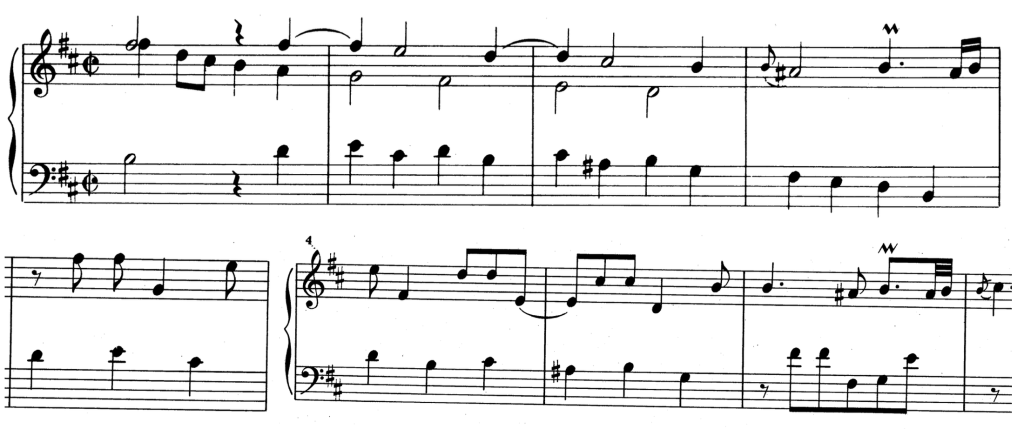
Scarlatti always alters identical themes rhythmically. Often companion sonatas with a one-voice entry begin in contrary and complimentary motion: one may begin with a descending S-A, the other with an ascending B-T. Between companions a melodic voice may be transposed to a different register in the other (see K486•513 below). Pairs in major/minor prefigure respective tonal excursions in eachother. […].
Thematic sonata-pairs: Christmas, Easter, Corpus Christi, João, Court Dances.
Alessandro Longo (1864–1945) was the first to identify the siciliano of the sonata in C, his LS 3 (K513) as a Neapolitan Christmas pastorale. His modest one sentence “L’episodio […] Natale” outweighs in importance his collective erasure of all Scarlatti’s 5/4s:
“L’episodio centrale di questa composizione è identico a una Pastorale popolarissima che si vuol cantare a Napoli e in parecchie contrade del mezzogiorno d’Italia nel novenario di Natale. Si tratta di una composizione originale di Scarlatti, venuta man mano popolarizzandosi o d’una melodia popolare intercalata da Scarlatti nella sua composizione? Io inclino per la seconda ipotesi.” (Longo 1972, 96; originally 1913 or 1937)
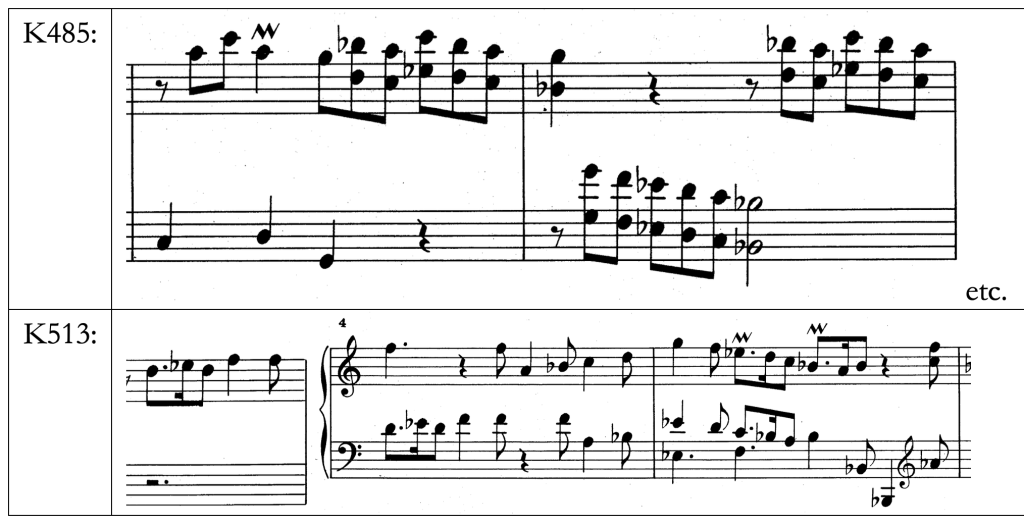
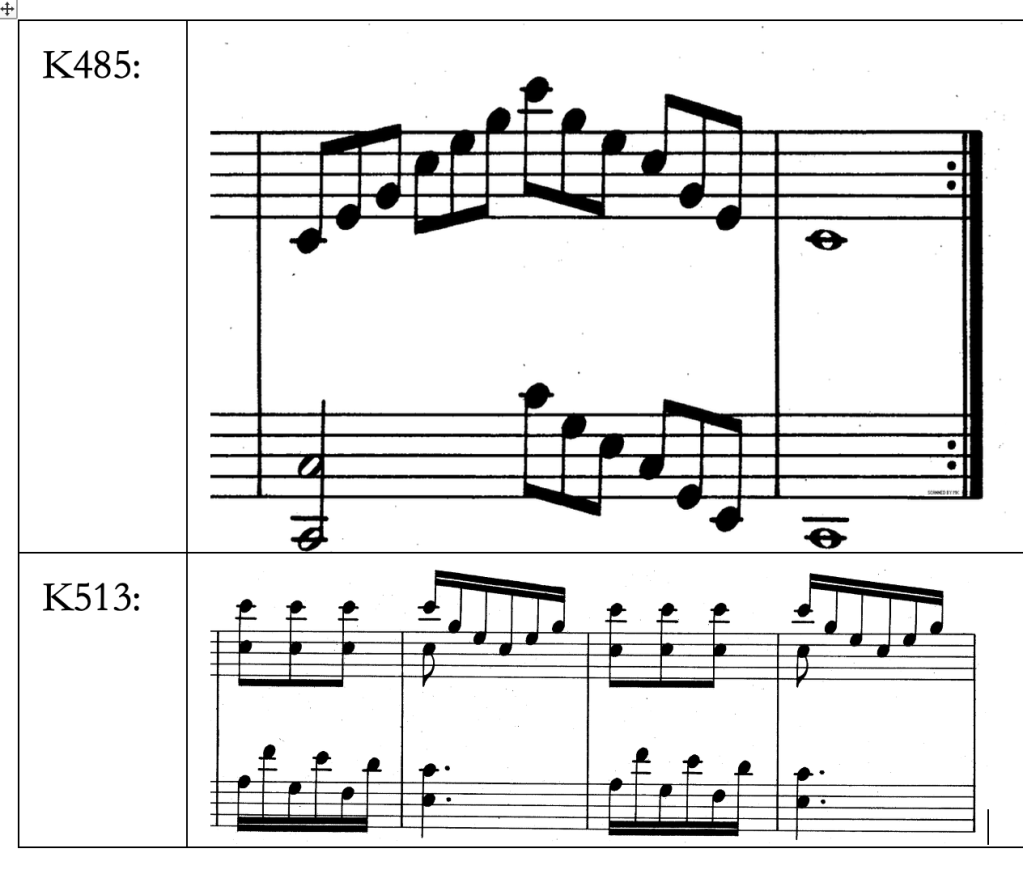
The sonata in C (K513) is divided into three sections. The ”Pastorale”, whose first 17 1/2 measures are designated “Moderato”, is in 12/8. The tempo changes mid-measure to “Molto allegro” for the remaining 18 1/2 measures of the first half. The second half begins with a different theme in 3/8, ”Presto” which ends the sonata in m. 81. This seeming disjointedness of both halves led to the characterization of K513 as “another example of a sonata with a totally irrelevant ‘C’ section (Presto, 3/8) […] with the result that the two halves give the impression of belonging to two completely different works. This juxtaposing of unrelated material is by no means confined to pastorales, and K170, 227 and 333 are other examples of sonatas in which the two halves are totally contrasted in style and material. Their curious structure seems to be unparalleled in the sonatas of other composers.” (Boyd 1986, 173). However, “K513 has a curious parallel in Bach’s Pastorale for organ BWV 590 […] which also breaks off the ‘Christmas’ movement prematurely (in this case in the mediant minor key) and never returns to it.” (Boyd 1986, 288, fn. 30) Bach does return to it, but Boyd was not aware of the three following sections belonging to BWV 590. K513 is the second of a pair of a Natale. It begins with K485 which anticipates motifs, modulations and playing figures of K513. There exists a dialogue between the two. Both share the “shooting star” scales in 32nds, descending in K485, ascending in K513, here K485 S-A mm. 25-29, 50-53 → K513 T-B mm. 13-15. These figures are unique to both companions. The descending 32nds in K485 from d3 (sequence d3-c3-b2 reversed b1-c2-d2, with repeat) reflect the plea for redemption, which is fulfilled and “grounded” in K513:
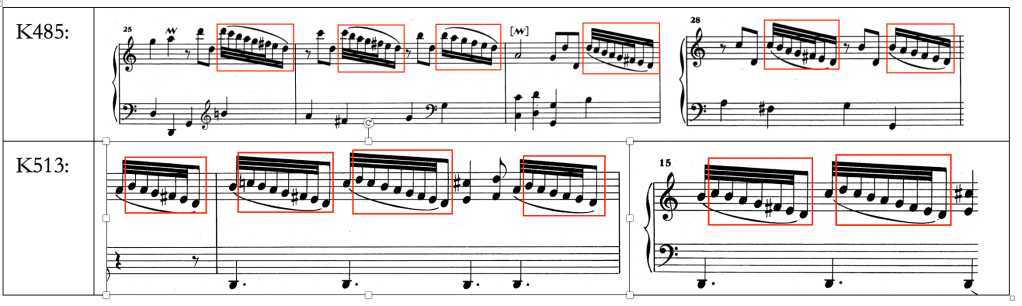
The “penitent soul”:
Broken C-octaves anticipating the celebration:
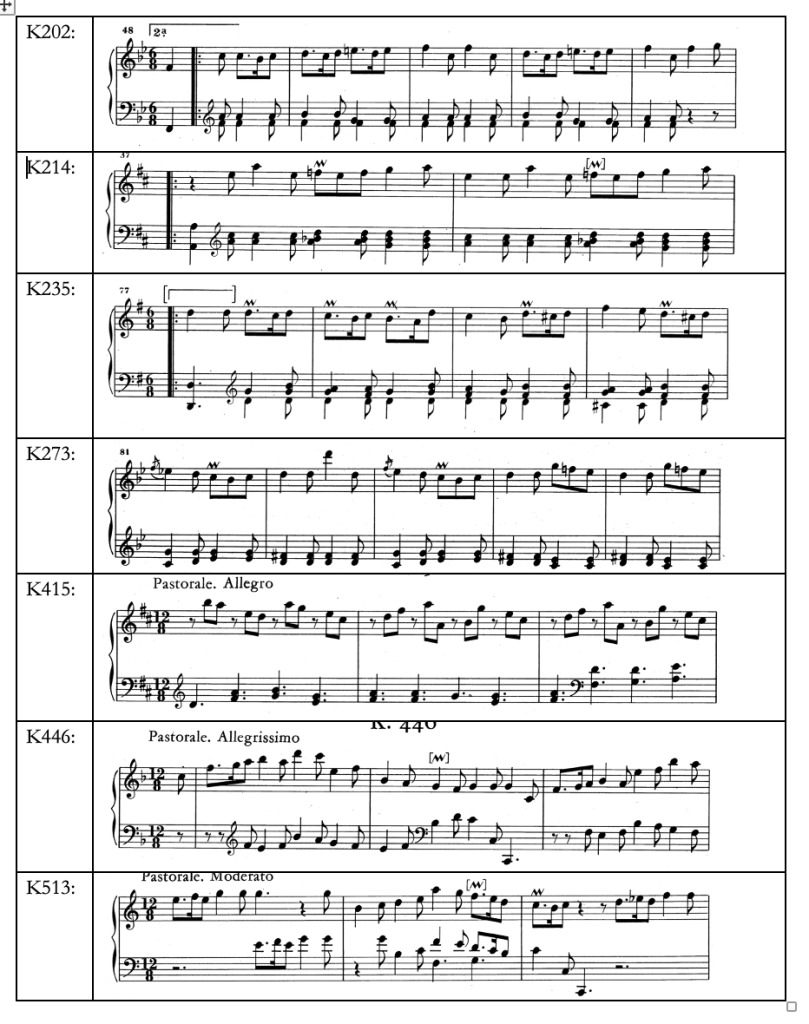
All Christmas pairs reference bells, depict human anguish by extended minore sections and/or rhythmic displacement. The siciliano is always reserved for the second sonata of the pair. Christmas secunde are not always called pastorales, like K202 in B♭, K214 in D, K235 in G, K273 in B♭, K415 in D, K446 in F, to name a few. Other Natale do not have a siciliano. Their hallmark is 6/8 or 12/8 and the siciliano rhythm, and a valedictory procession before the beginning of the celebration. Melodies and harmonies of prime and secunde are always related, i. e. the harmonic shifts of the sicilianos are prefigured in the prime, and the celebration-figures, harmonically “whole” intervals like thirds, fifths, octaves are always prefigured in the prime. The number three plays a central role in the liturgical pairs. – K259 and K235 share the first theme:
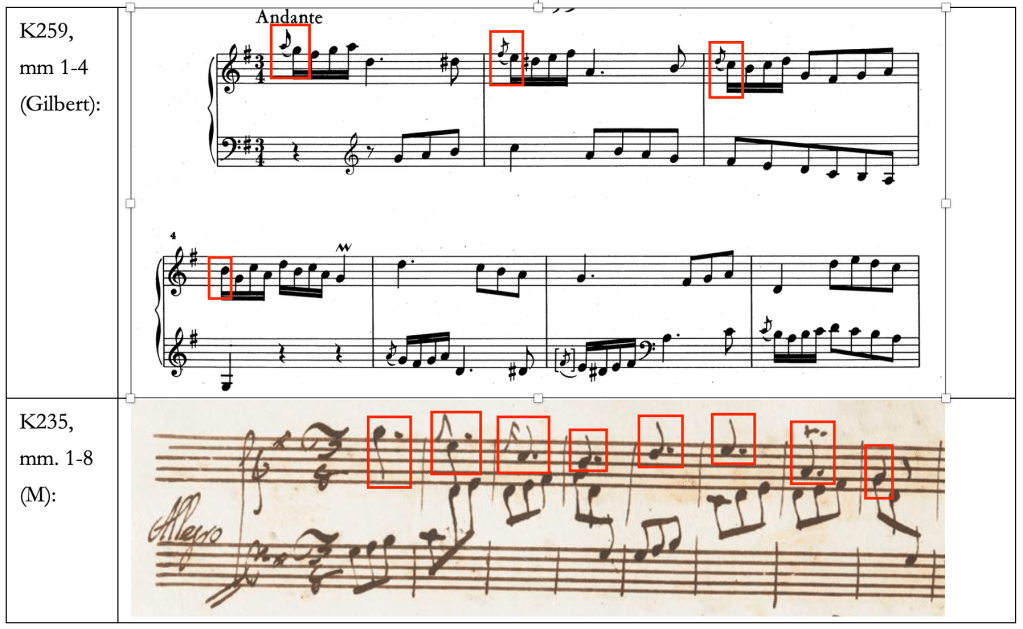
K259 and 260 were mismatched, K260 is the prima to K241. In K235 the melody g-e-c-b | d-e-a-g, with appoggiated e and c, unfolds bell-like on the first beat of the first eight mm. The bells of the first theme of the Christmas-secunda K273 in B♭ are similar to those of K235:

In K259 the errant soul is depicted in the second theme, four excursions through the keys of e and f♯ in the first half (mm. 9-16) and d and g at the beginning of the second half (mm. 39-47). Across displaced rhythmic accents unisons (d, e, a, f) split apart through dissonant chords. The chromatic drop to f♮ (key of G) announces that sth. is amiss; mm. 9-11:
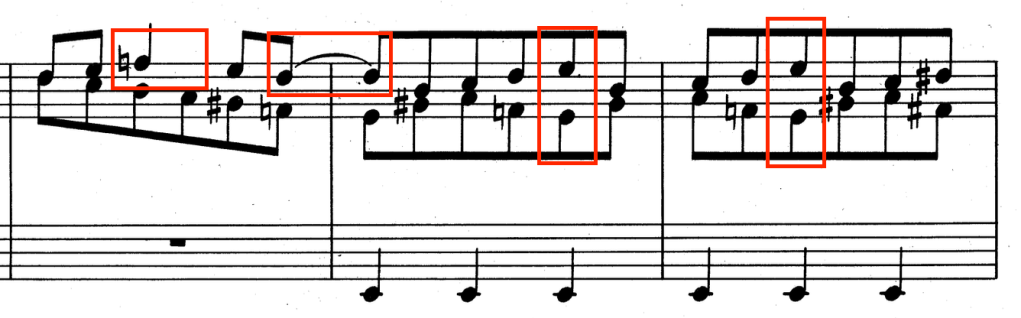
Scarlatti integrates the minor keys from the prima in the pastorale (mm. 77-89) of the seconda of K235 (M):
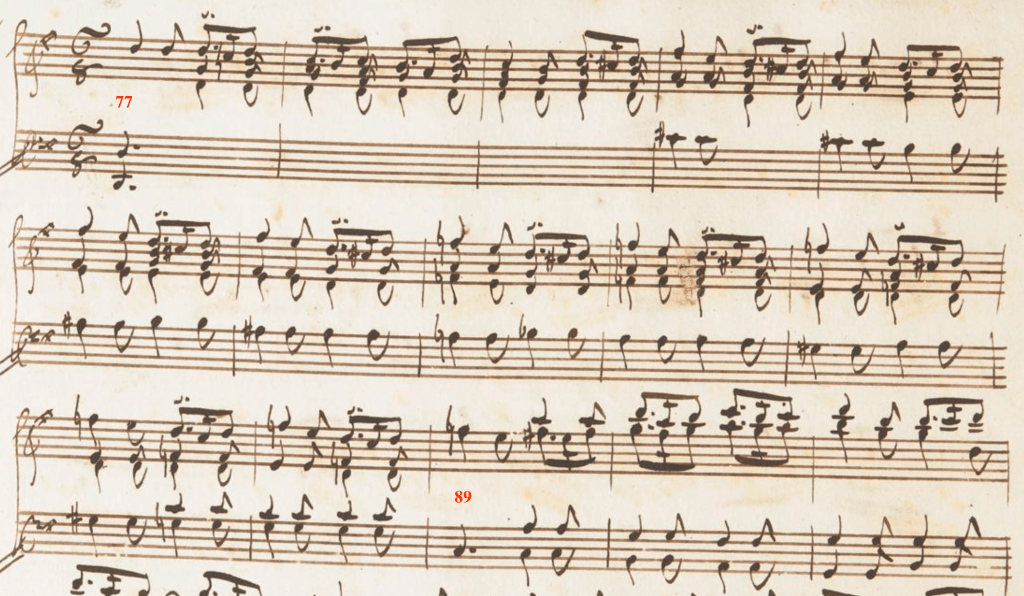
Before the celebrations in 3/8, Scarlatti concludes every siciliano with the gradual departure of the players, here the eight mm. 93-101 from K235 (M):
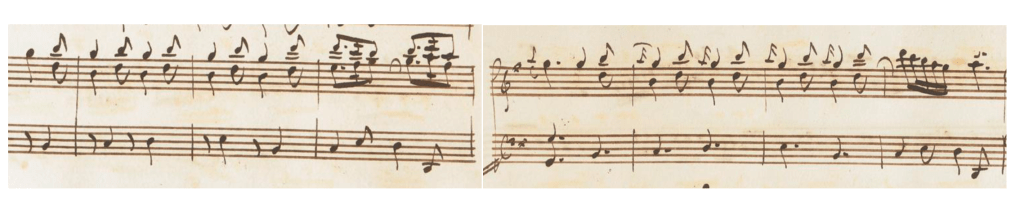
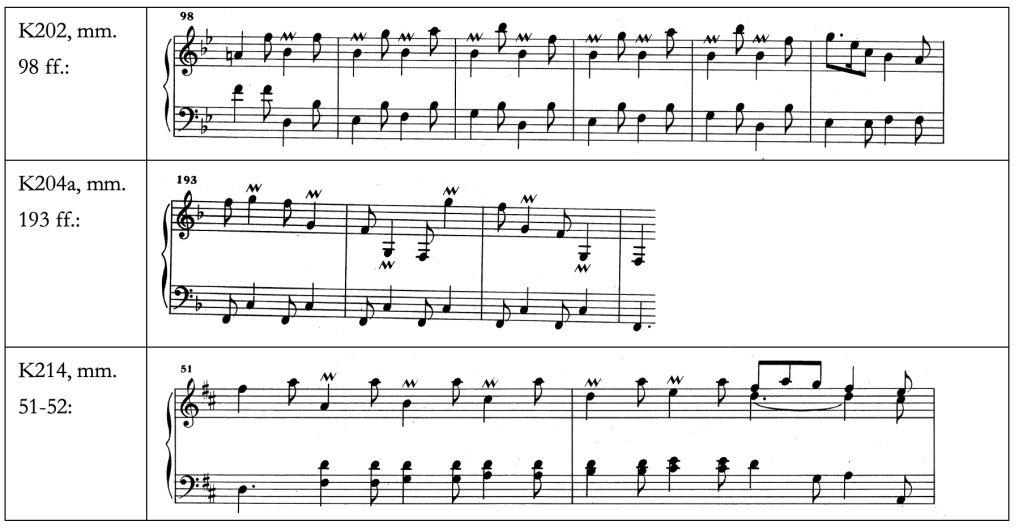
Similar valedictory progressions in K202, K214:
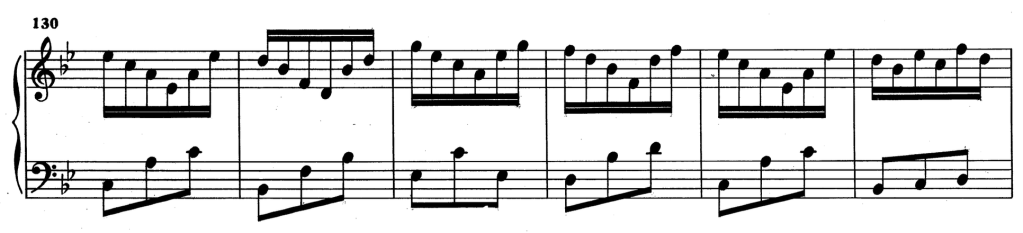
After the procession has left there follows a joyous celebration in “restored” intervals, broken octaves, thirds, fifths, usually in 3/8, here the tumble at the end of K259 and K202 (K513 see above):

The composer-copyist of Cary composed his own Christmas-companions (ff. 156v-158r). They consist of an “Andantino Para la Pastoral” in 3/4 and a “Pastoral. Allo” in 6/8. The initial figurations of the prima are re-iterated in the siciliano in 6/8:
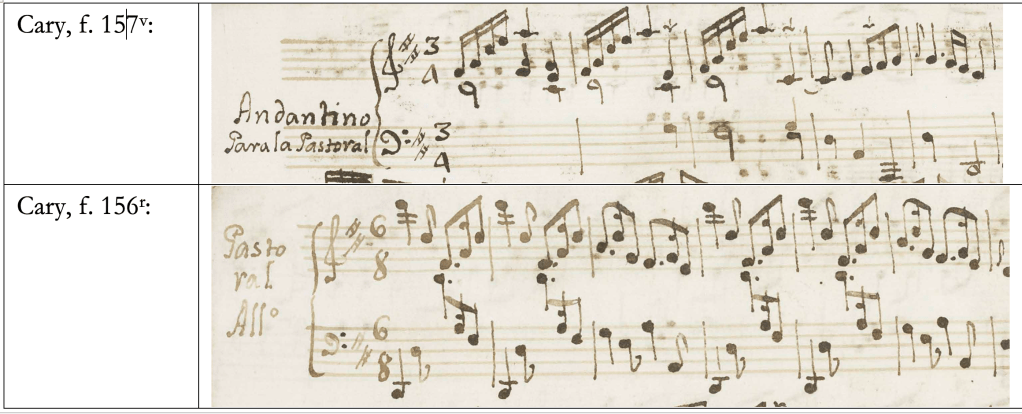
Although this sonata pair is simpler in structure and modulations, thirds and broken octaves depict “completion”, and the jaunty descent from d1 through D through three octaves and in three mm., in reply to the plea of the rising broken chords of the Andante, against the repeated bells of the high d2, depict the manifested trinity. The composer maintained the dotted 6/8 through the end. This particular siciliano, unlike those by Scarlatti, ebbs away like a marching band and drum rolls disappearing into the distance:
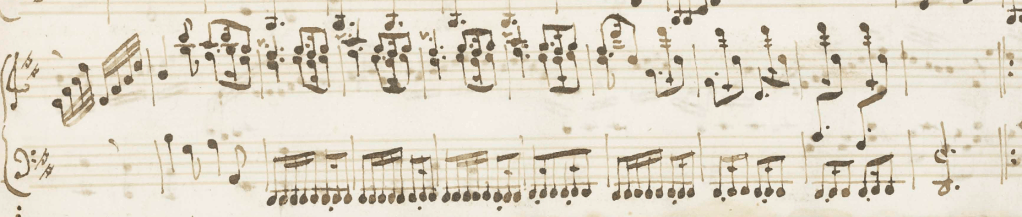
Cary’s composition shows that paired Christmas-toccatas for keyboard were not an isolated musical phenomenon. Scarlatti composed at least nine Christmas-pairs (more to be restored). Many pairs were disunited during their archived state: K189•202, K259•235, K331•273, K462•446; the same applies to many Pasqua-companions.
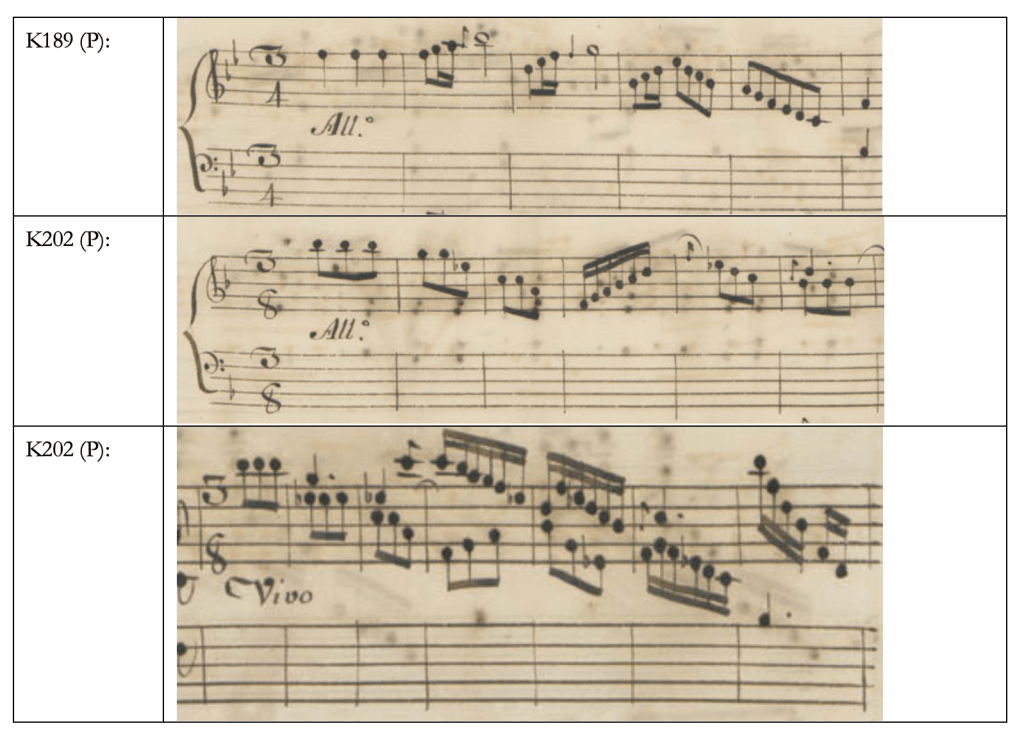
K189 and K202 in B♭ also constitute Christmas-companions. Where K189 begins with three repeated f2, K202 answers with three repeated b♭2. Both begin in a single voice, the 3/8 at the end of K202 combines to a dialogue. K189 repeats three f2 ascending to b♭2, K202 begins on three repeated b♭2, reiterated at the beginning of the closing section of K202. K189 tentatively ascends f2-b♭2-g2-e♭2-a1-f1, while in K202 the thirds b♭2-g2-e♭2 c2-a1-f1 come joyfully tripping down no longer nudged by questioning appoggiaturas:
Some of Scarlatti’s Christmas-pastorales in the second companion:
The siciliano of K202 in particular is of matchless intensity and beauty. The blind Welsh pianist Alec Templeton loved it well enough when, in 1934, he made it the centerpiece of his Springtime in the Village. While of a smaller scope than Casella’s Scarlattiana from 1927 it is worth seeking out as part of Scarlatti-adaptations of the early 20th Cent. Springtime disregards Scarlatti’s triple time and begins in 4/4 in F, Allegro giocoso, but the siciliano in g slows to an Andantino in 6/8 Andantino. The piece concludes as it began. The overall structure follows that of K202, though the minore is as long as the framing sections. Templeton paints a cloud-chased April day in the Welsh countryside rather than a Neapolitan Christmas scene.
Since Scarlatti wrote Christmas-companions, he did so for Easter. The Easter-companions also share interlocking characteristic features; they move in triple rhythms or triplets and have a triple structure. The core events usually depicted are the twelve Stations of the Passion, the lament about Christ’s leaving earth, the joy over his resurrection. One characteristic part of many Easter-companions are groups of three notes in 3/8 or 6/8 rushing upwards, symbolizing the resurrection, as in K163, K174, K333, K334:
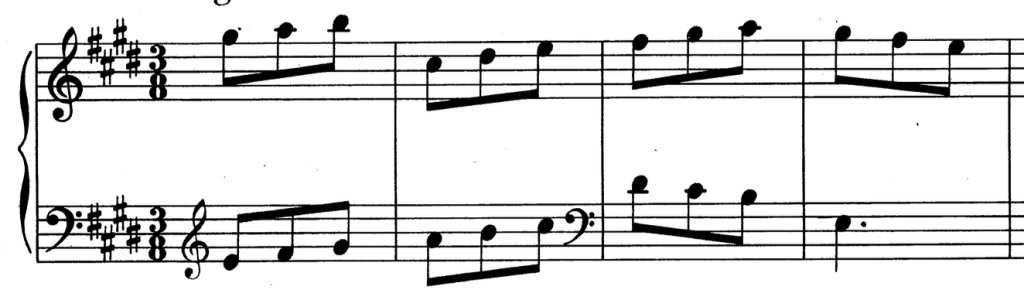
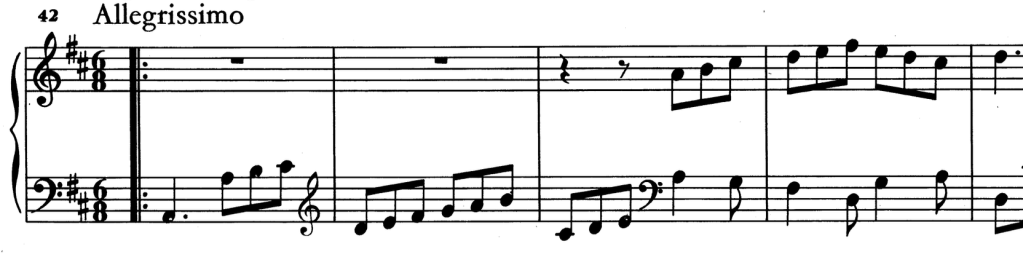
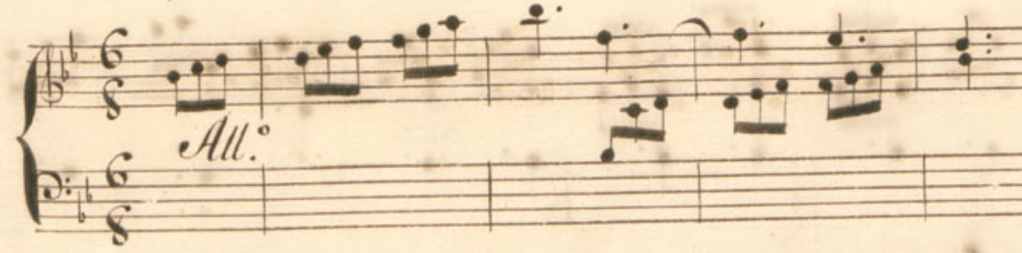
[further examples …] K249 is interspersed with four “Station”-blocks à 3, first half mm. 18-20, 24-26, second half mm. 98-100, 104-106; here mm. 98-100 (Gilbert):
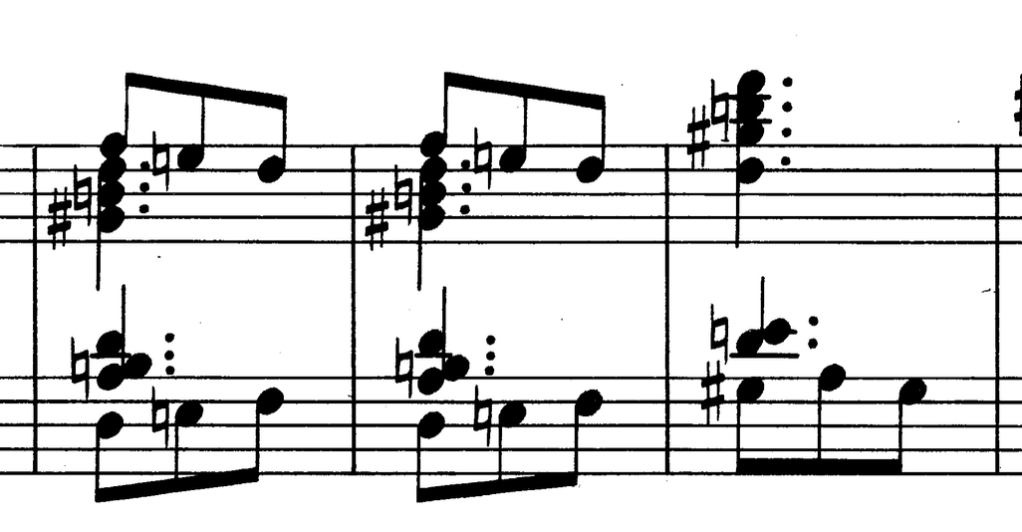
The same scene of the twelve Stations unfolds in K215 in 3 x 4 measures, at the opening of the second half:
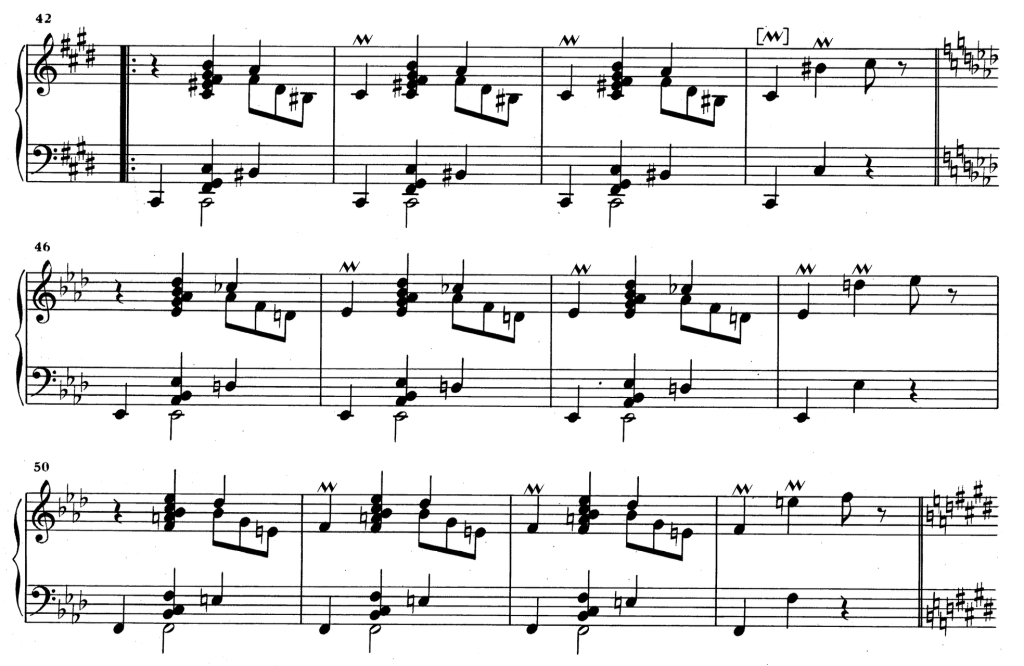
In K264 (companion K263) the twelve Stations also open the second half, mm. 127-138. They are structured similarly to those of K215:
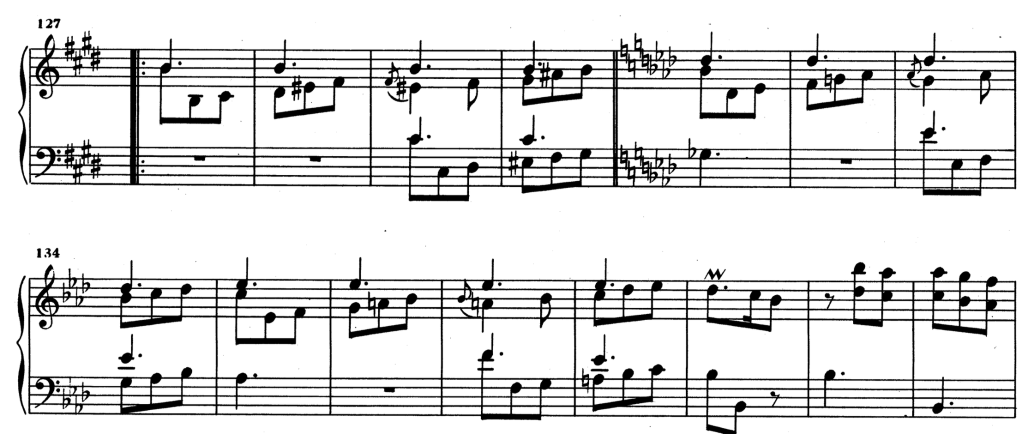
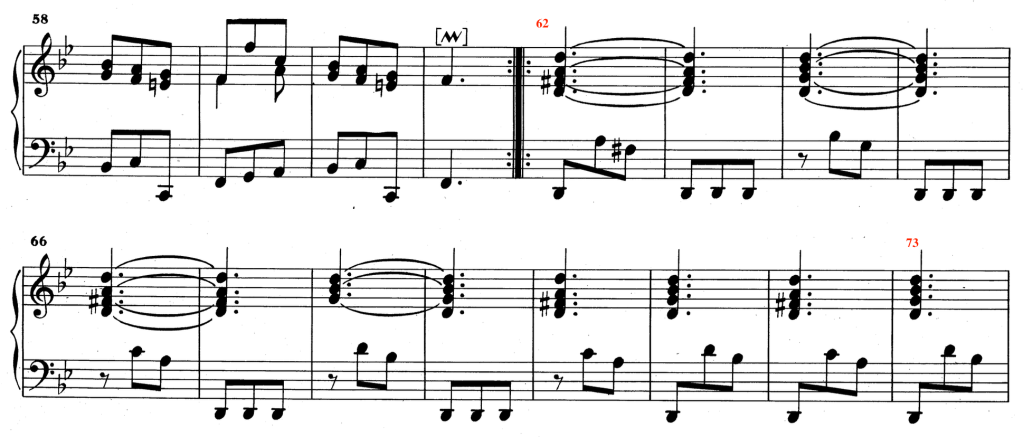
In K529 in B♭ the twelve Stations likewise open the second half, mm. 62-73, on the major mediant D (cf. K489 second half, which is not a Pasqua), followed by the relative minor g of the original key B♭. The effect of the sudden “crush” of the f1 of m. 61 by the f♯1 of m. 62 is as startling today as it must have been at its premiere:
All Pasqua-companions depict the ascension and a lament, either in the prima or the secunda; here from the secunda K249, with upper and lower voices drifting apart:
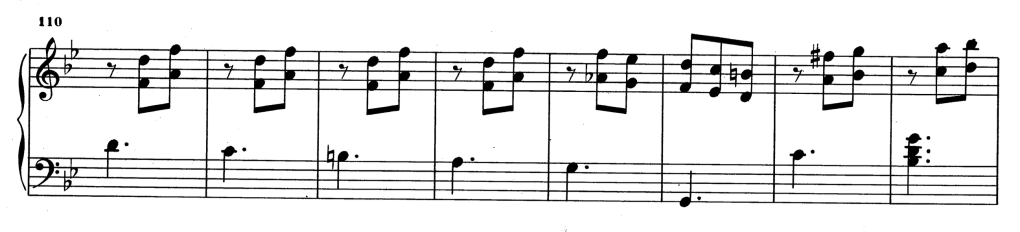
K215:
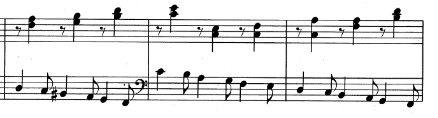
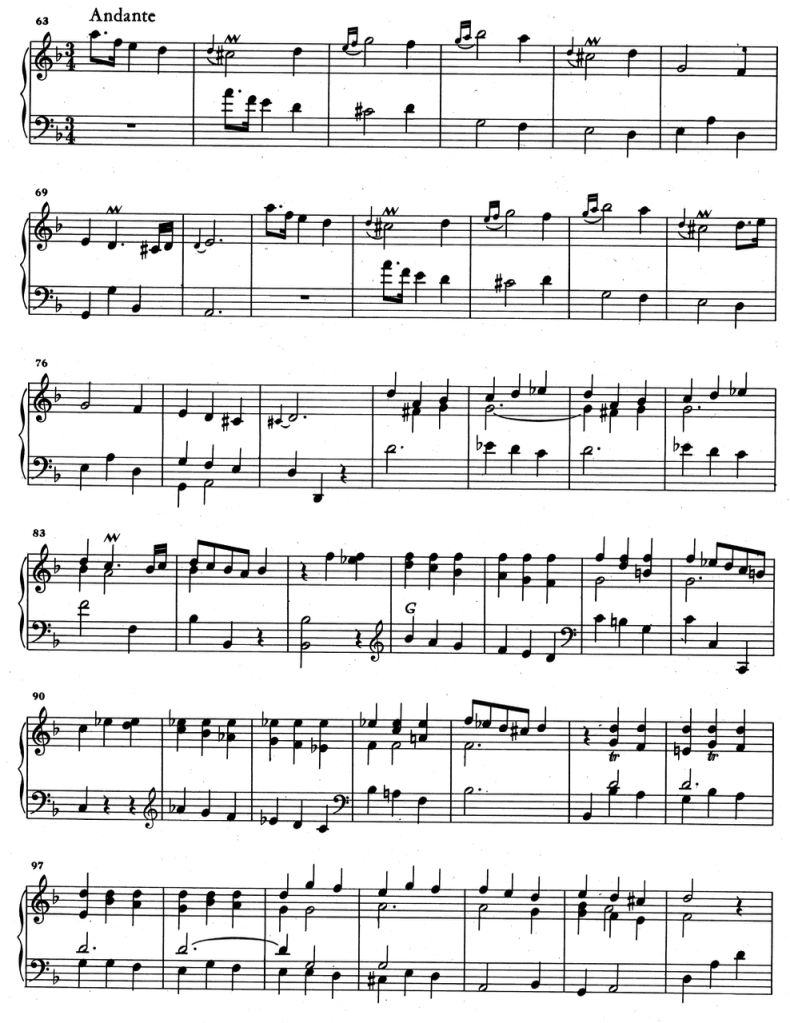
Scarlatti’s most extensive and most moving Easter lament is at the center of K282 in D-d-D (¢ Allegro – 3/4 Andante – ¢ AllegroD-d3). K282 is structured like a brief cantata without words. Scarlatti changed tempo and key for mm. 63-111:
The companions for Corpus Christi, for example K380•381, 420•421, 443•444, 460•461, 491•492 begin with a stately processional prima while their secunda always breaks into an extended passionate street or theatrical dance. These may be of Portuguese, Spanish, Cuban, Arabic or African origin, and the focus should also include professional guild dances and theater music associated with the liturgical Corpus Christi plays (this is a topic for Ars Longa de la Habana):
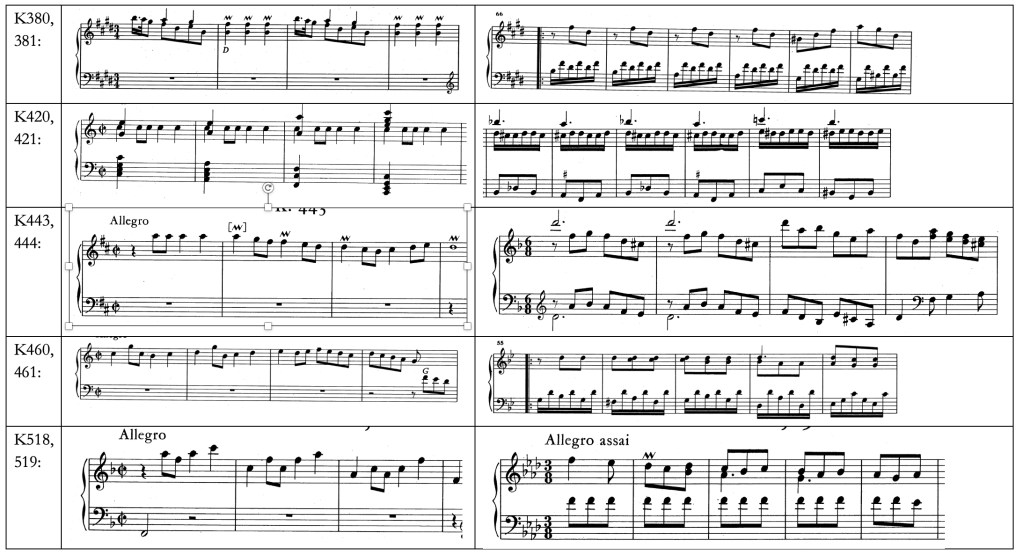
[…].
Minuets and courtly dances K379, K391, K393, K397, K430, K440, K453, K471 for a recurring secular festivity sometimes follow a complex prima in duple time with several themes. The proximity of the minuet pairs in the sources, like that of the Corpus-Christi companions, suggest that topical companions were archived thematically, or originally at the location where a new pair was premiered at the same time every year.
Some notational features.
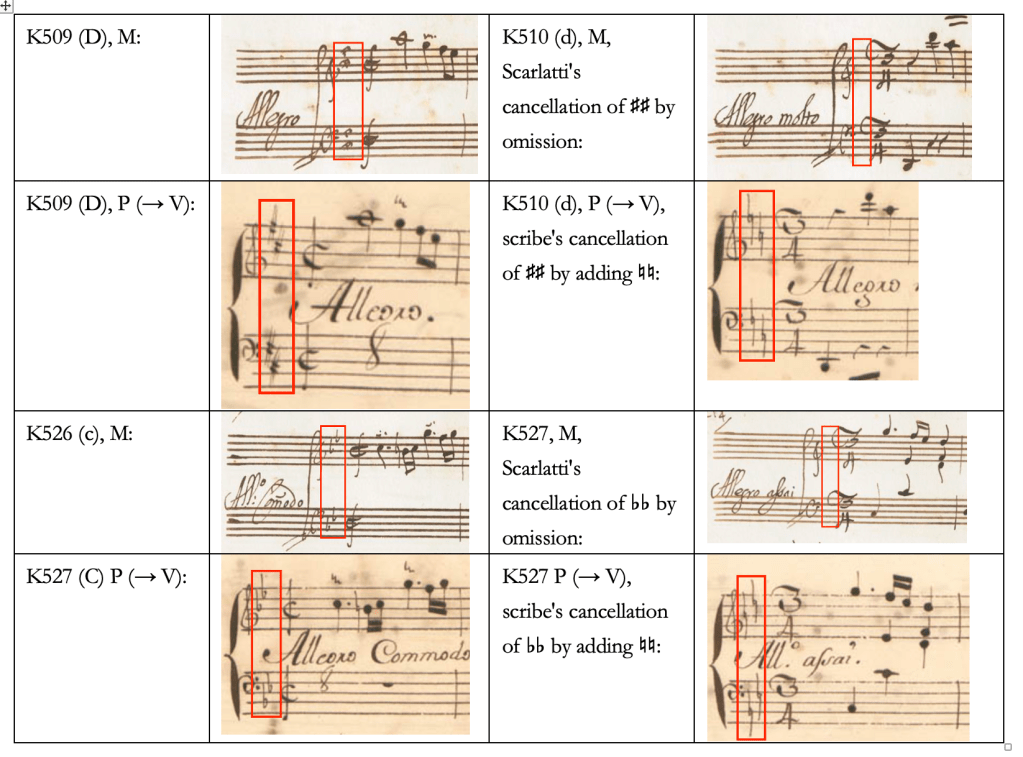
M, Z and Ca preserve notational features which likely originated with Scarlatti’s musical orthography, which P always regularized. Scarlatti cancelled a key signature by omission (M) instead of placing naturals (scribe P): M had no reason to apply the same idiosynchratic notation between sonatas in different keys:
M, Z, Ca suggest that Scarlatti indicated innertextual repeats by encasing the measures to be repeated within repeat marks rather than writing them out, since this would explain the occasional omission of repeated mm. in M and Z [will add examples]. Cary indicated such repeats with mm. 45-52 in K470. This is an interim illustration, especially since Cary left out a c♯ and all trills and may just have been in a hurry:
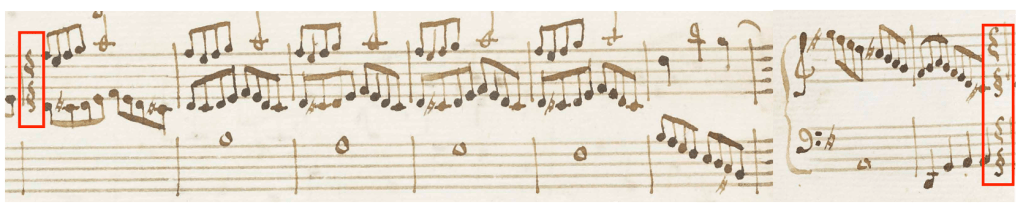
[additional illustrations …] P always rendered innertextual repeats in “longhand”.
Re K470 (Sources: M2:45/P55:28 → V55:32) Scarlatti appears not to have explicitly repeated every ornament if the implicit context made it clear, for example mm. 45-49 → 53-57 | 121-126 → 128-133, trills. The context suggests that all 20 mm. should be played with trills on the first notes in both the right and left hand in both halves, as Gilbert indicated. The reason why Scarlatti or the scribe of M discontinued them in the first half could have been a notational conflict with the c♯1, as the placement of the tr in m. 47 above the d1 in M suggests, or, as the second half suggests, because Scarlatti stopped indicating them. M copied eight trills, P notated all trills consistently above the notes, but left out the one on the f♯2 in m. 49. V began discontiuing them in the left hand:
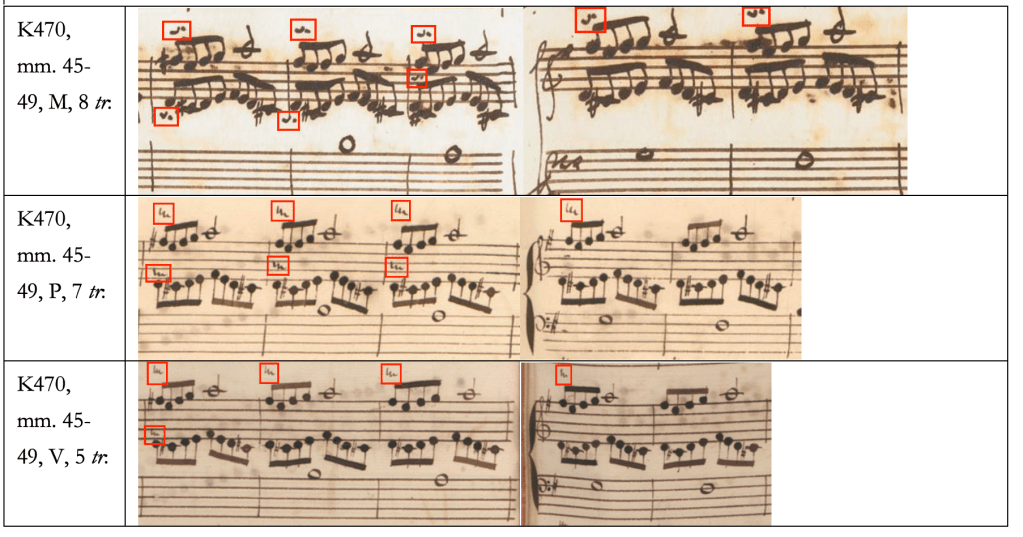
The omitted trills in Ca (see above) likely were an editorial choice, but are certainly not a “variant” by Scarlatti.
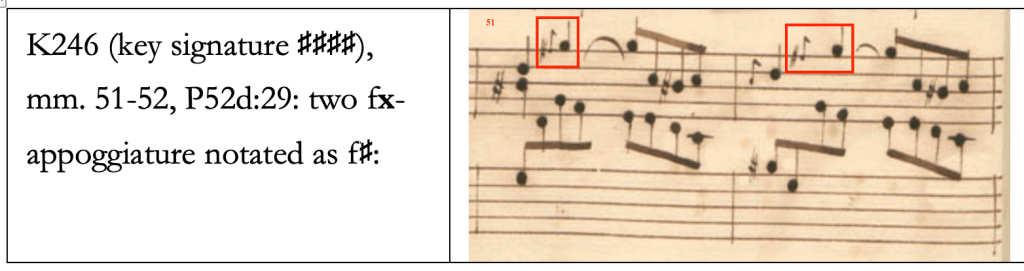
Scarlatti did not indicate double-sharps with an x if the key signature already contained a sharp. Soler bears witness to Scarlatti’s practice in his Llave de la Modulación (1762, p. 115): “Yo confiesso haver executado dicha cruz, (sin mas fundamento, que por haverlo vista) assi en algunas Sonatas de Don Domingo Scarlati. […]. Confiesso mi mal obrar, porque no se dè la culpa á quien no la tiene; y assi digo, que no se debe tomar por exemplar, porque no es bueno, como queda probado; y si se encuentra en las Obras de Scarlati tal señal, no la tengan por escrita del dicho, sino mia.” Soler’s (and Scarlatti’s) reason for not prefacing notes with an x that were already raised by a ♯ in the key signature was that it would have cumulatively raised, e. g., the note f♯ in the key of f♯ a half-tone higher to a g♯ instead of a g. Cary copied Scarlatti’s orthography in K25, the Essercizio in f♯ (other sources: E:25/M5:47/Ba:35/Or:23—), here Cary, f. 11v, mm. 37-40 (likewise in M):
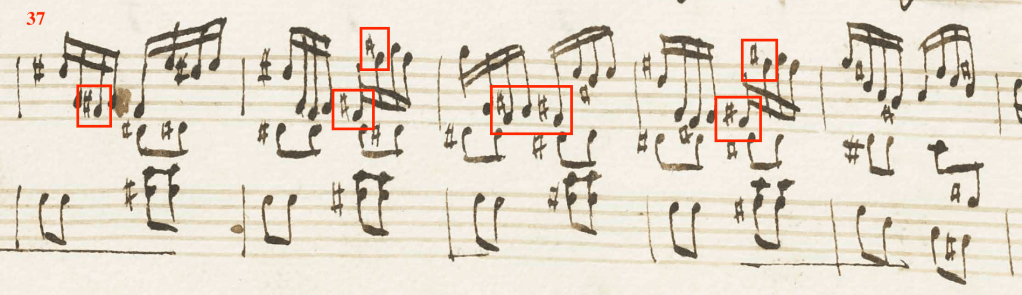
More recently, no mention of Soler, it has been claimed that Scarlatti employed the x in m. 58 of K25 as part of an “Andalusian cadence” in “flamenco harmony” and that it was part of his orthography because it in appears in Wien A. Wien A is a secondary source that was copied from M, and a later hand had corrected the original ♯ to an x. – In m. 58 Cary and M copied – from Scarlatti’s autograph – a g♯2 (key signature g♯2 + ♯ = a2). Cary should have added one to the second g2, as he did with the following a♯2, but he did not:
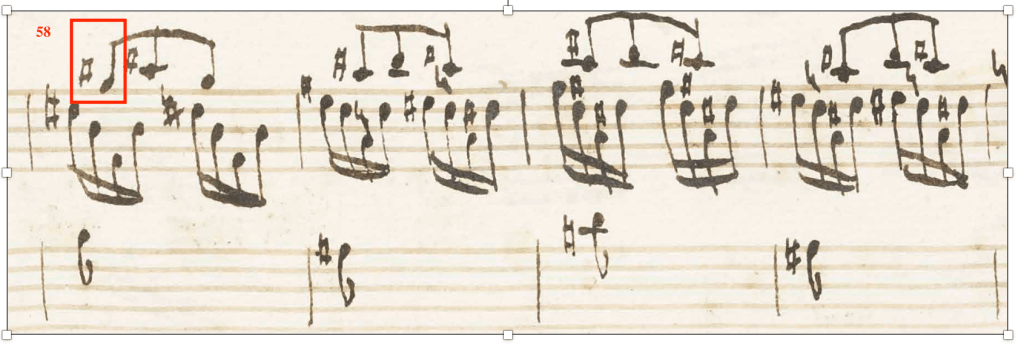
While Cary repeatedly altered the compass, sometimes the contents of Scarlatti’s texts (see K2) he remained truthful to Scarlatti’s orthography. – Scarlatti’s non-use of the double-sharp is also evident in K246, as copied by P:
If the melodic line allowed, as in K319 in F♯, Scarlatti used cancellation signs, here a g♮ which M and P (→ V) also copied:
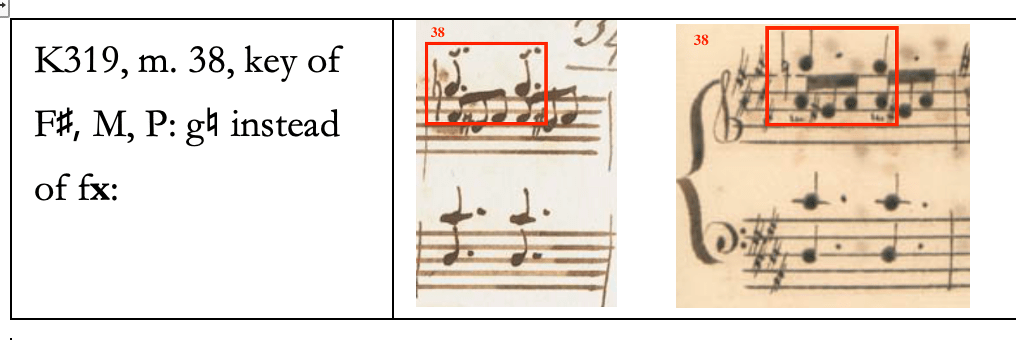
Scarlatti never used the double-sharp.
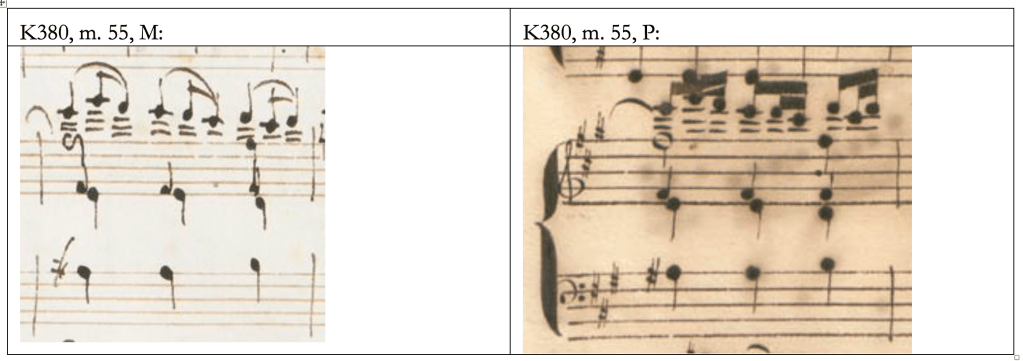
Implicit instrument range. The highest note in K380 in E, m. 55 is a g3 (passing through e minor) but none of the sources (M, P, NH, V) have a ♮ to cancel the key signature ♯. Expecting a ♮ applies modern expectations. The answer is pragmatic: Scarlatti did not notate a ♮ because he knew that the highest note of his instrument was a g3. Why negate a note that did not exist:
Emphatic or deictic accidentals.
Like many composers, for example Chopin, Scarlatti added accidentals melodically or emphatically to notes that had been altered and returned to their previous state, regardless of whether the accidentals were already contained in the key signature. Cary preserved a deictic or emphatic ♯ before the second f1 in m. 39 of K25 (see above) which is characteristic for Scarlatti’s harmonic orthography in M. Composers – Chopin, for example – regularly emphasized the melodic return from ♮ to ♭ even if the ♭ was part of the key signature. M consistently retained these melodic accidentals, for example in K466 a return from b♮ to b♭, PV omitted them:
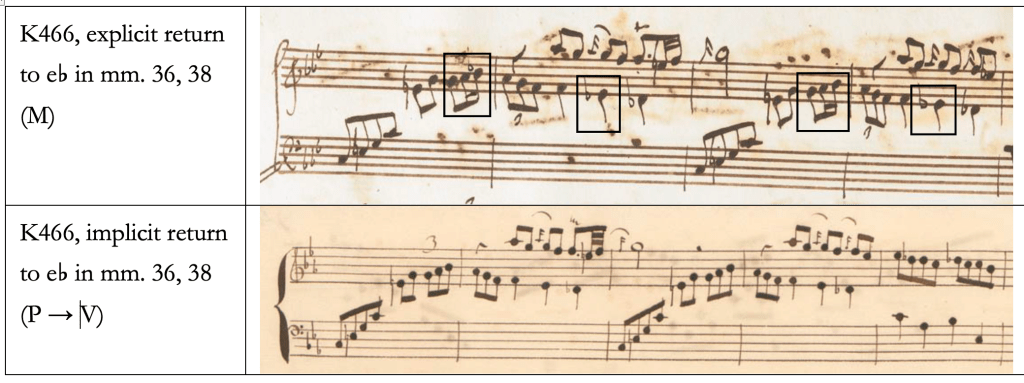
Even if superfluous by modern standards, if this notation was characteristic for Scarlatti (and Soler, and Schubert, and Chopin), it should be retained in modern editions.
Original sonata-pairs in ascending order from G/g to F♯/f♯.
Pairs are listed by key because all sonata-pairs are in the same key, whether major or minor. The ascending sequence from G to F♯ is adopted from the indices in Münster. The scaffolding by increasing K-numbers is for convenience only. Ideally, the pairs should be listed by instrument-range. Instead of the RISM nos. which sometimes link to the same sonata in another source, the sigla are used: Al = Ms. Add. 31553, Ay = Ayerbe, B = Boivin (LeClerc), Bo = Bologna, Ca = Cary, CF = Cambridge-Fitzwilliam, E = Essercizi, M = Münster, Na = Napoli, NH = New Haven, P = Parma; PdC = Pièces de Clavecin, RC = Roseingrave, V = Venezia, WQ15114, 15115, 15116, 15118 = the four L’Augier-volumes, Z = Zaragoza. Added in superscripted italics are the actual ranges of each sonata, which have been checked for each piece. * indicates handcrossings. Tempo deviations, and all external markings are likewise added in superscript: “R.na” occurs only in Z, “Scarlatti” in M4 and M5 where it indicates the first of a pair, “1754 in Aranjuez” also only in M4 and M5 which indicates the end of a pair and the copying year and location. “L’Augier” refers to the set of 42 sonatas purchased by L’Augier in 1755. An → before a source indicates that it was copied from the preceding source. “•” indicates pairing, a “~” that the companion sonata is missing in the respective source[s].
G/g:
Some original companions: K152•153, K180•125, K169•171, K179•373, K234•196, K259•235 (Christmas), K240•241, K324•325, K347•348, K374•375, K390•391 (minuet), K424•425, K426•427, K449•450, K454•455, K470•471 (minuet), K476•477, K493•494, K520•521, K522•523, K538•539, K546•547.
🐈⬛ Companions g: 3/4 AndanteC-d3 • 2/4 AllegroC-d3.
Sources: M4:50Scarlatti•~/Z2:34•52/P52d:19•52c:4 → V53a:29•52b:25|K234•196.
Notes: M5 “Scarlatti” indicates prima; K234 and K196 complimentary tempi, complimentary contrary beginnings S-A-T → T-A-S; share rhythmically altered descending melody d2 → a2 melody; fermate on g1 before entrance of second theme m. 9 ff.; complimentary figurations at end of first half; ascending l. h. steps, descending r. h. sixths; rhythmically altered movement; M has the f♯2 between mm. 61-62 tied correctly, not P/V; […].
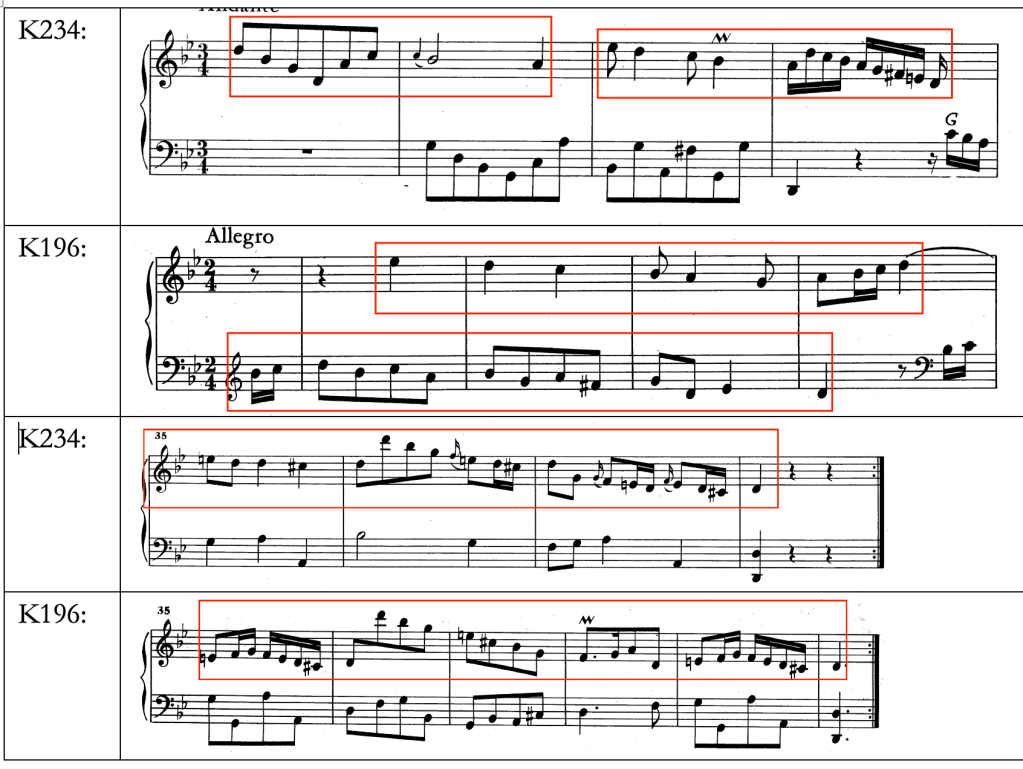
🐈⬛ Companions G: ¢ Allegro1G-d3 • 3/4 Allegro – Minuet1G-d3
Sources: M3:39•40/P54c:1•2 → V54c:3•4/~•Ca1:59transposed to F|K390•391.
Notes: M has 3rd sing. descriptive “Tace” only at its first occurrence in each half, m. 17, not m. 23 in the first half, m. 45, but not 51. P → V regularized in all four mm., and changed to “Tacet”:
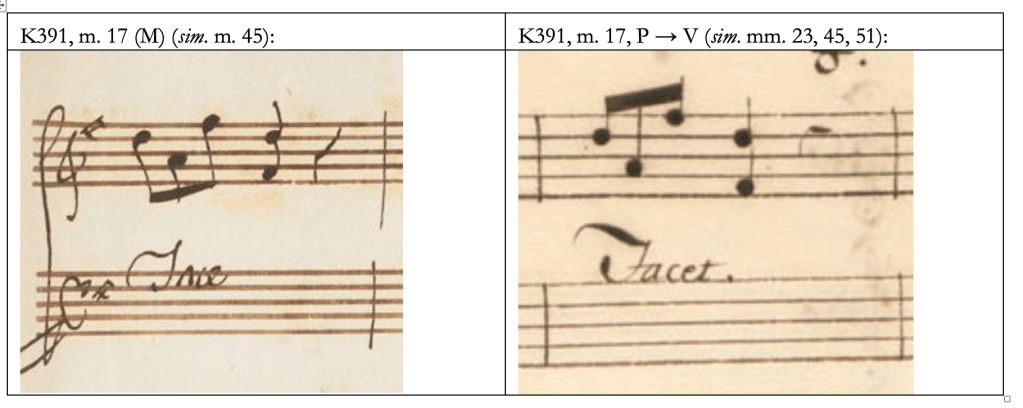
See also K255 scribal corruption “Oytabado.”, “Tortorilla.” (P only) and K439 scribal additions “Este compas […]” above.
🐈⬛ Companions G: 3/4 Andante spiritoso1G-g3 • ¢ Allegro1G-g3
Sources: M2:47•48/P56a:1•2 → V56a:1•2|K454•455.
Notes: The repeated notes at expanding intervals on the second and third beats in the second half of K454 become the main theme of K455 where they are shifted to the first beat:
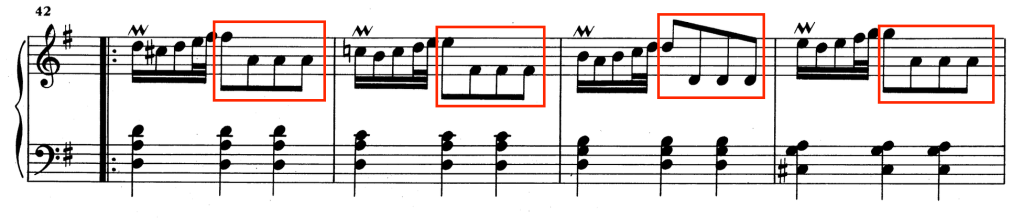
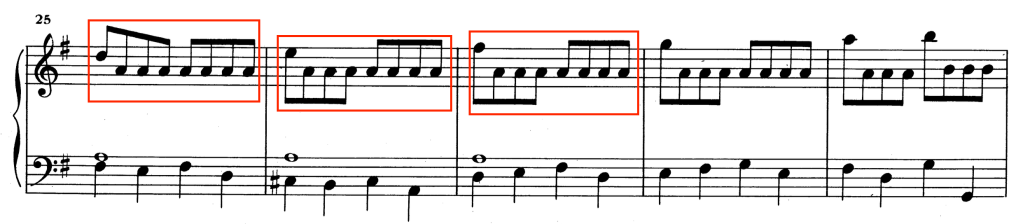
A♭:
🐈⬛ Companions A♭: ¢ Allegro1Bb-d3 • 3/8 Allegro1Ab-c3
Sources: M4:36Scarlatti•3:16/Z3:4•5/P52a:21•22/V49:31•34/ CF13:14•11/~•Li:38/WQ15116:391752•~/Ha:3•~|K127•130.
A/a:
Original companions (incomplete): K39•62, K113•114, K217•341, K181•182, K300•301, K320•321, K322•323, K343•344, K368•369, K428•429, K452•453, K456•457, K499•500, K532•533, K536•537, […].
🐈⬛ Companions A: ¢ Andante1A-e3 • 6/8 Allegro1A-c3
Sources: M3:49•50/P54c:17•18 → V54c:17•18|K404•405.
Notes: Beginnings SA → BT; long descending scales in both. K404 m. 12, 43, 125, 176 correct in M, wrong in P → V. K404 mm. 43, 125 typical for P’s regularization of an unexpected rhythmic pattern by precedent:
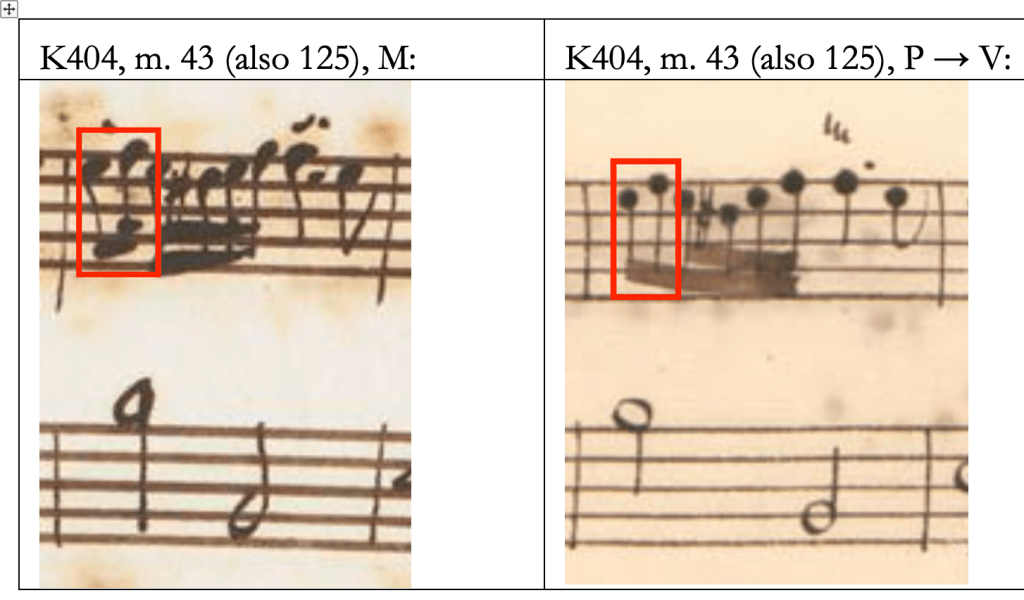
K405 mm. 71, 73 correct in M, wrong in P → V: P → V omitted two e♭ at the end of the descending “flamenco-“scale which is repeated twice across four mm. The wrong version is in print. K405, mm. 71, 73:
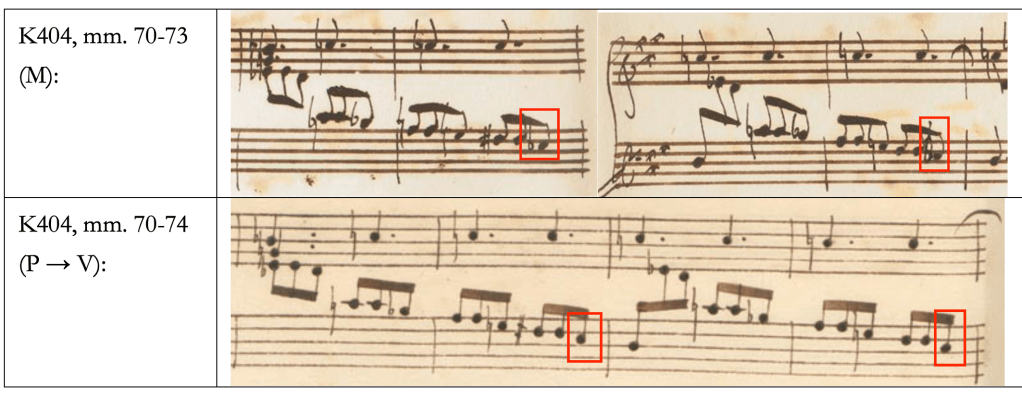
B♭:
Original companions (incomplete): K154•155, K189•202 (Christmas), K248•249 (Easter), K310•311, K331•273 (Christmas), K332•334 (Easter), K360•361, K392•393, K410•411, K439•440, K441•442, K528•529 (Easter), K544•545, K550•551, […].
🐈⬛ Companions B♭: ¢ AllegroC-d3 • 6/8 AllegroF-d3
(Sources: P53c:30•54a:2 → V54a:7•9/Ay:6•~|K332•334).
Notes: Easter companions. K331 (false triptych in P) precedes K273, with which it forms a Christmas-set. – K332•334 shared first theme, altered ascents b♭1-b♭2, imitation. K332 describes lament; K334 resurrection […]. Beginning of both quoted from P:
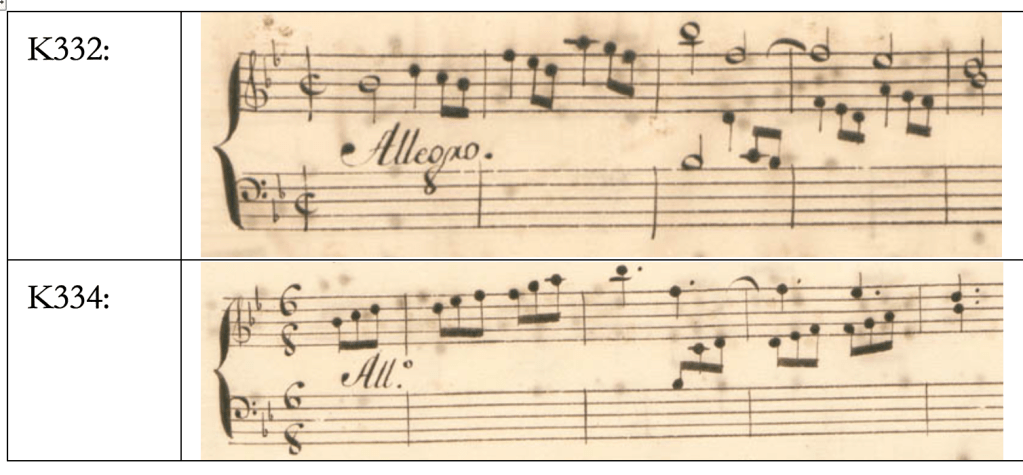
b♭:
Original companions: K128•131.
B:
Original companions: K244•245, K261•262.
🐈⬛ Companions B: 3/8 AllegroC♯-c♯3 • 6/8 AllegroC♯-c♯3
Sources: M2:17•~/P52d:27•28 → V53b:9•10|K244•245.
Notes: M2:18 one out of a set of four missing; […].
🐈⬛ Companions B: 2/4 Allegro1B-c♯3 • 12/8 Vivo1B-d3
Sources: M4:49Scarlatti•3:6/P53a:17•18 → V53b:26•27|K261•262.
Notes: the “Scarlatti” above the beginning of the prima here and elsewhere in M4, M5 and Z2 indicate the begining of a pair, only a few are misplaced […].
b
Original companions: K197•293, K173•227, K376•377, K408•409, K497•498.
🐈⬛ Companions b: c AndanteC♯-d3 • ¢ AllegroF♯-d3
Sources: M4:46Scarlatti•~/Z4:35•~/P52c:9•53b:23 → V52b:26•53c:28|K197•293.
Notes: Common compass C-d3; theme; singletons in M, P, Z. Scarlatti’s only pair whose seconda varies the duple time of the prima.
🐈⬛ Companions b: b: 2/4 Allegro1A-d3 • 2/4 Allegro – 3/81B-d3
Sources: M3:9•~/Z4:4•2:51/P51:26—•52d:11 → V52a:26•53a:22|K173•227.
Notes: compass; theme; motif of repeated notes leading to six repeated notes at the beginning of 3/8; rhythmic displacement; singletons in all sources. The only pair which continues a time signature from prima to secunda before changing to 3/8 in the latter’s second half.
🐈⬛ Companions b: 3/4 AllegroD-d3 • 2/4 AllegrissimoE-d3
Sources: M5:3Scarlatti•41754 in Aranjuez/P54b:19•20 → V54b:19•20|K376•377.
Notes: M closes with copying year and location; since copied from autograph, these particular texts must have been in Aranjuez at the time; unity of thematic material in both.
🐈⬛ Companions b: ¢ Andante1B-d3 • 3/8 Allegro1A-d3
Sources: P54c:21•22 → V54c:21•22|K408•409.
Notes: P is the only source. […].
🐈⬛ Companions b: ¢ Allegro1A-g3 • 3/4 Allegro1B-d3
Sources: M1:36•37/P56b:14•15 → V56b:14•15|K497•498.
Notes: Related themes and quotes, rhythmic displacement; descending 7ths f♯2-g1, e2-f♯1, d2-e1, c♯2-d1; descending major sixths g1-e2 ff.; halt on h1-a♯1. 1a mm. 1-4 → quoted 2a mm. 3-5, 9-10; trills a♯-h. The rising broken octaves till g3 in the soprano of the first half of K497 mm. 36-38 transposed to the tenor of the second half of K498 mm. 55-58; […].
C/c:
Original companions (incomplete): K115•56, K116•139, K126•129, K132•133, K156•157, K158•159, K165•166, K170•174, K199•200, K302•303, K308•309, K356•357, K398•399, K460•461, K485•513, K486•487, K501•502, K526•527, K548•549, […]:
🐈⬛ Companions c: 3/4 Allegro1G-d3, x • 12/8 Allegro con spiritoC-d3, x
Sources: Z2:22•23 All.o Fin/M4:37Scarlatti•~/Z3:51•35All.o/P52b:13•52a:25All.o con spiritu/Al:23•22Con spritu/V49:19•~/WQ15115:6•15116:14Con spirito 1752/~•V42:14Con spirito|K115•56.
Notes: Preserved as a pair in Z2, part of a triplet in Wo. Harmonies; final ascending/descending broken chords complimentary contrary motion. WQ “1752” taken from P.
🐈⬛ Companions c: 3/8 Allegro1G-d3, x • ¢ PrestoC-d3, x
Sources: M4:38•~/Z3:52•54/~•Z2:4/P52b:14•6/Ay:20•19/Al:24•27/V49:20•~/Ca1:43•~/WQ15115:341752•~/
~•V52b:13Fin•~/Li:42•~/~•NH:17 /~•Ba:25|K116•139.
Notes: “1752” correlated from P.
🐈⬛ Companions c: 3/8 —1G-d3 • 6/8 AllegroC-d3
Sources: M3:17•~/Z3:10•11/P52a:26•51:29/~•Z2:20/V49:30•33/~•V52a:29/Ay:9•~/Ha:2•~|K126•129.
Notes: K126 chain of descending trills e♭-d-c-b♭-a♭-g mm. 9-14 → K129 mm. 13-14; chromatic scales; key of b♭ mm. 88 ff. → 62 ff.; beginnings second half contrary motion G-c; concluding thirds mm. 110 ff. → mm. 82 ff.; K126 ends on 1C-C-♭♮c1, K129 ends on 1C-C-♭♮d1c1. Link: both share, rhythmically altered, the same sequence of trills e♭-d-c-b♭-a♭-g (in K129 redirected via ascending eighths) over the same bass (K126) and tenor (K129), c-b♭-a♭-g-f; rhythmic and tempo proportions 2:1:
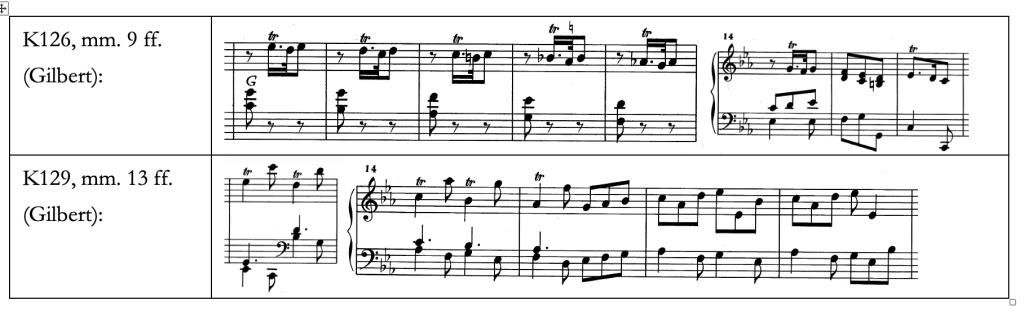
Companions C: ¢ CantabileC-c3 • ¢ AllegroD-d3
Sources: M4:14Scarlatti•15/P53c:7•8/V53d:13•14|K308•309.
A rare pair in ¢: the proportions indicate that four mm. of K309 are to be played as fast as two mm. of K308, thus the “Allegro” is twice the tempo of the “Cantabile”. Shared first theme, rhythmically modified, first part doubled in K309:
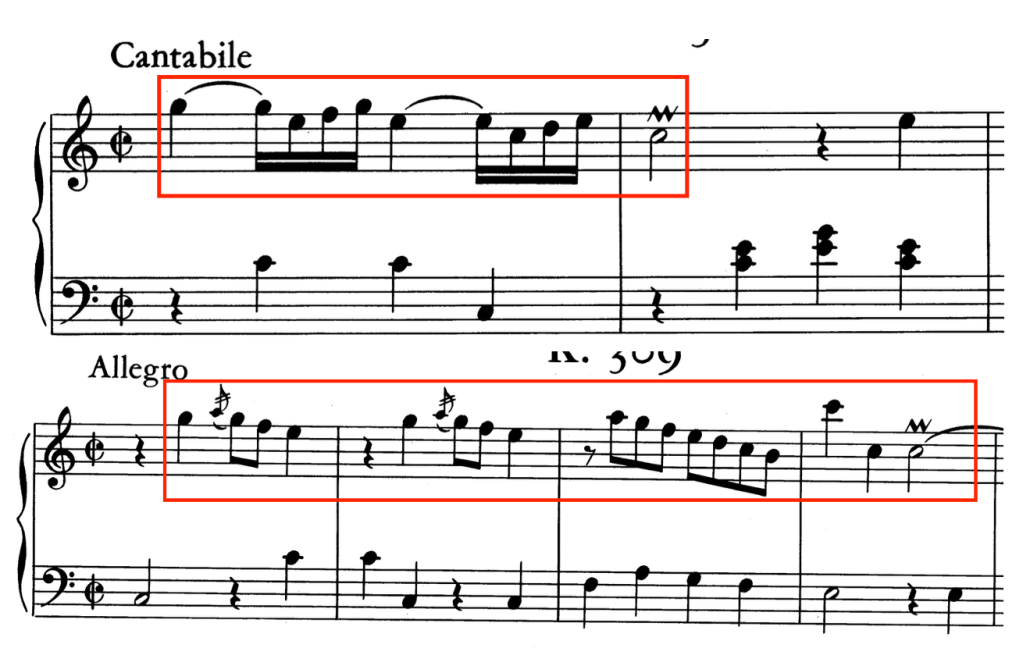
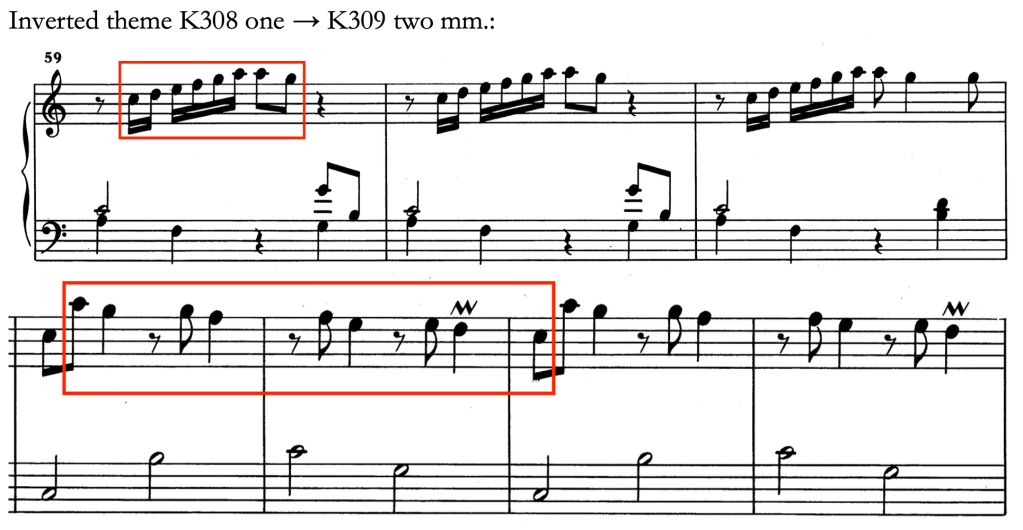
🐈⬛ Companions C: c Andante e cantabile1G-g3 • 12/8 Pastorale: Moderato – Molto allegro – 3/8 Presto1G-d3
Sources: M1:20•50/P56b:2•30|K485•513).
Notes: Natale. 61-key transposition harpsichord; see above.
Companions C: ¢ Allegro1G-e3 • 3/8 Allegro1G-f3
Sources: M1:21•22/P56b:3•4 → V56b:3•4/Ca2:11•12Del Rey D.n Fernando el VI|K486•487.
Notes: K486, m. 9. The sonata begins with a trill on e1, the top voice, and all other trills occur at the top voice. At m. 9, Scarlatti intensifies the sequence by adding a third underneath. M has two distinctive trills on e2 and c2, P, V, Ca only one on the lower c2. There is no musical reason for the trill to move to the lower voice for only one measure throughout the whole piece. M is the correct musical reading, the “D” can be supplemented from P. Here M, P, V:
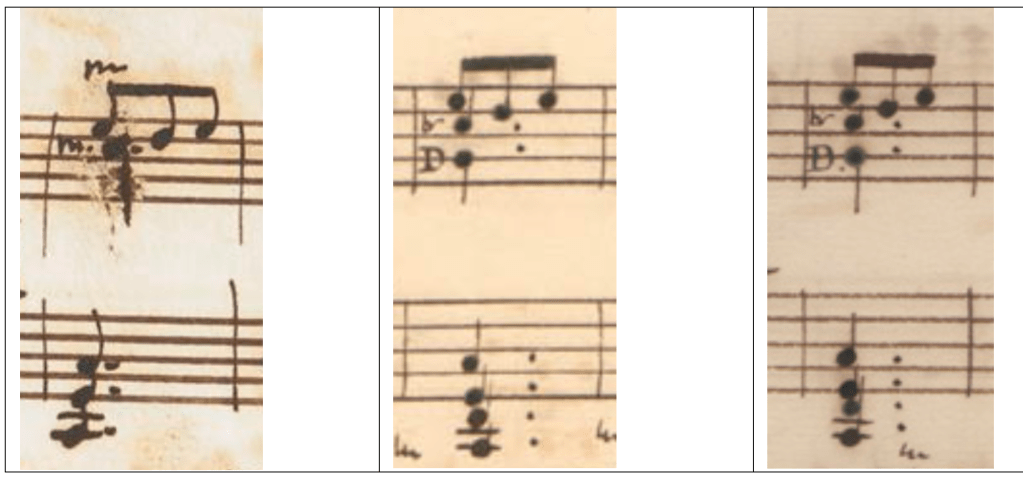
K487: Cary wrote “Del Rey D.n Fernando el VI.” above the beginning of K 487:

Fernando was King of Spain since 9 July 1746. Scarlatti would have referred to Prince Fernando unless he composed the sonata in or after 1746, which I find unlikely. Since the only other piece thus annotated in Cary, K480 in D, shares a similar festive tone and an exuberance in octaves it is possible that the composer-copyist-performer of Cary documented Fernando’s delight in the piece, perhaps in the festive octave stomping, and designated it above the beginning as “The King’s Sonata”. Likely there is another explanation for it.
c♯:
Original companions: K246•247.
🐈⬛ Companions c♯: ¢ Allegro1B-c♯3 • 3/8 AllegroC♯-c♯3
Sources: M2a:19•~/Z5:33•~/P52d:29•30 → V53b:11•12/WQ15119:5•1|K246•247.
Notes: missing M2a:20 part of a group of four pairs without companions. K246 (49 mm.) first theme g♯2 f♯2 | e2 d♯2 c♯2 b♯1 c♯2 g♯1 c♯2 d♯2| e2 d♯2, then imitation an octave below mm. 3-5 → K247 (99 mm.): c♯2 g♯2 e2 | d♯2 c♯2 b♯1 c♯2 d♯2 | e2 c♯2 g♯1. Enharmonic change K246 f♯2 → g♭2 in the middle of m. 17 over a held note reminiscent of K318 mm. 54-55 g♭1 → f♯1. K246 especially theme mm. 13-14, 23-25, 44-45, 53-54 saudades of unforgettable beauty:
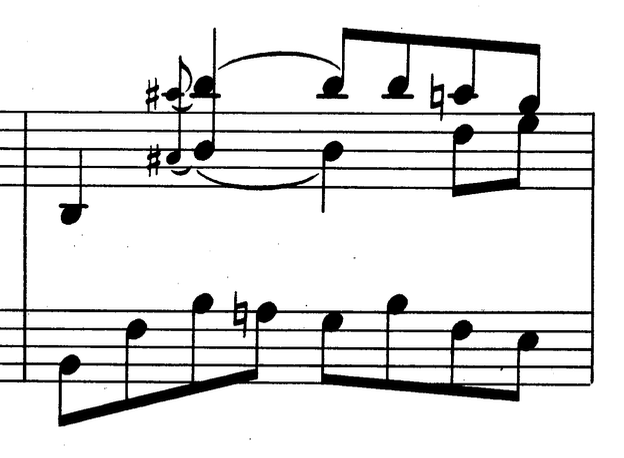
Landowska commented on the “moorish fifths” of K247, a secunda rhythmically as sensitive as the prima. K246•247 are linked by their halved and mirror-inverted themes a rovescio. The first theme of K246 is mirrored in the first theme of 247. K246 first theme g♯2 f♯2 | e2 d♯2 c♯2 b♯1 c♯2 g♯1 c♯2 d♯2| e2 d♯2, then imitation an octave below mm. 3-5 → K247: c♯2 g♯2 e2 | d♯2 c♯2 b♯1 c♯2 d♯2 | e2 c♯2 g♯1:
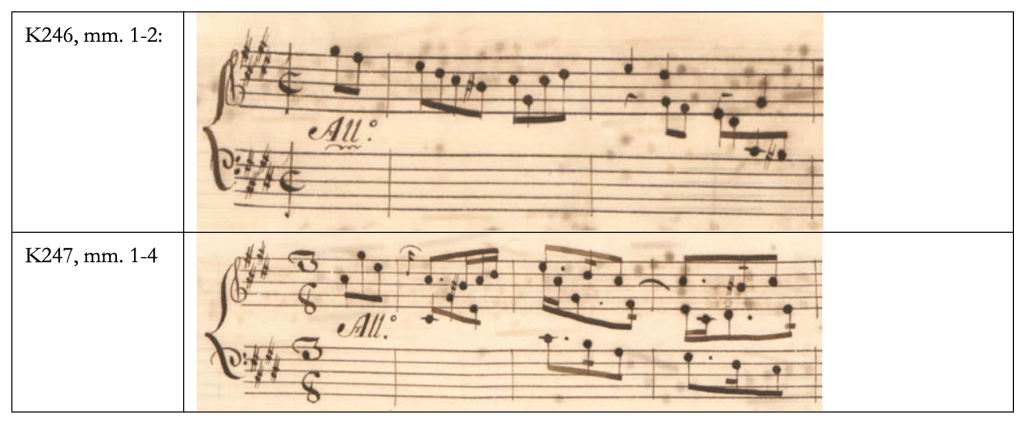
D/d:
Some original companions: K160•161, K164•176, K177•178, K223•224, K236•237, K277•278, K281•282 (Easter), K287•288 (organ), K294•295, K312•313, K335•336, K345•346, K352•353, K358•359, K389•388, K396•397, K400•401, K414•415 (Christmas), K435•430 (minuet), K434•436 (Easter), K443•444 (Corpus Christ), K458•459, K478•479, K484•480, K491•492 (Corpus Christ), K509•510, K511•512, K516•517, K534•535, K552•553 […].
🐈⬛ Companions D: ¢ AllegroD-c♯3 • 3/8 AllegroD-d3
(P53c:11•12 → [V53d:17•18]/~•[M5– →]~•WA:14|K312•313).
The pair survives intact only in P; one of three sonatas for which WA serves as a primary source since M5 is only known from the index but the text is lost. – A theme and variations: rhythmically varied melody with shifted accents from duple to triple, d1 – f♯2 K312 mm. 1-4 → K313 mm. 1-6; second theme derived:
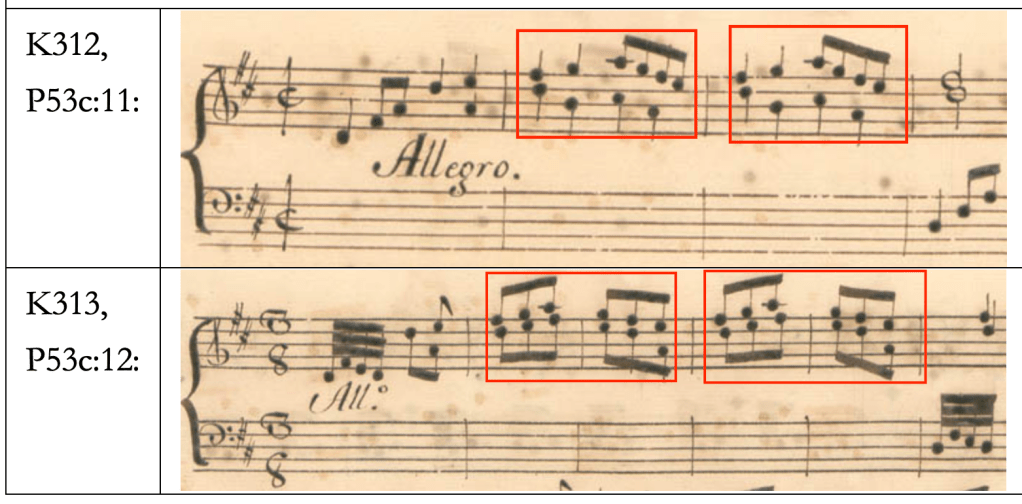
🐈⬛ Companions D: c AllegroD-e3 • 3/8 Non presto mà a tempo di ballo1A-d3
Sources: M3:63•59/P55:6•1 → V55:18•13/Li:59•54/Ca1:28•23/~•WQ15114:15/~•Bo1:1/~•Bo2:10/~•Ay:22|K435•430.
First theme of K435 → first themes of K430. Re ámbito past d3 see K356•357. – Dances always follow technically or musically intricate first companions in duple time (cf. K470•471, others). In M and P K430 is a singleton, K434-436 is a false tryptich:
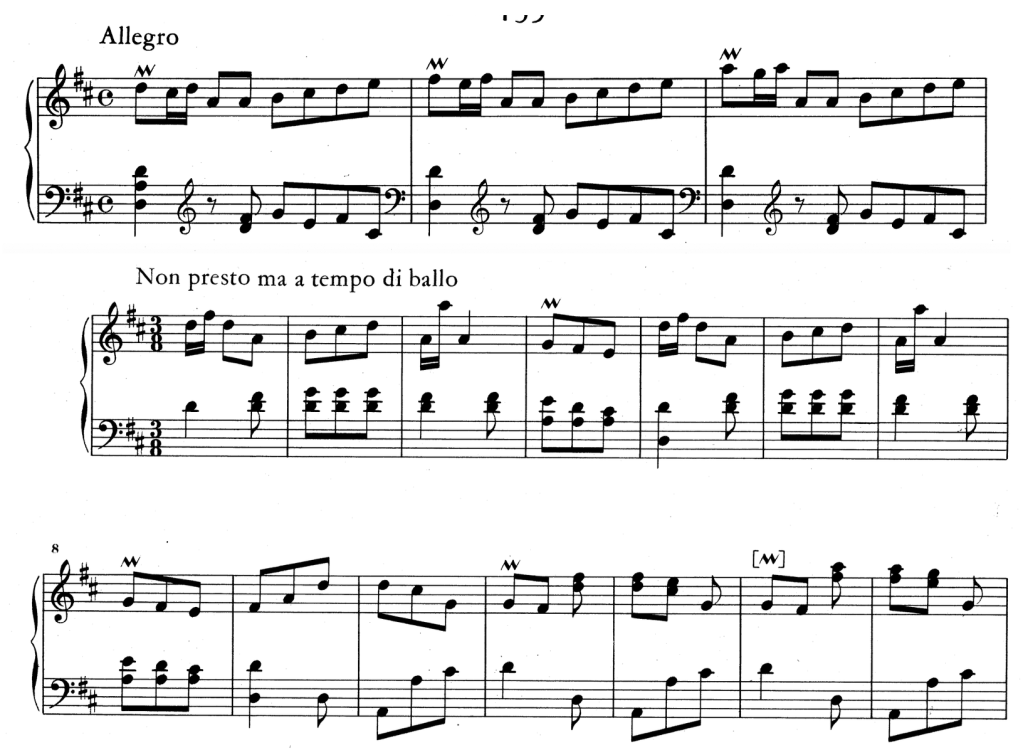
🐈⬛ Companions d|D: 3/4 Andante1G-d3 • 3/8 Allegro1A-d3
Sources: M3:62•64/Z2:27Scarlati•~/P55:5•7 → V55:17•19/Ay:25•~/Ca1:27•~|K434•436.
Easter? In M and P the companions are separated by K435 which belongs to K430. K434 core theme throughout are rhythmically displaced chromatic “sighs” mostly in form of the harmonic minor sevenths (cf. K30) c♯-d, b♮-c, g♯-a, here mm. 30 ff. which depict the “errant” of sorrowful soul:
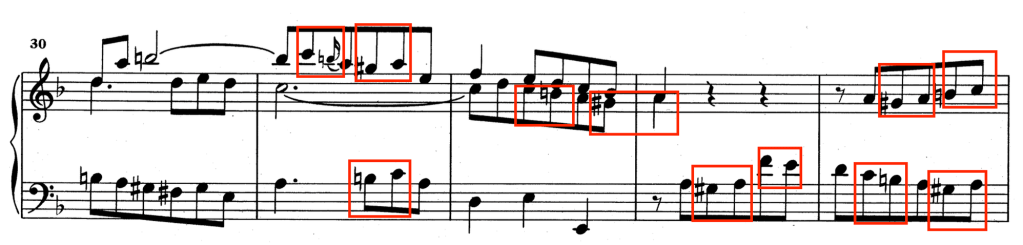
K436 begins with festive “restored intervals”, unisons, major thirds, major sixths, perfect fifths, octaves. The ascent in D and descent in A all comprise twelve eighths; the emphasis on 12 is maintained throughout the piece:
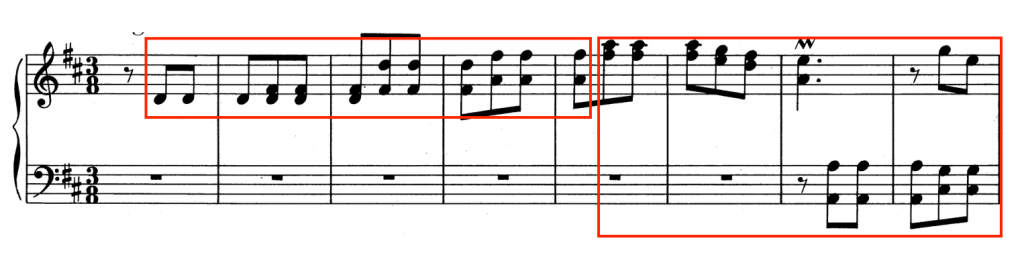
n K436 the chromatic sighs of the prima are turned into twelve consecutive jubilant skips in twelve eighths or 24 16ths for both hands across the keyboard, here major 7ths d♯ in the key of E, g♯ in the key of A, for example:
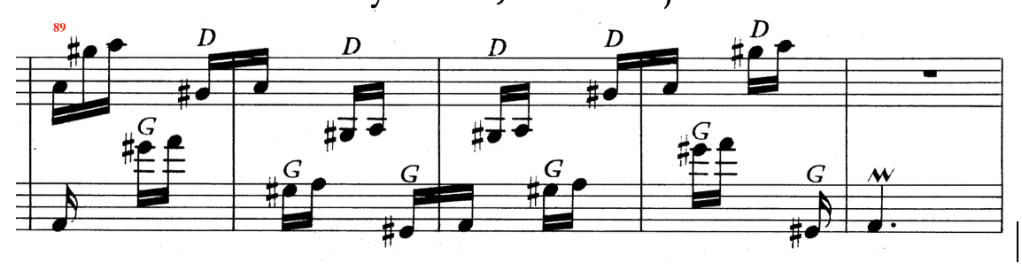
As K436 began, the jubilant sections also conclude with twelve eighths at the end of K436:
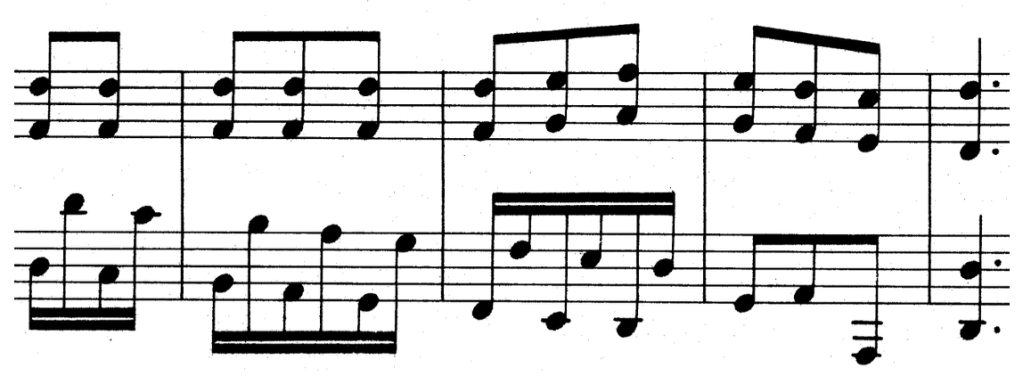
The number twelve is so prevalent in K436 that it must have an allegorical meaning. The preceding lament speaks for a different type of liturgical companions, so does the key of D.
🐈⬛ Companions D|d-D: ¢ Allegro1A-g3 • 6/8 Allegrissimo1A-d3
Sources: M2:39•40/P55:22•23 → V55:26•27/Ca2:35•36|K443•444.
Notes: Corpus Christi; possibly followed by flamenco. Broken sixths from K443 serve as first theme of K444; proportions 4/4 : 6/8. K444 alternates major/minor:
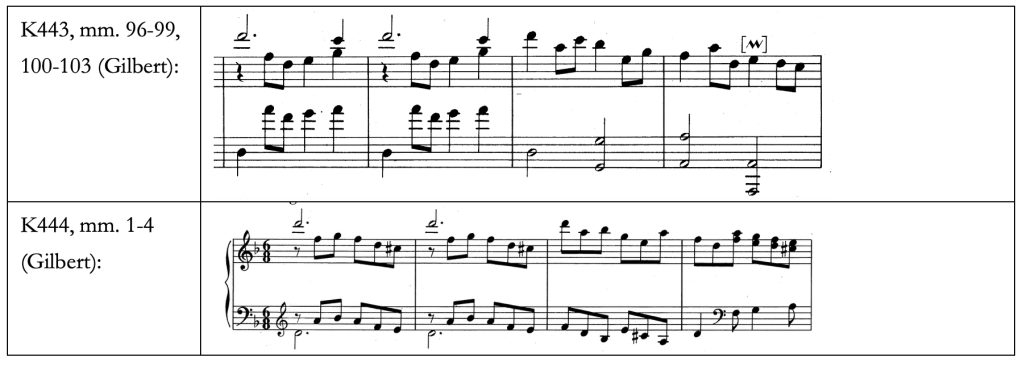
E♭.
Original companions: K123•68, K192•193, K252•253 (Easter), K306•307, K370•371, K474•475, K507•508.
🐈⬛ Companions E♭: ¢ AllegroEb-d3 • 3/8 AllegroF-c3, x
Sources: ~•Z2:10/Z3:46•38/Al:15•40Allegro/~•V42:30—/V49:27•~/P52b:21•~/~•[B5 → ?]PdC3:6|K123•68.
Notes: K68: Z2 and Al have original hand crossing indications mm. 10 et sim., here from Z2:
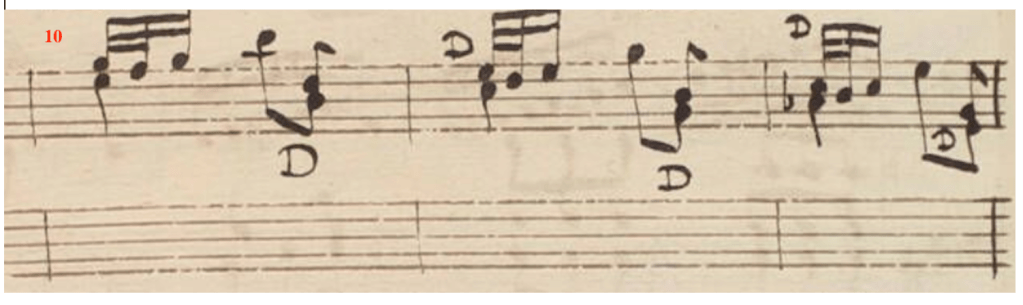
According to Fadini, who only collated V42 and Al (I, 1986, p. 198), Al has ten “D” over the third eighth in mm. 10, 12, 37, 39, 71, 73, 97, 100, 103, 105. The indications must be authentic because neither Albero nor the scribe of Z2 had a reason to randomly invent Italian handcrossing abbreviations. Text of Z3:38 unclear. Since the handcrossings were omitted in the “control source” V42:30 Fadini relegated them to the commentary section. Unclear how accurate Boivin’s print was. Sheveloff 1985, p. 423, facsimiled mm. 1-88 of K68 from a ms. owned by a collector in NJ who wanted to remain anonymous. The writing and staving of the facsimile identify it as being part of the Pièces de Clavecin, with its characteristic title “Sonata per il Cembalo del Signor Dominico Scarlatty” (cf. other sonatas from PdC). Since PdC lacks the bass E♭ in the first measure and uses mordents, often dropped them, it may have been copied from B5; sonatas PdC demonstrably did not copy from print are K125, 179, 180 (see above). – No “Allegro in Z2; V42:30 noted the absence of a tempo indication by “·⁄⁄·”. – Complimentary beginnings descending SA → ascending BT and intervals; […].
🐈⬛ Companions E♭: ¢ AllegroEb-d3 • 3/8 Allegro1B-d3
Sources: M5:67•~/Z4:33•34/P52c:16•17 → V52b:21•22|K192•193.
Notes: K192, m. 6 textual deterioration from P to V: when copying from P, V omitted appoggiatura-tie and left hand:
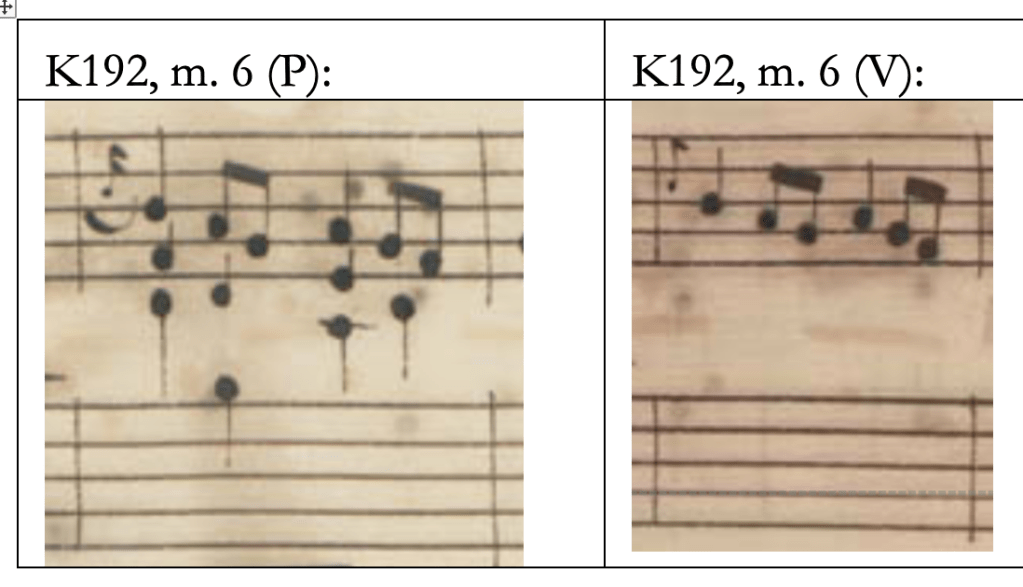
María Bárbara corrected a similar omission in K190; since she did not do so in K192, she likely did not play it.
K193: without tempo in V; mm. 51, 53, 59, 61 incorrect rhythmic values in V (correct in M, P, Z); m. 70 (which repeats m. 67) wrong bass-line in V (correct in M, P, Z):
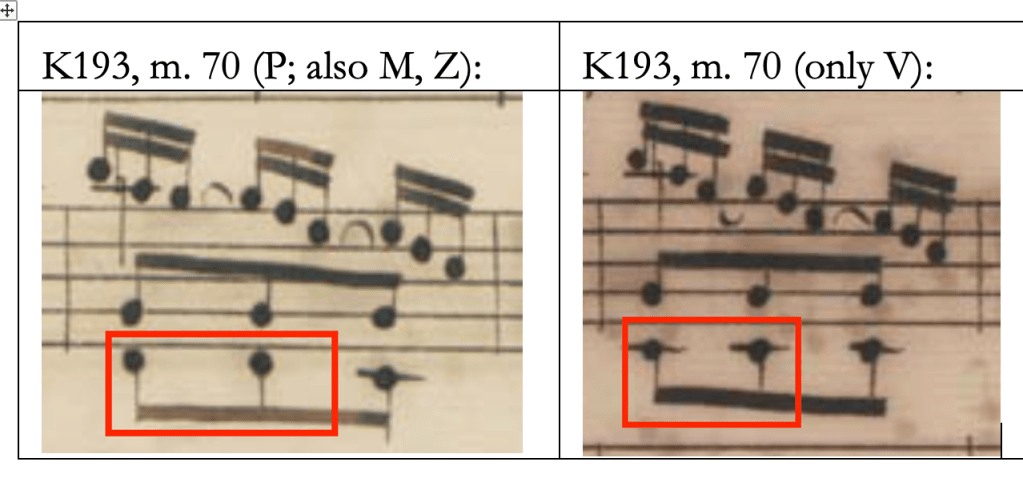
E/e:
Original companions: K198•98, K134•136, K203•135, K162•163 (Easter), K206•207, K232•233, K263•264 (Easter), K291•292, K380•381 (Corpus Christi?), K394•395 (saudade), K402•403 (saudade), K495•496, K530•531.
🐈⬛ Companions E: 3/4 Andante commodo1B-g3 • 3/8 Allegro1B-e3
Sources: M4:47Scarlatti•48/NH:15•16/P54b:23•24 → V54b:23•24|K380•381.
Notes: K380 Corpus Christi prima. Harmonically and melodically the highest note in m. 55 must be a g♮3 (Gilbert added a ♮) and not a g♯3. Scarlatti did not notate a ♮ because the ceiling of his 61-key transposition harpsichord (see K356•357) in this pair sonata was a g3. Why cancel a note that the instrument did not have?
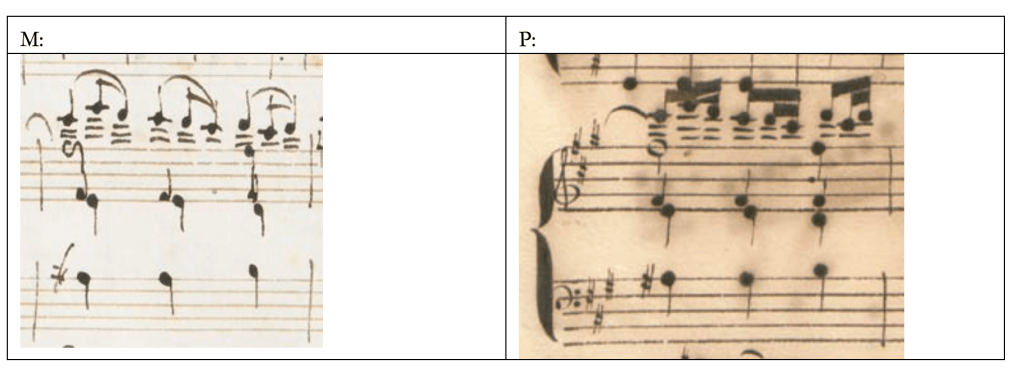
To replace g♮3 with an e♮3 distorts the melodic line. It was Wanda Landowska created the epithet ‘Cortège’ in 1934 and had it printed on the label of her recording. K380 – as Landowska intuitively grasped it – depicts a procession.
F/f.
Some original companions: 150•151, K106•276, K238•239, K364•387, K462•446, K466•467, K468•469, K540•541, K542•543, K554•555.
🐈⬛ Companions F: 3/8 AllegroC-d3 • 3/8 Andante/AllegroC-c3
(Sources: P51:3•4Andante allegro/M4:24Scarlatti•25All.o/Z4:18•60Andante allegro/V52a:3•4|K150•151).
One of only three companions with the same time signature. K151 “Andante allegro” occurs nowhere else in Scarlatti, he never modified one tempo with the other. It could be a conflation of two misread, probably abbreviated tempi. M has “All.o” only, although K151 appears too “gallant” for it. Both pieces depict imaginary dancers, they are theatrical music. K150 enters acrobatically, it is rhythmically intricate; in K151 a graceful dancer pirouettes onto the stage, the rhythm is less complicated:
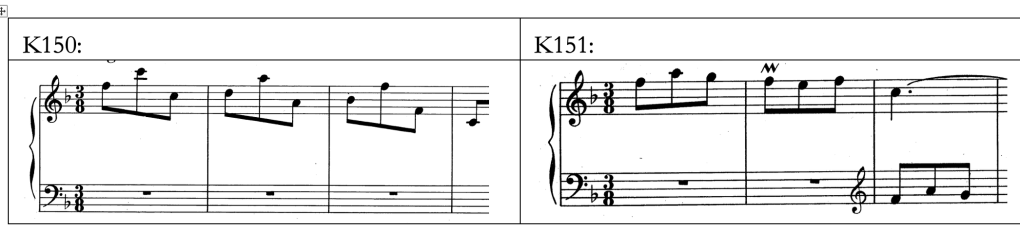
Both companions thematize minor seconds, “crunched” and acerbic (K150 m. 5) or consecutive (K150 m. 5, 26-29, K151 mm. 21-23). K151 (mm. 21-23) has an unmistakable “gallant” feeling. Both also thematize the coulé (K151 mm. 14-16) albeit with different accent and effect (K150 second beat, K151 first beat):
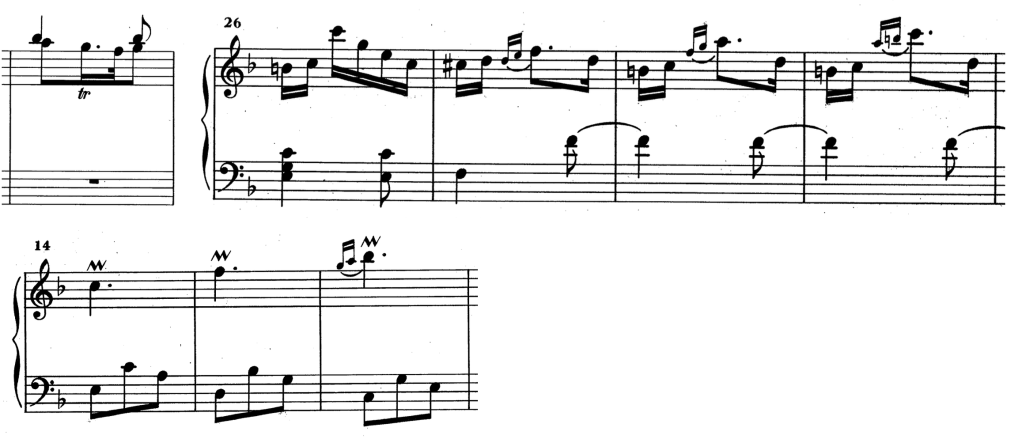
K151 mm. 87 ff. minor seconds thematized:
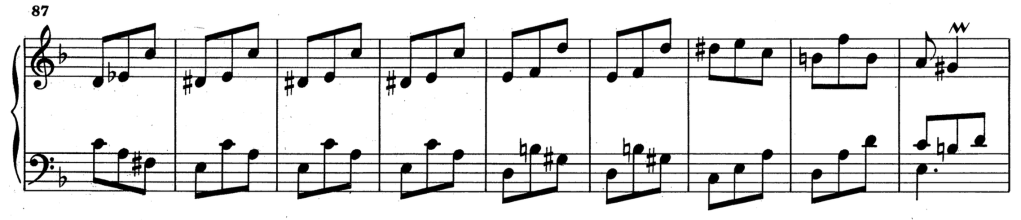
K151 depicts a stylized farewell, with the bass “departing” from f to a (cf. K457 mm. 66 ff.):
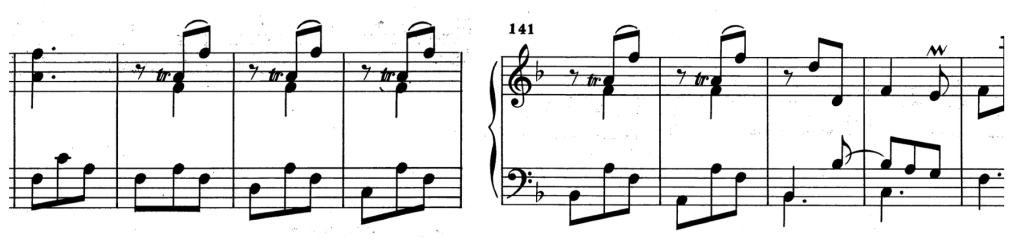
🐈⬛ Companions F: ¢ AllegroC-d3 • 3/8 AllegroC-d3
Sources: M5:43•11/P52b:15•53b:3 → ~•V53c:11/V49:10•~/Al:3•~/B4:7a•~|K106•276.
Notes: K106 first theme mm. 1-4 → K276 mm. 1-2; K106 second theme descending appoggiature third and fourth beat g♯2-a2 | f♯2-g2 | e-f | e through F-C → K276 descending appoggiature mm. 13-20 shifted to first and second beat, which become a reiterated dominant theme; second halves both A♭/D♭, e♭, etc.. Scarlatti often changes key signatures in one companion, and continues adjusting accidentals in the other:
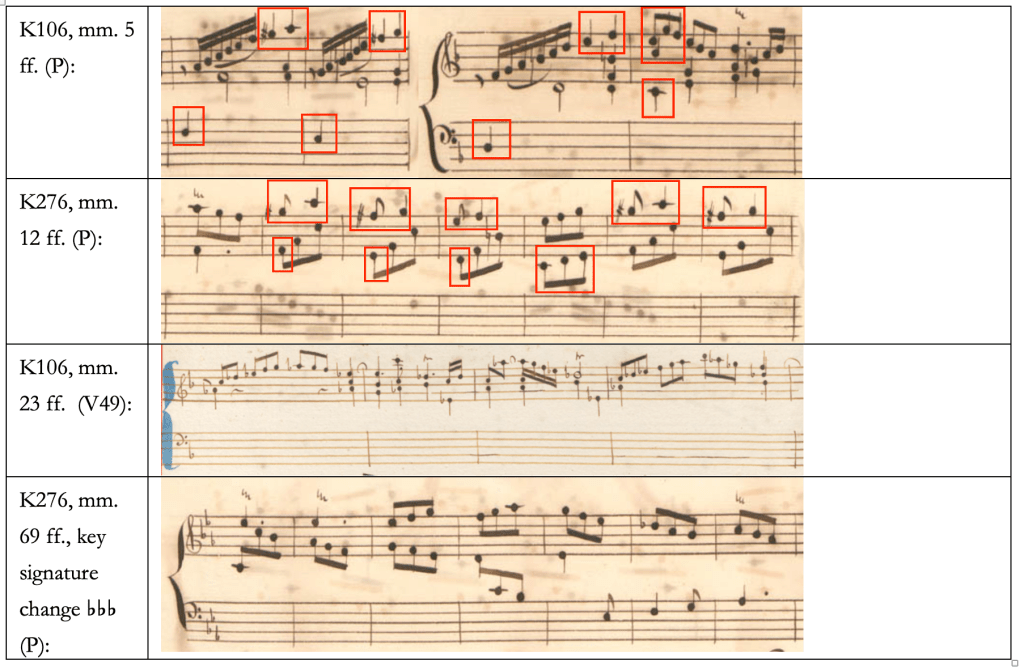
F♯/f♯:
Original companions: K318•319, K447•448.
🐈⬛ Companions F♯: ¢ AndanteF♯-c♯3 • 6/8 AllegroF♯-d3.
Sources: M3:33And:e Allegro•34/P53c:17•18→ V53d:23•24/~•Ay:10|K318•319.
First themes one voice entering from complimentary opposite directions, frequently employed by Scarlatti: K318 mm. 1-4 descending scale SAT a♯2-f♯1 with imitation, two eighths + one quarter → K319 ascending scale TAS f♯1– a♯2 with imitation mm. 1-5, continuous eighths. The scales likely served as first theme to intune the ear to the temperament of F♯. M “Andante Allegro” common conflation of tempi of both companions, also found in other sonatas in other sources:
A few notes on some of the manuscripts and prints.
Essercizi.
Scarlatti could not have closely overseen the details and the “packaging” of the print of the Essercizi: vide the missing hand disposition indications in K1 and the missing B♮, and also in K2. It is also likely that the title “Essercizi” was an editorial approximation of the English “Lessons” (vide Burney’s use of the term): the word occurs nowhere else in the sources, and even in print the individual “Essercizi” are never called “Esercizio” but always “Sonata”. However, Scarlatti must have arranged at least the contents of the collection, because the sonatas begin and end with a hommage to their dedicatee, the Rei-Sol João V: E:1 in d and E:2 in G | E:29 in D and E:30 in g. On April 21, 1738 João V had initiated Scarlatti to the Order of Santiago, the event commemorated in Velasco’s painting. The tonalities are interwoven, d-G | D-g, the Re-Sol remains unchanged. The duple-triple time signatures are also related, C-3/8 | C-6/8, as they often are in sets of two companion-sonatas (see above). Musically, many esercizi are an unmistakable hommage to Rameau, as are numerous other sonatas overall. Likely both of them met in 1724 or 1725 in Paris, and Rameau may even have connected Scarlatti with the publishing house Boivin.
Essercizi 1 d: c AllegroD-c2
Souces: CF13:23Allo vivo/B2:13 → B3:7/E:1 → RC:36|K1.
In the preface to the Essercizi Scarlatti promised to indicate hand dispositions:

“Vivi felice” may have been a rhetorical topos; it also closes the ad lectorem of the libretto by Giulio Convo to his opera Il Giustino from 1703 (Boyd 1986, p. 37), to which Scarlatti provided most of the music. – In ms. Cambridge-Fitzwilliam 13:23 a distinct “M” survives before the d1 of m. 1. This lone vestige suggests that all of K1 once had hand indications which were omitted in the LeClerc and Fortier prints, either because they could not be fitted on the printed page (see m.7), or because the compositors did not understand them. Originally the beginning of K1 likely looked like this (superimposed on Boivin Choisies, who would have printed D and G):
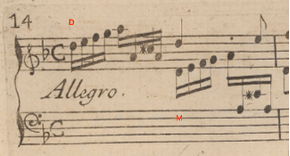
While the hand dispositions in m. 1 may appear self-evident, though Scaraltti repeatedly indicated them at the octave, the sequence mm. 7 ff. requires them. Assuming the left hand was supposed to play the 8ths, the right hand the 16ths, the hand dispositions may have looke like as follows, here superimposed on Boivin/LeClerc:
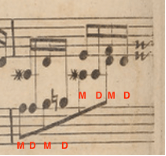
Typographical confusion over the hand dispositions may even explain the missing B♮-eighth. CF also has trills not only on the a2 mm. 8-9, but also on the c2 of the parallel m. 18, which, in conjunction with the lone hand disposition, suggest their authenticity. While CF erroneously shifted mm. 18 and 19 into eachother, CF had no reason to invent the Italian “M” unless it is what he saw in the text he copied. – All prints omitted the B♮-eighth note in m. 7; Boivin inserted it before the B♮-16th, which is why the B-eighth does not have a ♮. – All trills should be begun on the main note, otherwise the upper note into which they resolve loses its melodic effect (see K99).
Essercizi 2, G: 3/8 — D-a2, Cary (Ca1:13—12v-14r).
Cary‘s emendations to K2 have elicited the “conclusion that these were the results of the composer’s retouching, not an outside intervention. As it seems, each time Scarlatti had a chance to write down one of his sonatas, he provided a different copy, always rethinking the previous one, sometimes slightly, sometime in greater depth.” (Ricordi, vol. 10, 2020, p. XLIX). This suggests that Scarlatti intentionally destroyed his own polyphony. The voice leading and the two consecutive left-hand eighth rests on the second and third beats of mm. 14, 16 ff. make it clear that the eighth note f♯1 ff. of the tenor concludes the melodic line that begins in the soprano, initially with the eighths g2-f♯2-e2 (mm. 13 ff.), then the alto-soprano-alto leaps d2-a2-c♯2 (mm. 19 ff.). Both Boivin and Essercizi printed the eighth rests in the left hand, in current prints they are omitted. The beginning of K2 as first printed in Boivin Choisies (1737):
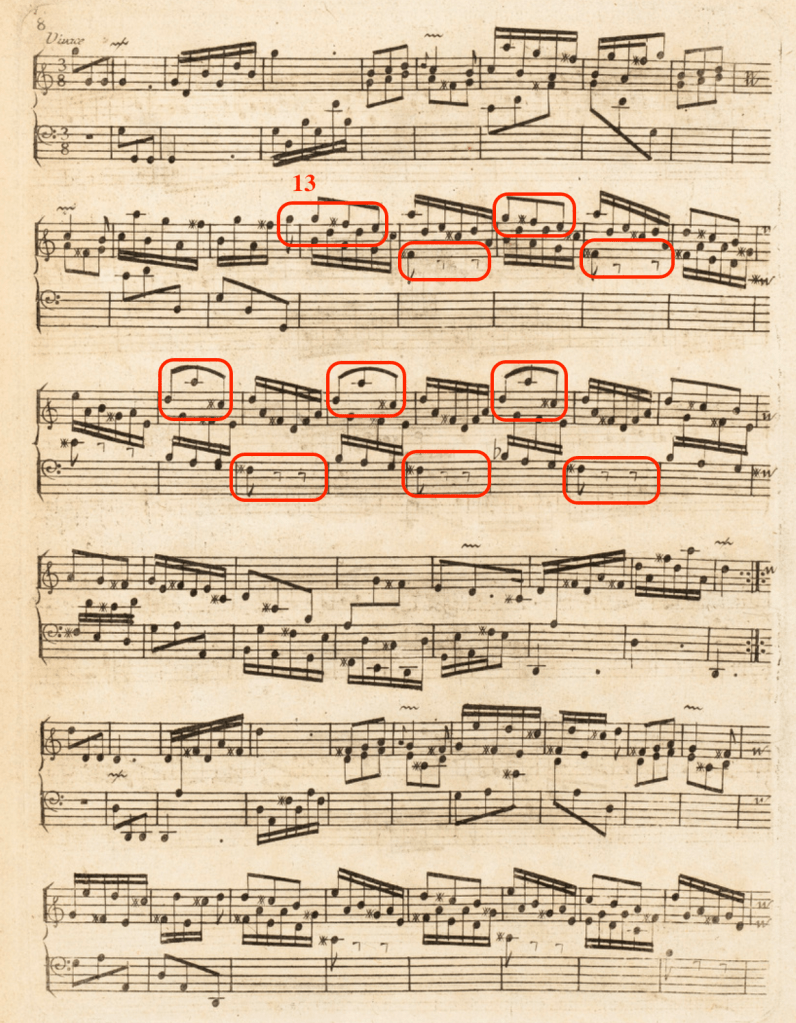
It is possible that the eighths of the top and bottom voices were originally excecuted by hand-crossings, but no corresponding indications survive. The composer-scribe of Cary changed mm. 17-20 from major to minor which is a catchy emendation but unfounded since it does not align with the second half. Apparently Cary misconstrued the melodic jump to the eighth note f♯ in the bass, and he continued with the alto instead. He concluded the melody g2-f♯2-e2 of the S-A with an a2 instead of Scarlatti’s f♯. Accordingly he misread the bass eighth f♯ as an incorrect and incomplete conclusion of the descending broken 16ths of the left hand and replaced Scarlatti’s f♯-eighth note with a pair of dotted quarter thirds, f[♯]-d ff., the top note apparently lowered to avoid interference with the right hand:
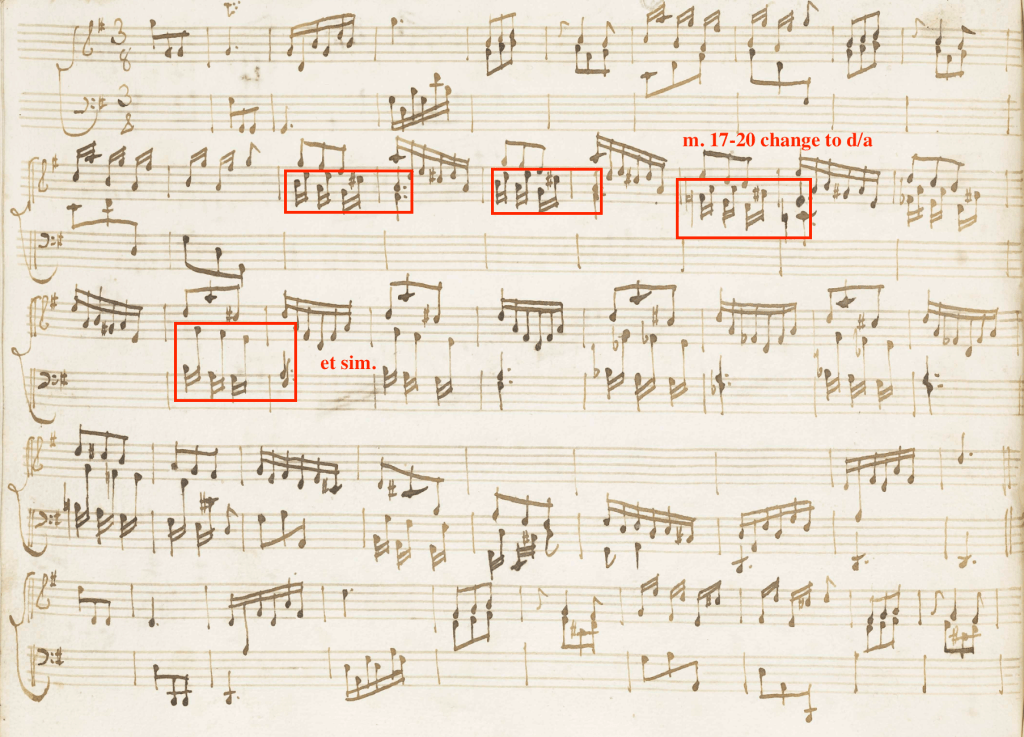
However, those thirds tell us very much about Cary the composer: for him – to continue on to mm. 21 ff. – the c♯2 of mm. 21, 23, 25 et sim. resolved into the following d2, not into Scarlatti’s f♯ in the bass. Scarlatti wrote: d2-a2-c♯2-f♯. Cary wrote: d2-a2-c♯2-d2. The piece can be played that way which imbues it with more of a stark austerity, but the concept is different. For simplicity’s sake: it sounds as if Soler had rewritten Scarlatti. Cary‘s thirds clearly go against Scarlatti’s single voice-skips from soprano to bass, as the single voice and the eighth rests in Boivin prove. – Cary changed mm. 17-20 from major to minor analogous to mm. 50-53; however in the second half the four mm. are part of an different harmonic structure. In this case first half and second half do not mirror eachother, which Cary misunderstood:

Within the context of the double-sharp question (see notation above) Soler mentioned having copied Scarlatti sonatas (Llave, p. 115). […] Re the two references to King (not Prince) Fernando which the scribe of Cary added above K487 and 480 see those sonatas […].
Essercizi 30, g: 6/8. The theme of the fugue has never been properly explained; the f♯ is certainly not a “raised fourth” (Ricordi 2020). The fugue’s theme is derived from combining consecutively the tail-ends of the harmonic minor scales of the tonic g and its dominant d, hence its exotic flavor: g (tonic), b♭ (III of g), e♭ (VI of g), f♯ (VII of harmonic g) | b♭ (VI of d), c♯ (VII of harmonic d), d (dominant of g); the theme’s reiteration in the key of d progresses the same way: d (tonic), f (III of d), b♭ (VI of d), c♯ (VII of harmonic d) | f (VI of a), g♯ (VII of harmonic a), a (dominant of d):

The harmonic minor 7th informs much of K30; see also K434.
Pièces de Clavecin.
The manuscript survives in three sections:
PdC1 (BnF RES-2671) [https://gallica.bnf.fr/ark:/12148/btv1b10509323f.r=pi%C3%A8ces%20de%20clavecin?rk=21459;2].
Title derived from spine and title page: “Pièces de Clavecin.” Later ff. 1-75, 89. The handwriting and paper of PdC and Ms 17072 as well as the title on the back of Ms 17072, “Pièces de Clavecin”, indicate that they belong together; the dates of the compositions copied indicate that ms 17072 is the second part. Pencilled on top of [1v] in PdC1 by a descendant of F. Couperin: „Il y a dans ce receuil quelques pièces de Couperin, mais l’ensemble est loin d’être constitué par cet auteur. On le retire donc du rayon où il a été classé à tort parmi les œuvres de Couperin pour le placer aux receuils. Couperin”. Since a descendant of François was called upon or felt necessary to ascertain the contents, the writer of PdC may have been Marguerite-Antoinette Couperin (1705–1778), who was “ordinaire de la musique de la chambre du roi pour le clavecin” from 1730 to 1741, and also taught the daughters of Louis XV. – Contains pieces by F. Couperin, Chambonnières („Les Baricades”), Marchand; 29v-30r Couperin’s “La Babet” under the title “La Blonde, et la Brune – de Couperin”; Rameau („Triolets”, „Sauvages”). 61v-62r: Pseudo-Scarlatti K95, which was copied from Bovin 37b2:16 and was given the new, centered, and later semi-obliterated title: „La [C/L]o[…]tique”. A later hand added on the left of the title: “Pièce pour clavecin de D. Scarlatti”. This correction was based on Boivin or Czerny:

PdC2 (BnF D-11608) [https://gallica.bnf.fr/ark:/12148/btv1b10509646r?rk=214593;2], also [https://gallica.bnf.fr/ark:/12148/btv1b10509646r.r=h%C3%A4ndel%20rinaldo?rk=321890;0].
K138, 125, 180, 179, 182. Bibliothèque du Conservatoire de Musique, ms. 17072 (M. i. [c.?] I. 64.). Later blue oval stamp „CONSERVATOIR DE MUSIQUE | BIBLIOTHÈQUE”. p. 1centered, hand-written nr. 17072. Red stamp underneath: „BIBLIOTHÈQUE | DE L’UNIVERSITÉ | DE FRANCE”. Some pieces apparently copied from prints, others not, like K125. p. 2 top left marginal comment: „Vo far guerra / Sung by Sign.ra Pilotti in the opera of Rinaldo. „Rinaldo” was performed in London, intermittently, from 1711–1731. Elisabeta Pilotti-Schiavanetti (~1680–1742) sang at the „Queen’s Theatre” from 1710–1717; she sang „Armida” in the premiere of Händel’s „Rinaldo” on 24 February 1711. | „Armida” by Händel (2-9), Martiny [sic] (10) | pp. 12-13: „Sonata per cimbalo del Signor Scarlati” (K138); not in Vernadez and Haffner I; the piece attributed to DS in Haffner II:5 is in C is not by DS (Sheveloff, 144-145). | pp. 14-15: „Sonata per cimbalo del Sigr. Scarlati” (K125; printed Vernadez and Haffner I:1; tempo in Haffner “Vivace” not “Vivo”; the first two g have trill signs above them (not mentioned for Haffner in Fadini 2, p. 204), which corresponds to the beginning of the second half, and there is no trill sign in m. 26, which also corresponds to the second half). | pp. 16-17: „Sonata per cimbalo del Sigr. D. Domenico Scarlati” (K180; printed by Vernadez); separate notation which puts all the notes of the progression mm. 42-58 in the upper staff, m. 57 has eight notes in the upper staff; ends with “Da capo”) | pp. 18-19: „Sonata per cimbalo del Signor Scarlati” (K179; printed Haffner I:6); separated notation; the final measure of the first half is bracketed between repeat signs; at the end “D. C.”) | pp. 20-21: „Sonata per cimbalo del Sigr. Scarlati” (K182; printed Haffner I:5 but PdC3/Vernadez does not share its misreadings in mm. 2, 30, 31 profuse hand dispositions from the beginning, “M” mm. 1, 2, 3, 6, 7, 8, and more throughout the piece; correct third beat mm. 2 and 7, a1-d2 instead of h1-d2; at the end “D. C”). | Geminiany “Gratieusement” and “Tendrement”, arranged for harpsichord Pièces de clavecin I, nos. 6-7 (London, 1743), from his Violin Sonata in A, op. 4, no. 5 (p. 22) | Rameau „premier, second double des tricotes” (1727; pp. 24-27), untitled (pp. 28-29) | Royer (Marche des Schytes [sic], 1746; pp. 30-35) | Mondonville, Alberti, Ferdinando Pellegrini (to p. 83); second hand […]; first hand: Galuppi, Sonata D (pp. 90-91) | Alberti, Sonata F (p. 92). | F. Couperin: La voluptueuse (p. 93), Soeur Monique (1722); 94-95 crossed out, then 96-97). P. 94-95 were crossed out because a third part of this recueil found its way into the hands of a person in New Jersey, who, in 1983, under the wish of anonymity, had fotocopied for Sheveloff “all pieces in this source”, of which Sheveloff facsimilied the first part of K68 on p. 94, “its final phrases spilling over onto the first systems of page 95” (Sheveloff 1985, p. 424). Sheveloff acknowledged the musical superiority of PdC over V42, in particular with its lack of the bass e♭ in the first measure, its omission throwing “the weight on to the top note of each ascending triad” (Sheveloff 1985, p. 426), where it should be. – Since the Scarlatti pieces occur early on in the ms., and the scribe refers to a performance by Pilotti of „Armida”, this may constitute one of the earliest mss. of Scarlatti sonatas, perhaps before 1738, since he is called “Signor”. K180 and K125 appear in Vernadez’ Paris print in the order K180•125, but without trills K125 m. 1. „Armida” appears to be a keyboardist’s score, with more elaborate harpsichord passages than in current performances. Though the ink of „Armida” is more faded, the handwriting of the „Pilotti” is the same as that of the Scarlatti sonatas, despite „cembalo”/„cimbalo”; also same F-key.
PdC3: Contains K68. In 1985 owned by a New Jersey Collector, who wanted to remain anonymous, but let Sheveloff facsimile part of K68 (Sheveloff 1985, 423). Part of the PdC-corpus; see above.
Alexandre L’Augier
During the first week of September 1772 the musicological traveller Dr. Charles Burney (1726–1814) made the acquaintance of the imperial physician Dr. Alexandre-Louis L’Augier (1719-1774) in Vienna (also spelled Laugier). Burney was to document L’Augier’s remarks about Scarlatti twice, first in the „Present State of Music in Germany, the Netherlands, and United Provinces” (1773, revised 1775), and, near the end of his life, in the two biographical sketches „L’Augier” and „Scarlatti, Domenico” written for Rees’ Cyclopædia which appeared in instalments from 1802 to 1820. Burney was a main contributor to the Cyclopædia on musical matters. Burney did not document Farinelli’s remarks about Scarlatti till 1796, in his Memoirs of Metastasio (Metastasio II, 206), and, in slightly altered fashion, a second time in Rees’ Cyclopædia. In his Musical Tour Burney only states that Farinelli „furnished me with all the particulars concerning Domenico Scarlatti, which I desired, and dictated to me very obligingly, while I entered them in my pocket-book.” (Burney I, 156).
L’Augier impressed Burney in particular with his ethnomusical sensitivities:
“M. L’Augier, in despight of his uncommon corpulency, possesses a most active and cultivated mind. His house is the rendezvous of the first people of Vienna, both for rank and genius; and his conversation is as entertaining, as his knowledge is extensive and profound. Among his other acquirements he has arrived at great skill in music, has a most refined and distinguishing taste, and has heard national melody in all parts of the world with philosophical ears. […] M. L’Augier sung to me several fragments of Bohemian, Spanish, Portuguese, and Turkish music, in which the peculiar expression depended on the contre tems, or breach of strict time; beat the measure, and keep it as exactly as is necessary, in more refined and modern music, and it wholly loses its effect. […] I found that M. L’Augier had himself been a good harpsichord player: he now reads and judges of music very accurately.” (Burney II, 86, 87.)
L’Augier was acquainted with many of the poets and musicians living in Vienna, as Metastasio, Hasse, Gluck, Wagenseil, and Haydn. His visitor Burney was accorded the pleasure of having some of Haydn’s string quartets played „with the utmost precision and perfection” the following day. (Burney II, p. 88) Five years earlier, when in September and October of 1767 the Mozart family had performed in Vienna, L’Augier had tried to shield them from the smallpox epidemic by giving them shelter at his residence, and advised them to leave the city as soon as possible. (Jenkins, 97)
One of Burney’s musical passions was shared by L’Augier: the music of Domenico Scarlatti. L’Augier supposedly had met Scarlatti in person around 1755 in Madrid. Since some of L’Augier’s assertions about Scarlatti appear to be embellished, if not projections of himself onto Scarlatti, doubt must be raised about anything he said about Scarlatti:
“Scarlatti frequently told M. L’Augier, that he was sensible he had broke through all the rules of composition in his lessons; but asked if his deviations from these rules offended the ear ? and, upon being answered in the negative, he said, that he thought there was scarce any other rule, worth the attention of a man of genius, than of not displeasing the only sense of which music is the object.”
When Burney directed his conversation to the music of Domenico Scarlatti, L’Augier dropped tidbits of conversations with Scarlatti and Farinelli, and he presented supposed musical proof of his meeting with Scarlatti that has remained a musical enigma until today:
“In Spain, he was intimately acquainted with Domenico Scarlatti, who, at seventy-three, composed for him a great number of harpsichord lessons which he now possesses, and of which he favoured me with copies. The book in which they are transcribed, contains forty-two pieces, among which are several slow movements; and of all these, I, who have been a collector of Scarlatti’s compositions all my life, had never seen more than three or four. They were composed in 1756, when Scarlatti was too fat to cross his hands as he used to do, so that these are not so difficult, as his more juvenile works, which were made for his scholar and patroness, the late Queen of Spain, when Princess of Asturias.” (Burney II, 86-87)
The mistake about Scarlatti’s age is irrelevant to the veracity of L’Augier’s account, “fat” is a projection (vide Metastasio’s letter to Farinelli 17560212, Metastasio II, 164) but the adverbs in „intimately acquainted” and „frequently told” raise doubts. The assertion that Scarlatti „composed for him a great number of harpsichord lessons”, is, if not a linguistic misunderstanding by Burney, a falsehood by L’Augier. It is not known in what language(s) L’Augier and Burney communicated. When in August 1770 Burney had been introduced to the Bavarian Elector Maximilian III Joseph and his sister, Margravine Maria Anna of Bavaria at Nymphenburg, a brief exchange between the three with regard to the language to be used implies that Burney’s knowledge of German was insufficient, and Maria Anna offered herself as interpreter for an English-German exchange. The Elector found this mode of communication too cumbersome, and since Burney „spoke French and Italian”, Maximilian began the conversation in French (Burney II, 49-50). Thus it can be assumed that French, perhaps Italian, was the language of conversation between L’Augier and Burney. “composed” cannot be misunderstood in either of these. […]
Vienna Manuscripts.
Sonatas copied from Münster (as Kirkpatrick and Sheveloff already pointed out) into Wien A-F have no source value except for two which were copied from M5 into WA but no longer exist in M5, i. e. K154 (WA:15), 313 (WA:114); K112 (WA:16) with its reduced compass may have been copied from B6 of which only one copy came to light in 2017. Wien G remains unclear: it contains some fugues not even by Scarlatti, but surprises with K45, which could have only been copied from V42. The text of K45 is not correct in either version. – A textual comparision of the others shows: 15112 and 15126: copied from RC | 15113: copied from Witvogel | 11432: copied from 15112, 15114, 15115, 15116, 15118, 15126, Haffner | 15117 copied from RC and […] | 15119 copied from WG:40-44, Johnson 1752:8, Johnson 1754:1, 3, 5, 6 | 15120 copied from Johnson 1754 (nos. 4, 3, 5). These have no source value either.
The only four WQ fascicles with possible source value are WQ15114, 15115, 15116, 15118 since they are copies of the 42 pieces shown by L’Augier to Burney in September 1772. Dr. Alexandre-Louis L’Augier (1719–1774) was physician to the imperial court in Vienna, who in October of 1767 would save Mozart’s family from a smallpox epidemic in Vienna, and remained influential in Mozart’s early life. – The Christmas pastorale K446 appears twice, as WQ15114:12 and WQ15118:8, which gives a misleading total of 43 (WQ15118:8 lacks a note on the third beat in m. 33, which is present in WQ15114:12). Thirteen items in WQ15116 retain their original L’Augier-numbers: 24, 28, 29, 30, 31, 32, 34, 36, 37, 38, 39, 40, 42. According to Burney, L’Augier had commissioned sonatas with a national flavour, without handcrossings, and of recent vintage, i. e. not available in print. In some “national” pieces like the tarantella K54 the handcrossings were omitted. Mss. WQ15114-15118 are unified by their individual ascriptions „al Barone DuBeine” = Joseph du Beine-Malchamps (1717-1803) who received the volumes through L’Augier. WQ15117 does not belong to the “42”, since all but one of its twenty-two pieces are derived from printed editions. The four DuBeine-mss. WQ15114, 15115, 15116, 15118 contain music which could not have been copied from any prints available at the time of Burney’s visit with L’Augier. The exceptions are K96 (WQ15116:8) and K112 (WQ15115:4) which had been printed by Boivin, K112 also in Owen 5 (1771, Sheveloff, p. 146), K116 in c (WQ15116:7), which had been printed by Johnson in 1752 (Sheveloff, p. 141), K115 in c (WQ15115:6) also in Owen 5 (Sheveloff, p. 147), K127 (WQ15116:11) had been printed in 1754 as no. 3 in Haffner’s first „Raccolta”. If we discount Burney’s familiarity with the Owen print because he was travelling in Europe at the time of its publication, as well as his familiarity with B6 of which a copy only came to light in 2017, the „three or four” compositions from L’Augier’s manuscript which Burney mentioned as already being familiar with were counted correctly, namely K112, K116 and K127. WQ15116 retained 13 numberings from L’Augier’s 42, with year dates correlated from Parma („1765” before no. 42 = „1756”; „1752” = „1753”):
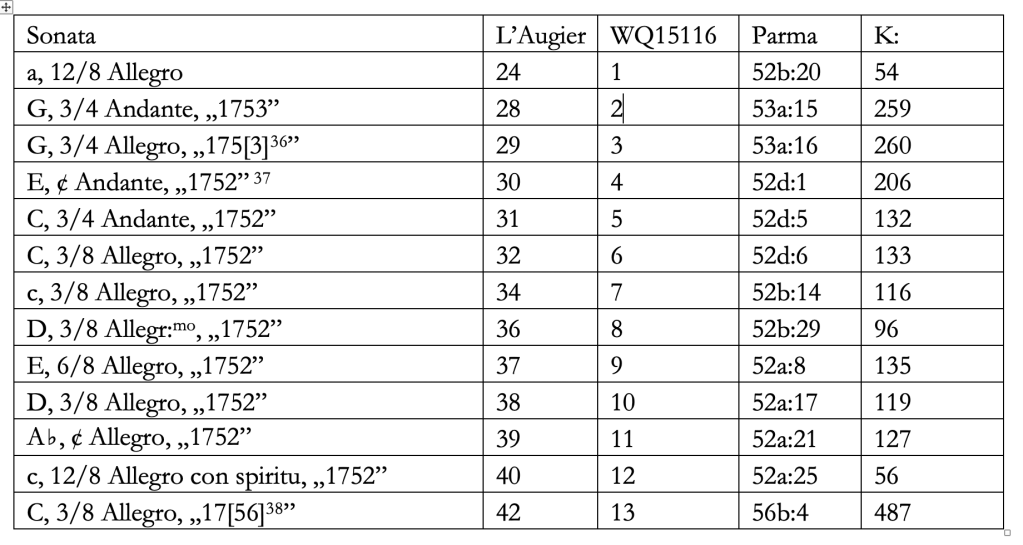
Copies of all the sonatas L’Augier showed to Burney in 1772 are contained in WQ15114 (16), WQ15115 (6), WQ15116 (13), WQ15118 (7, minus the double K446 already contained in WQ15114) = 42. Since a textual comparison shows that L’Augier’s 42 were copied from M, only three sonatas have a primary source value because they are no longer extant in M: K56 (WQ15116:12), K96 (WQ15116:8), K112 (WQ15115:4).
BL ms. Add. 31553.
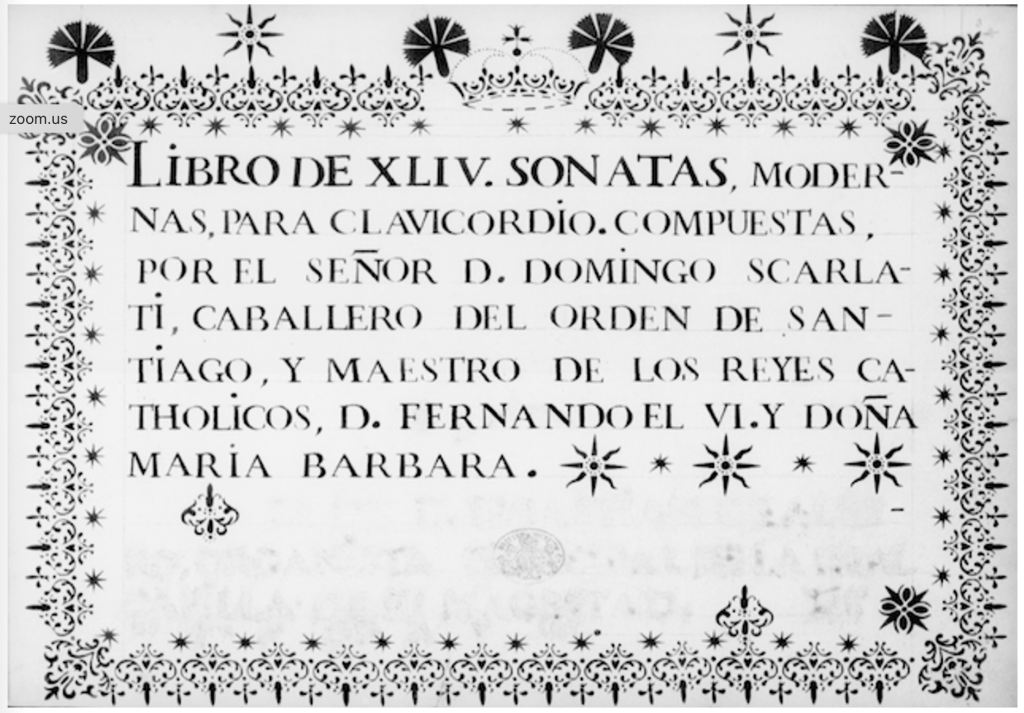
Stamped on the cover of the manuscript is „These Sonatas were composed by Domco Scarlatti for Dr. John Worgan. This valuable volume is the gift of Mrs. Worgan to Charles Wesley”. Mrs. Worgan was John Worgan’s third wife Martha, Charles Wesley jun. (1757–1834) had been John Worgan’s (1724–1790) music student. “composed for” is a fabrication that originated with John Worgan to increase the value and interest of his manuscript; he had twelve sonatas printed by Johnson under the original Spanish title: “LIBRO DE XII / SONATAS / MODERNAS para CLAVICORDIO / Compuestas por / EL SEÑOR D. DOMINGO SCARLATI / CABALLERO del ORDEN de / SANTIAGO Y / MAESTO de LOS REYES / CATHOLICOS / D. FERNANDO EL VI. Y / DOÑA MARIA BARBARA / LONDON / Printed for the Editor & sold by J. JOHNSON facing Bon Church Cheapside. […]” Retaining the Spanish title appears to have made the volume more attractive. In the preface Worgan declared that he had been „at great Trouble in collecting and procuring a Number of new Sonatas for the Harpsichord composed by Signior Domenico Scarlatti that never were published”. – In 1939 Newton first identified the obliterated three last lines from „DE” to “MAJESTAD” but misread „ALONSO”. In 1953 Kirkpatrick suggested „ALBERO”. In 1970 Sheveloff observed that the obliterated text began with two letters and ended with two letters, but could not identify them either. On my copy made by the British Library, I deciphered the first two letters as „MP”, the final two letters as „FR[.]” (or „RF.”). The two abbreviations stand for „manu propria” (“by the own hand [of]”) and „Fernando Re[y]”. Thus the manuscript was indeed copied by Sebastian Albero. The erasure of the third letter of the composer’s name – Newton’s N, Kirkpatrick’s B – appears not “massive” enough for a B, hence a V seems likely:
Fernando VI made Albero chapel organist on 29 September 1746, which serves as terminus post quem for the compilation of the manuscript. The contents of Al, by comparison with CF13, V42, V49, Z2-4, P52b: [to be added]
A textual comparison – vide for example K68 – shows that Albero could not have assembled the ms. commissioned by John Worgan from V42, P52b, […]. Thus the fourty sonatas Al:1-40 constitute primary sources. There are many interesting details about the sequencing of sonatas, e. g. K47, K57 which are singletons in V42, but are paired in Z3 and P52b in the same (incorrect) order, duple before triple, although K47 is a “Presto”. […].
Make a one-time donation
Make a monthly donation
Make a yearly donation
Choose an amount
Or enter a custom amount
Your contribution is appreciated.
Your contribution is appreciated.
Your contribution is appreciated.
Scarlatti and historic tempo.
Hand in hand with textual accuracy goes the problem of tempo. Modern ears have become used to an abhorrent speed-blend of non-articulated rhythmic and harmonic changes. When the senses of player and listener alike no longer perceive every last rhythmic change and harmonic modulation which the composer has put into his music, when overtones blur, when ornaments because of the tempo in which they are played disconnect from the melodic line: then the music is being played too fast. The ear should perceive the sudden 16ths on the weak beats of the flamenco K492 as a surprise, as beguiling and seductive. Instead player hammer through the piece at a relentless 6/8 at record speed, and there is no surprise and no beauty left. Each pair of 16ths has to create suspense. If the ear cannot follow the alternating 6/8 and 3/4 of the flamenco K444 and the changing rhythms are perceived only as sudden pauses, K444 is being played too fast. The rhythmic suspense and surprise of these two bars of the fado K426 has to be palpable each time the pattern occurs:
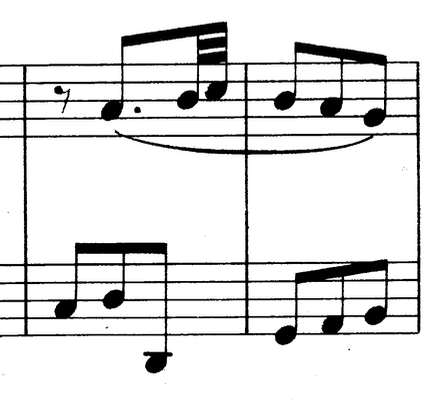
The same applies to the kaleidoskopic modulations in K426: the ear needs to experience the sudden unexpected chromatic shift to A♭ in m. 15, after the previous conclusion in g and a long suspenseful fermata, as the moment of musical wonder it must have been for the first listeners. When K240, at the conclusion of its second theme in A and following a fermata on D, literally turns around on the key of c and begins a long chain of distant modulations, with its accent shifts, this moment of dejection has to be harmonically and rhythmically palpable to the listener:
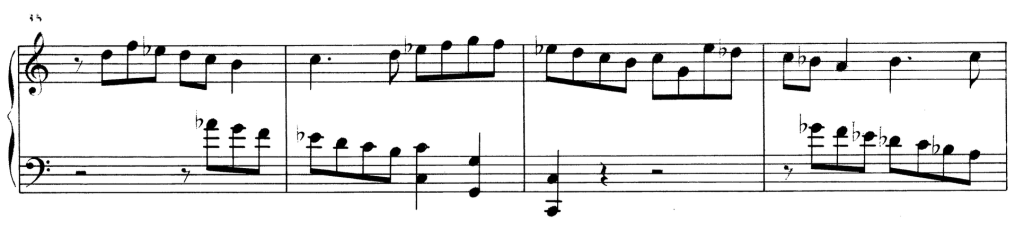
During the first week of September 1772 the musicological traveller Dr. Charles Burney (1726–1814) made the acquaintance of the imperial physician Dr. Alexandre-Louis L’Augier (1719-1774) in Vienna (also spelled „Laugier”, but Burney wrote „L’Augier”. L’Augier impressed Burney with his ethnomusical sensitivities:
“M. L’Augier […] has arrived at great skill in music, has a most refined and distinguishing taste, and has heard national melody in all parts of the world with philosophical ears. […] M. L’Augier sung to me several fragments of Bohemian, Spanish, Portuguese, and Turkish music, in which the peculiar expression depended on the contre tems, or breach of strict time; beat the measure, and keep it as exactly as is necessary, in more refined and modern music, and it wholly loses its effect.” (Burney II, pp. 86, 87).
It is a rare feat to be able to sing (L’Augier) and to hear (Burney) “national melody”. What Burney called contre tem[p]s or “breach of strict time” is not rubato, it is, for lack of a better word, a tightening or slackening in cross-rhythms, a lingering around stressed weak beats, as occur in K232, K240, K246, K260, K394, K426, a precise timing of fermatas, more. To make these moments perceptible, the music has to be slowed down from current speeds. Mozart, Dussek, Lanner, Schubert, Chopin would not recognize their music at the speeds at which it is being electrocuted today. The evidence that metronome markings (not until 1816) were read at whole beat and not single beat, i. e. two ticks per indicated note value, not one, although not new, is still being ignored today. Their correct readings, in turn, provide a glimpse that Couperin’s, Rameau’s, Bach’s and Scarlatti’s music from a hundred years earlier was played even slower. Griepenkerl’s metronomizations of Bach’s Inventions can only be read at whole beat, and already constitute tempo-recreations across one hundred years. The mindless speed-varnish needs to be removed from the playing of Scarlatti’s music. [expand later]

