The following restoration of the texts of Domenico Scarlatti’s sonatas and restoration of their proper pairings is based on musical principles and not on unfounded editorial prejudice as to what constitutes a “control source”. No other composer of comparable fame is in greater need of rescue from performers and editors alike than Domenico Scarlatti. No performer of Scarlatti applies historical tempi or plays from accurate texts. Modern ears have become used to an abhorrent speed-blend of non-articulated rhythmic and harmonic changes. When the senses of player and listener alike no longer perceive every last rhythmic change and harmonic modulation which the composer has put into his music, when overtones blur, when ornaments because of the tempo in which they are played disconnect from the melodic line: then the music is being played too fast.
Chopin and Liszt played Scarlatti ed. Czerny, Carlo Zecchi recorded Scarlatti ed. Bülow, Bela Bartók and Wanda Landowska recorded Scarlatti ed. Longo. Since Kirkpatrick, everyone plays Scarlatti ed. Venezia. While the counterpoint Bülow added to K259 is quite beautiful, and while Longo’s texts clearly were musical arrangements albeit stripped of dissonances and arranged in suites the composer never intended, the texts of the Venezia-set (V), except for instances where no other source is available (V42), is neither correct nor musical, and as rule textually more corrupt. Editors and performers alike have elevated Venezia to “control-set”-status because of its burgundy morocco binding (Kirkpatrick) and royal provenance (Fadini, Texting) and because it supposedly contains the greatest number of pieces. Not one editor or performer has ever given one musical reason for this preference. V42 and V49 do not belong to the set proper, and the remaining thirteen volumes contain fewer sonatas than Parma’s 463. If you play Scarlatti from V you play music that was mostly copied from Parma (P) and which, in hundreds of details, Scarlatti never composed. Likewise you end up with pseudo-variant readings that Scarlatti never composed.
The first bar of K125 begins on two trills and two appoggiature, as Marguerite-Antoinette Couperin’s Pièces de Clavecin from the 1730s attest to. In Parma (P) you are left with a trill in the left hand only, while the appoggiature are still in place. In V49 have not only both trills disappeared, but the appoggiature have turned into ties between between the g2:
| K125, mm. 1-3 (PdC): |  |
| K125, m. 1-3 (P52a): |  |
| K125 m. 1-3 (V49): |  |
If you feed these scribal mistakes into a computer without understanding the specific copyist’s attitude towards his work, you end up with musically senseless pseudo-variants that Scarlatti never wrote, instead of understanding that the text of V49 has deteriorated, that of PdC not.
Everyone who plays the ascending triplets in the second half of K466 plays not what Scarlatti wrote, but a scribal emendation first effected by P, and from there copied into V. Yes, the famous Horowitz recording is musically wrong, because he and everyone else play[ed] from the most corrupt texts, V copied from P. The correct rhythmic values were preserved in Münster (M), which was copied from the autographs (more below), but the musically completely unfounded prejudice against M has suppressed the authentic readings (Gilbert), relegated them to the commentary section (Fadini) and just as often does not mention them at all (Fadini):
| K466, mm. 35-38 (M): |  |
| K466, mm. 35-38 (V, copied from P): |  |
M had no reason to invent a rhythmic pattern that occurs nowhere else in K466, and to repeat it. The repeated g followed by two 16ths adds dramatic tension to the fourth beat. Where Longo smoothed out harmonic dissonances, the scribe of P repeatedly smoothed out rhythmic deviations by textual precedent (more below); since V copied P, the same inaccurate rhythm shows there.
In K. 474, m. 17 the bass line continues f1-f-B♭. In the parallel m. 46 of the second half, the E♭ is present in M and Ca, both of which were copied from the autographs, but it was omitted by P (also copied from the autograph), and accordingly in V (copied from P):
| K474, mm. 45-46 (M): | K474, mm. 45-46 (Ca): |
  |  |
| K474, mm. 45-46 (P): | K474, mm. 45-46 (V): |
 |  |
P and V are clearly defective, but since Gilbert and Fadini established them, musically unfounded, as primary sources, they amputated the bass line of the E♭ in their main texts. Fadini relegated it to the commentary section. Any musician who is not prejudiced about the sources can see that it belongs into the main text. If we take Texting‘s approach, the E♭ constitutes a variant by Scarlatti, and the composer was uncertain whether to continue the bass line or not. It is absurd.
The concluding mm. of K474 are an extreme copying disaster which no editor or performer ever questions. K474 has 56, not 54 measures. P, analogous to the first half, compressed mm. 51-54 into two mm. of 16ths, but without repeat, and amputated the soprano voice by analogy to the first half. M and Ca render the passage in four mm. in eighths, with the expressive melodic turn a♭2– f2 in the soprano (in Ca with a mis-copied g2). Why would the scribes of M and Ca rewrite this passage in eighths and invent a melodic turn for which there is no precedent in the first half unless it originated with Scarlatti’s autograph? M and Ca also affixed the necessary ♭ before the a1 (key signature ♭♭) which P omitted while rewriting the text:
| K474, original mm. 51-54 (M): |   |
| K474, original mm. 51-54 (Ca): |   |
| K474, shortened mm. 51/54 (P): |   |
| K474, original mm. 51-54 (V, copied from P): |   |
Gilbert and Fadini quietly substituted the missing a♭ without explanation. Fadini, without any musical justification, called the four mm. in M “sostituite” for the two edited mm. in P and V. It is musically evident that the readings of M and Ca are correct, and that P melodically and rhythmically regularized the text by compressing it to mirror the mm. of the first half. And, if the 16ths were authentic, Scarlatti would have repeated them, as he did in the first half:
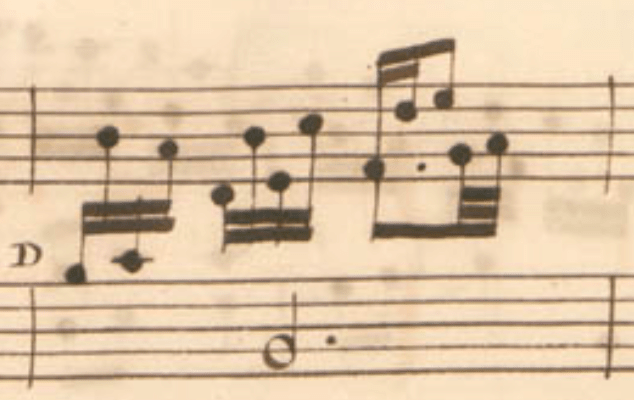
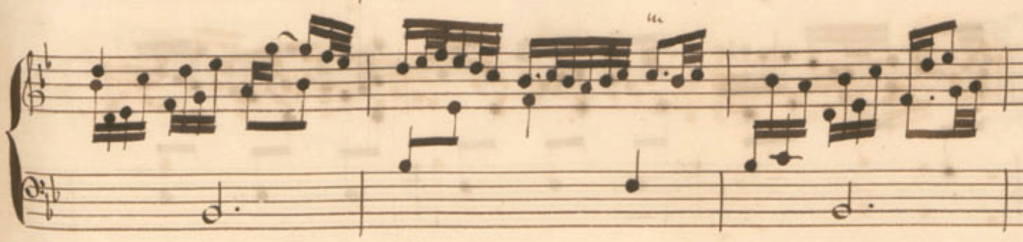
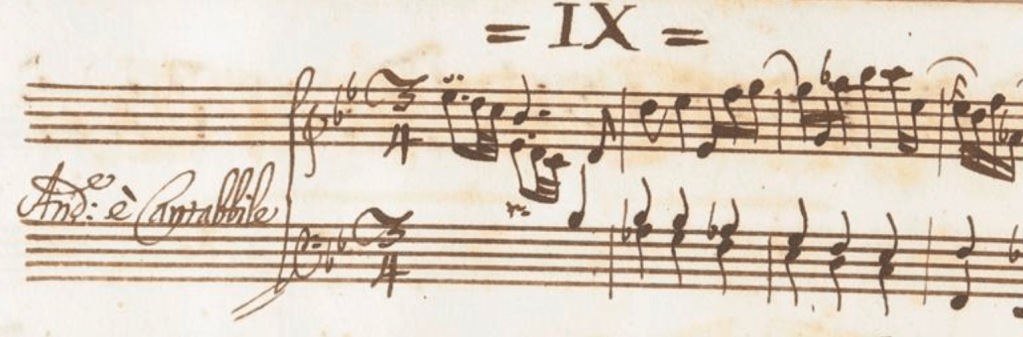
At the end of the first half the 16ths are musically necessary because they lead into the agitated development at the beginning of the second half. To conclude the sonata, however, Scarlatti restored the calm by returning to the initial syncopated eighth notes of the first three mm. and end on ornamented quarter notes which echo the initial trills. The music begins on two quarter notes, changes to syncopated eighths on the third beat, and initiates the movement of 16ths not until the third beat of m. 3 (mm. 1-3 here from M):
The four mm. of eighths at the end of the second half do not require a repeat. The readings of P are melodically and rhythmically incorrect. Every performer who plays Gilbert’s or Fadini’s versions plays the edits of the scribe of P and music that Scarlatti never wrote. Texting would consider the conflicting texts of M and P compositorial variants, which is absurd. If the musical (!) reader is not yet convinced, please play the authentic version and the corrupted “condensed” edit by P and V.
K510 is polyphonically complex. M copied correctly all the hemiolic tied notes held over from weak beats to strong beats across three bars, as in mm. 6 ff., 36 ff., 41, 46 ff., 49 ff., 100, 102, 105 and elsewhere. P repeatedly shifted the accents back to the first beat. Mm. 5-7 are correct in M only, as the parallel bars 9-12 prove, but wrong in P, copied from there into V. The d2 is held over from the second beat of bar 5 to the first beat of bar 9, as the repetition shows. Gilbert quietly corrected the mistake, Fadini did not: in her m. 7 you play a d on the first beat, because V said so:
| K510, mm. 5-12 (M): |   |
| K510, mm. 5-12 (P → V), corrected in Gilbert, not Fadini: |    |
Likewise P disregarded the held over hemiolic tenor notes a in mm. 36-39 and sim. M holds each a on the third beat of mm. 36, 38, 40. In P (→ V) the rhythmic pattern holds only from m. 36 to 37 and disintegrates at m. 38. Incredibly, in this case both Gilbert and Fadini integrated the mistake into their main text. And people play this nonsense:
| K510, mm. 36-41 (M): |   |
| K510, mm. 36-42 (P (→ V → Gilbert → Fadini): |   |
The same applies to all similar passages. P regularized or simplified these rhythms either because he was overall less competent than M, or because he worked in a hurry, or he intentionally regularized rhythms he did not understand. Passages like these make it clear that P was a hired hand, while the copyists of M and Ca (a composer in his own right, see below) were more experienced musicians. P’s tied dotted half notes on the first beat are rhythmically meaningless. But people play this nonsense because it occurs in the “control-source”. If I were to take Texting‘s approach, than the readings of M and P are rhythmic variants by Scarlatti who could not handle polyphony and hemiolas. It is absurd.
For more textual tampering by P see the pair K304•284 below (both K283 and K305 were mis-paired). Unfortunately the pair survives only in P (copied from there into V), and the player will have to recompose one measure, as I have done for him. P managed to amputate the final measure of sonata K304 which is in ¢ by three quarter notes, and that is what Fadini printed.
Musical evidence shows that Scarlatti composed most of his sonatas in pairs, but despite the inherent evidence that the composer himself provided, there exists no comprehension of how he paired his sonatas. The pairings of Venezia (V) are used as guidelines, although V is a secondary source and textually more removed from Scarlatti’s autographs than the other large collections of his sonatas, Münster (M), Parma (P), Zaragoza (Z) and Cary (Ca). It is musically evident that in all main sources original pairs become separated into singletons or were mismatched. Anyone performing K240 without its original partner K348 plays amputated music. K347 was originally preceded by K121. K259 does not belong with K260 – both are in 3/4 and have no thematic connections – but it precedes K235 to form one of at least nine Christmas-sonata pairs. Because neither Kirkpatrick nor anyone after him musically explained the principles of pairing, performers play or not play the pairings traded down in V or P without understanding which pairings survived intact and which pairings did not. There exist no musical guidelines why sonatas constitute pairs: the only pairs in A♭, b♭, c♯, f♯, F♯ and the two pairs in B demonstrate their compositorial togetherness as much as sonatas in large tonality groups such as G/g and D/d.
Singletons with missing compagne in all sources include (beginning with V49): K98, 101, 102, 103, 108, 111, 112, 117, 120, 121, 122, 123, 139, 140 (141 perhaps by Albero), 164, 169, 170, 171, 172, 173, 174, 175, 176, 187, 188, 196, 197, 198, 201, 202, 203, 210, 227, 258, 265, 293, 328, 333, 334, 351, 430, 451, 484, 513. False pairs are recognizable by identical metres and tempi, here V49 through V57: K104-105 (3/8), 124, 125 (3/8), 150, 151 (3/8), 308, 309 (both ¢), 215, 216 (3/4) 259, 260 (3/4), 386, 387 (both fast secundas). False triptychs include, here V49 through V57: K134-136, 204a-205, 274-276, 431-433, 434-436, 481-483, 485-487, 490-492. The musically absurd false quintuplet K183-187 occurs only in V.
In 1772, the 73-year-old composer and singer Johann Adolf Hasse admitted to Charles Burney that his “Cantatatas, Serenatas, Intermezzos, and Duets, for voices; his trios, quartets, and concertos, for instruments, were so numerous, that he should not know many of them again, if he was either to see or hear them. […] he […] had more pleasure in producing, than in preserving his offspring.” (Burney II, p. 108). Haydn made a similar remark about his early compositions. Scarlatti was 66 when the re-collection of his sonata-pairs began which he likely had stopped composing years earlier. Why is he expected to have properly re-assembled every last sonata pair after they had been archived for many years during which time many of their sequences became disturbed?
A musically detailed and logical examination of the texts of Scarlatti’s sonatas, without preconceived notion of “control-texts”, proves the following:
1) Scarlatti composed the majority of his sonatas in pairs, with the underlying principles:
• Pairs are always in the same key.
• Most pairs are in the same tonality, but major can be followed by minor, and minor by major.
• Pairs are never in the same meter, i. e. 3/4 never follows 3/4. K259 and K260, for example, were archived together erroneously.
• A slower partner is always followed by a faster one. The exception are minuets and fugues, which are always in end-position.
• Slow partners are never matched with slow partners, fast ones never with fast ones. The two sonatas in f, K386, “Presto”, and K387, “Veloce è fugato”, were archived together erroneously.
• All partners of a pair are thematically or motivically linked.
• Scarlatti combined several pairs. The pairs in A♭ and b♭, for example, were composed together, since Scarlatti quotes bars from the set in A♭ in the one in b♭.
2) Scarlatti composed a large group of sonata-pairs for religious holidays, specifically Easter, Christmas, and Holy Week. Scarlatti’s musical symbolism in his sonatas is as identifiable as that of Bach in his cantatas. Scarlatti’s Easter sonatas will allude to the crucifixion, sorrow about Christ’s death, and the joy over his resurrection. Scarlatti’s Christmas sonatas depict human anxiousness for redemption, the birth of Christ (siciliano), and the joy over his birth. The Holy Week sonata-pairs always link processionals and ensuing festivities.
3) Some hallmarks of Scarlatti’s musical notation include:
• Writing some key signatures “staggered” instead of in cycles of fifths, e. g. a♭, b♭, e♭ instead of b♭, e♭, a♭ for the key of f. This writing survives in M.
• A tendency to encase repeats within repeat marks instead of writing them out.
• A tendency to not write out ornaments if the musical context makes them obvious, such as the twenty right- and left-hand trills in K470.
• Indicating key signature changes by omitting the previous key signature instead of placing ♮, for instance when changing from D (♯♯) to d (– instead of ♮♮) between K509 and K510 or from c (♭♭) to C (– instead of ♮♮) between K526 and K527. The ♮♮ in P are editorial.
• As Soler attested in his Llave de Modulación (1762), Scarlatti indicated double-sharps with single sharps if the key signature already contained a sharp. For example within the key signature of f♯, a gx would have raised the g not to the note a but cumulatively to the note a♯ instead (g♯ + x).
• Like other composers, for example Chopin, Scarlatti placed melodic or emphatic accidentals before notes that had been altered before and returned to their previous stage, regardless of whether the accidentals were already part of the key signature. M retained these melodic accidentals, for example in K466 a return from b♮ to b♭.
4) The collections Münster (M), Parma (P), Zaragoza (Z) and Cary (Ca) were independently copied from Scarlatti’s autographs and not from eachother. A small part of M5 was copied from Boivin prints.
5) The largest part of Venezia (V), obvious exceptions V42 and V49, was copied from P and has no primary source value.
6) M contains the most precise copies of the sonatas. Sheveloff’s copyists “M1” and “M2” (the latter first identified as Antonio Reggio by Klaus Kindler) preserved many rhythmic and voice-leading details which were lost in P.
7) Z is as valuable as M – vide for example K202 and K226 – but José de Nebra’s scribes tended to omit more material.
8) P was copied by a professional paid scribe whose main goal was efficieny and a clean textual appearance. He smoothed out many rhythmic details, such as turning 16th notes followed by an eighth note into triplet eighths (K466), smoothed 32nds into 16th (K226), simplified or dropped voice-leading details such hemiolic ties in K510, dropped notes (K474), intentionally omitted text (end of K304), forgot to copy text (he omitted the left hand in one measure of K190), and falsified some text for the purpose of regularization and smooth appearance (extreme example K474).
9) Almost all of Venezia (V) from V52b onward was copied from P, with additional mistakes, and has no source value. Vide K190, K474, and many others. V stopped copying from P in V57 probably for lack of payment.
10) The copyist of Cary was a performer-composer who not only rewrote entire measures of Scarlatti’s sonatas to fit the range of his one manual instrument (ceiling d3), but who also emended entire pieces such as K2 (change of harmonies, voice-leading, composition of additional measure). To feed Cary’s texts into a computer as “variants” is to misunderstand the copyist’s intentions and to obfuscate Scarlatti’s texts.
11) The little referenced French collection Pièces de Clavecin from the mid 1730s contains superior readings of K125 and K179 and 182 [https://gallica.bnf.fr/ark:/12148/btv1b10509646r?rk=214593;2]. The ms., which survives in three fragments, was likely assembled by Marguerite-Antoinette Couperin (1705–1778), who was “ordinaire de la musique de la chambre du roi pour le clavecin” from 1730 to 1741, and also taught the daughters of Louis XV.
12) Scarlatti did not oversee the print of his Essercizi, as already the missing hand disposition indications in K1 prove, a vestige of which survives in Cambridge-Fitzwilliam.13) Several pieces which Kirkpatrick attributed to Scarlatti because they were printed by Boivin or copied by Albéro at the end of the Worgan-manuscript can for musical reasons not be by Scarlatti: K95, K142-146. Sheveloff already raised doubts about these in 1970.
Whereever copying years of manuscripts are available they should be used to identify the volume instead of volume numbers. Ralph Kirkpatrick downplayed the value of the Parma-set against that of his preferred Venezia-set by suppressing the Parma-dates because several of them are anterior to their Venezia-counterparts. All fifteen Parma-volumes except the first one have volume numbers and are dated. Since the explicit volume-count begins on the title page of vol. 2, the unnumbered volume was likely considered no. 1. Volumes 2-7 carry copying dates in the index, vols. 8-15 on the title page and the index. The first Parma-volume is undated, but since vols. 2-5 were all copied in 1752, the largest number of volumes of either Parma or Venezia to be copied in one year, 1751 can be tentatively adopted as copying year for Parma-I. It is the only volume to index the sonatas as “Tocatas”[1]:


The Parma-volumes should be referred to by copying date because these establish a terminus ante quem, barring the possibility that the scribes manipulated the dates for outstanding payment. To indicate the ascending order of the multi-volume years 1752, 1753, 1754, 1756 I have added letters: Parma I = P51, II = P52a, III = P52b, IV = P52c, V = P52d, VI = P53a, VII = P53b, VIII = P53c, IX = P54a, X = P54b, XI = P54c, XII = P55, XIII = P56a, XIV = P56b, XV = P57. The year dates which Kirkpatrick assigned to the Venezia-volumes past V42 and V49 (which do not belong to the series of “Collected Works”) I have adjusted accordingly: Venezia I = V52a, II = V52b, III = V53a, IV = V53b, V = V53c, VI = V53d, VII = V54a, VIII = V54b, IX = V54c, X = V55, XI = V56a, XII = V56b, XIII = V57 (which lacks the final twelve sonatas K544-555 contained in P57).
In the fourth and fifth Münster-volume the date 1754 concludes several pairs. These are copying dates. The dates 1756 and 1757 in M1 were added by a later hand by someone who had compared the contents with the Parma volumes. Since there are no copying dates associated with the Münster-set, I have listed them by their volume numbers, skipping the recount titles in between: M1:1 = K466, M1:90 = K555.
The year dates of the Laugier-sonatas copied in WQ were checked against those of the Parma volumes. These, like the Münster-dates, I have added directly to the source lists.
The second title page of Carey is dated 1756, but the date is similarly derived by comparison with the Parma-set.
[1] P51, f. 59r.
Terminology.
“Toc[c]ata” occurs in Z, M5 and P1, “Sonata” as early as Boivin: Choisies (1737), the Essercizi (1738) and the five main collections M, P, V, Z (1751–1757). Since Scarlatti used “sonata” as early as K347 (P54a:20) and authorized it for the Boivin-prints, I have adopted it. The designations “compagn[a/e]” for pairs and “prim[a/e]” and “segund[a/e]” for their components I adopted from the Spanish terms “compañeras” and “primera” in P53a:13, f. 25v:

Pairing: reception history.
Besides the actual pairings of sonatas as early as V49, the earliest extra-textual proof that sonatas were to be paired occurs in P53a. The Spanish scribe had paired P53a:13 in D (K53), ¢ Presto, ámbito 1A-b2 and P53a:14 K258), a 3/4 Andante in D, ámbito 1A-d3 (V53b:23/Z2:37/K258). The scribe mis-paired two singletons, and, after having done so, noticed that he had copied the fast compagna before the slow one. He corrected himself by noting over the beginning of P53a:13: “Ante de esta Sonata se debe Tañer la que sigue, que es Compañera, y 1.a deestas.” (quoted above) [2] Significant are “[primera]”, “sigue”, and “compañera”, the copyist’s reason for switching the two pieces around, his reason for mismatching pieces:
The scribe’s note identifies five important features of paired sonatas:
• The scribe of P was aware that sonatas were to be paired.
• Pairs were in the same key.
• In pairs duple time often preceded triple time, which led P to his false sequence.
• Slower always preceded faster. The exception to this rule were minuets and fugues, which always occur in end position.
• The pairing K258•53 is incorrect because K53 (compass 1A-b2) intentionally avoids d3 in m. 5 (by comparison to the parallel opening of the second half) while K258, range 1A-d3, includes the d3. P assembled this pair from two singletons in D.
• Since the the pairing K258•53 is incorrect, Scarlatti was absent from the copying process rather than present.
In 1757 P repeated the mistake duple/triple, slow/fast with P57:4 (K517) in d, ¢ Prestissimo, and P57:3 in d (K516), 3/8 Allegretto. Above the beginning of P57:3 he added: “La que sigue se debe tañer primero”[3]:
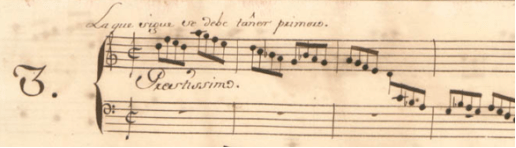
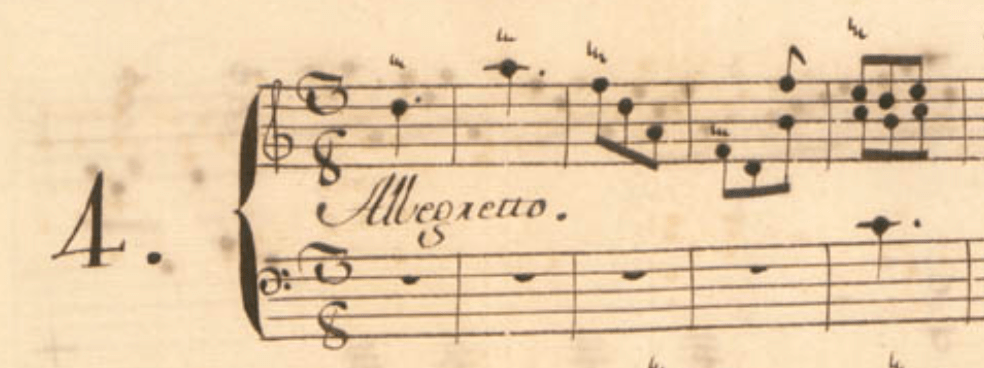
The pairing is correct but P erroneously switched the sequence which he corrected when copying P into V.
Pairing is also evident at the penultimate measure of P54a:20[4] (K347) in g, ¢ Moderato e cantabile, ámbito D-d3: “Al Cader dell’ ultimo termino di questa Sonata, atacca subbito la Seguente, Come avisa la Mano.” The Italian suggests that the scribe copied the instruction directly from Scarlatti’s autograph. The hand points at the end of the penultimate measure, indicating that the final measure with the chord G-g1-g2 should be skipped after the repeat and the player launch directly into the first measure of the following sonata, which repeats the hand before the first measure. V54a:22 repeats the same instructions[5], M3:2 only depicts the two hands:
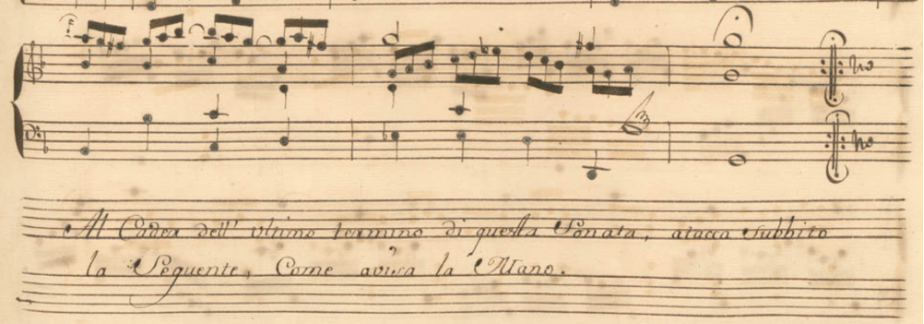
However, the hand points to the wrong seconda:

The unresolved f♯2 proves that K347•348 is a false marriage. Scarlatti’s only other sonata in g/G into which the penultimate chord of K347 can properly resolve is K121 in g, a singleton in all sources, which also has the proper ámbito:

K121 picks up the triplet motif from K347 and saunters downwards not in scale steps but in thirds, and in 3/8 instead of 12/8:
| K347: |   |
| K121: |  |
The original pairings were: K347•121 and K240•348 (see below).
In 1933, the notion of pairings was revisited by Walther Gerstenberg:
„Ein Teil der handschriftlichen Quellen […] stellt die Sonaten in auffallender Weise zusammen: es folgen hier in der Regel zwei Werke aufeinander, die sich in ihrer Taktart wie Tanz zu Nachtanz verhalten und die gleiche oder die variante Tonart aufweisen.[6] Ob eine solche Ordnung, die die Sonaten paarweis zusammenfaßt, vom Komponisten selbst beabsichtigt oder ob sie nur eine ad hoc getroffene Kopisten Maßnahme ist, die der Übersichtlichkeit dient, bleibt offen.”[7]
Gerstenberg acknowledged the preferred sequence duple/triple and the common tonality passim but did not elaborate, perhaps because he was the first to assume that the pairing could have originated with copyists.
In 1953, Ralph Kirkpatrick moved the pairing of sonatas into the lime light of his Scarlatti monograph: “[…] the pairwise arrangement is so consistent in the Venice, Parma, and Münster manuscripts as to make it absolutely clear that it was intentional.”[8] However, his only proof were the scribal evidences mentioned above, to which he added the inconclusive “Volti subito” that occurs in V49[9] between K99 (V49:2) and K100 (V49:3Alle,mo). Unlike the other “Volti” in V49 written in bright red ink which indicate the page turning between first and second half, this “Volti subito” is sketched in very faded black ink and was never reddened. It may have been a mistake by the scribe who missed that he had arrived at the end of K99.
Kirkpatrick found further proof for Scarlatti’s pairings in two-movement keyboard sonatas by Alberti, Durante, and Paradies.[10] “The relationship between the sonatas of a pair is either one of contrast or compliment. The sonatas that bear a complementary relationship to eachother may share a certain overall unity of style or of instrumental character or thex may be composed in the same harmonic color. For example, Sonatas 106 and 107, although in F major, both hover around F minor and its related tonalities.)”[11] That is very unsubstantial. So is the following: “In the contrasting pairs, a slow movement may be followed by a fast (Sonatas 544 and 545); a simple movement, generally slow, may serve as an introduction to a more elaborate (Sonatas 208 and 209); or an elaborate and concentrated movement may be followed by a simpler and lighter movement, for example a Minuet, which serves as a kind of Nachtanz (Sonatas 470 and 471).”[12] He does not explain or specify the following: “There is evidence that some sonatas might have been arranged in pairs or rearranged at some date posterior to their composition, but by and large the pairwise arrangement predominates and must be accepted as a requisite to any intelligent and adequate approach to the Scarlatti sonatas.”[13] He noticed the identy of the tonic: “One [sonata] may be in minor and the other in major, but both members of a pair always have the same tonic.” [14] He pointed out the complimentary ranges of the instrument: “Frequently the members of a pair demand roughly the same keyboard range […].”[15] Kirkpatrick sought in particular to redress the sonata-suites arranged by Alessandro Longo. [16] However, besides intuitive vagaries, Kirkpatrick never delivered one actual musical proof, although there is plenty to be found. Had he elaborated more on the musical reasons for pairing, many compagne would not continue to be performed as singletons, or in a wrong pairing. Despite his emphasis on the pairings, Kirkpatrick was so beholden to the Royal burgundy morrocco of the 15 Venezia volumes that in his reckoning of the sonatas, which was supposed to replace that of Alessandro Longo, he separated K126•129 in c, K127•130 in A♭ (he structurally only analysed K127) and K128•131 in b♭ because they appear in that sequence in V49. K126•129 belongs together thematically and remained intact in Z3, which K did not know. The pair in A♭ remained intact as P52a:21•22 and Z3:4•5, likewise the pair in b♭ as P52a:29•30 and Z3:6•7. In M the pair in A♭ became dispersed (M4:36•3:16), and of the b♭ in M only K128 survives. Noteworthy again is the distance two partners could drift apart: a whole volume separates the pair in c in P52a:26•51:29. In the case of P, “leftovers” repeatedly gathered at the end of sequential volumes. A similar case is the pair in e, K198*•98*, P52c:20•52b:19 (see below).
In 1957 Hermann Keller took the erroneous composition date 1753 as reason that Scarlatti would not have composed singletons as contained in V42 and the Essercizi, only to switch to pairs after 1753. He stated what Gerstenberg and Kirkpatrick had only suggested: that the copyists arranged them in pairs.[17]
In 1963 William Newman picked up Kirkpatrick’s pairing idea but suggested that the similar beginnings of K307•308 and the group 490•491•492 did not suffice to establish pairings with certainty. He observed that in “well over half the two-movement groupings the typical association of a duple and a triple-metered movement obtains”. Since no one knows about Scarlatti’s sonata-pairs for Easter and for Christmas (more below) he made the case for a single sonata like K170 to actually consist of “2 separate movements no different in relationship or extent from those in the paired sonatas” (Newman, p. 267). K170 forms a pair with K174. The three sequential rhythms ¢, 3/8, 6/8 and frequent excursions into the minor and joyful conclusion always in 6/8 constitute a typical pair of Easter sonatas (see below): Compagne C|c-C: ¢ Andante moderato è cantabile – 3/8 Allegro • 6/8 Allegro. These pasque, as I call them, usually contain three sections. In P51 and V52a K170 and 174 are singletons separated by three sonatas, P51:23•27, V52a:23•27.
In 1967, Pestelli[18] rejected the concept of pairing because there were single sonatas between paired ones which worked against his invented chronology. Like Kirkpatrick Pestelli was obsessed with the musically secondary aspect of chronology and sacrificed the structure of the sonatas to his unfounded preconceived notion of a chronology.
Sheveloff’s reaction to the notion of pairings was patronizing. In his dissertation of 1970 (Z was unknown to him) Sheveloff reacted with four rethorical questions:
Are the groupings really a scribal convenience after all? Were the sonatas conceived separately and later joined in pairs, even tryptichs? Were the earlier scribes confused? Is the pairing an arbitrary matter left to the scribe or even the performer like so many other features of eighteenth-century performance practice?[19]
Sheveloff countered Kirkpatrick’s and Newton’s concept of pairing[20] with another question:
How are we, on the basis of such all-encompassing musical possibilities for the relationship of a pair, to test this “true meaning”? It would not be difficult, almost at will, to yoke together two sonatas in the same key, but from different places in the sources, and find many kinds of “musical justifications” for this pair at least as good as the ones suggested by Kirkpatrick and Newman.[21]
There exists undeniable musical justification why sonatas belong together. Boyd acknowledged the high incidence of pairing, the similar compass of some pairs, mentions the scribal annotations quoted above, but left the pairwise arrangement as “an option for the player” (Boyd, p. 166). Like everyone before him he was incapable of finding any musical connection between pairs: “Attempts to trace thematic connections between paired sonatas have not been very convincing, but it is possible to sense some kind of unity at a more subliminal level” (166). He recognized similarities between a few non-paired sonatas, elaborated on those between K528 and 529, but summarized: “One is led to the conclusion that even if the pairing was not part of the original conception it was nevertheless done creatively when the works were brought to their final form.” The meaning of that conclusion is unclear.
[1] B6 = Boivin print 6, M3 = Münster vol. 3, Wo = Worgan, Ca1 = first section of Cary, Li = Lisboa, Z3 = Zaragoza vol. 3
[2] P53a, fol. [25v].
[3] P57, fol. [5v].
[4] P54a, fol. 41r.
[5] V54a, fol. 44r.
[6] fn. Dent, Auftakt, dazu Kommentar: “Die meisten hierher gehörigen Bände prägen eine solche Tendenz klar aus. S. auch in der Notenbeilage die ‘Paare’ Son. I-II und Son. III-IV, deren Zusammenstellung den Handschriften folgt.” Meant are K452-453, und […].
[7] “Some of the the manuscript sources” – Gerstenberg was familiar with M, P, Z – “combines the sonatas in a c onspicuous manner: in these instances two works usually follow eachother whose time signatures are related like an dance to an after-dance, and which share the same tonality, whether major or minor. Whether such an order, which pairs the sonatas, was intended by the composer himself, or whether it was only an arbitrary decision by the copyists for the purpose of clarity, remains open.” Gerstenberg, p. 99.
[8] In this context, Kirkpatrick points out the coupling of two movements in works by Alberti, Durante, Paradies. Kirkpatrick, p. 141.
[9] Kirkpatrick, p. 142. V49, fol. 5v.
[10] Kirkpatrick, p. 141.
[11] Kirkpatrick, p. 143.
[12] Kirkpatrick, p. 143.
[13] Kirkpatrick, p. 143.
[14] Kirkpatrick, p. 142.
[15] Kirkpatrick, pp. 141, 142.
[16] Kirkpatrick, p. 143.
[17] Keller, p. 34.
[18] Pestelli, p. 96.
[19] Sheveloff, pp. 316-317; he refers to Newman, p. 267, fn. 49.
[20] Kirkpatrick, p. 143.
[21] Sheveloff 1970, p. 317.
Some pairing principles: by key, by tempi, by musical themes, by topic.
The seven sets A♭, b♭, B, c♯, F♯, f♯ constitute pairs by key and by related themes and motifs: K127•130, K128•131, K244•245, K246•247, K261•262, K318•319, K447•448.
K126•129 are thematically and motivically linked. Both share the same sequence of trills e♭-d-c-b♭-a♭-g (in K129 redirected via ascending eighths) over the same bass (K126) and tenor (K129), c-b♭-a♭-g-f:
| K126, mm. 9-13 (Gilbert): |   |
| K129, mm. 13-15 (Gilbert): |   |
K232•233 are united by the same 4/5 albeit rhythmically and figuratively altered crossrhythms and syncopations, which are unique to this pair:
| K232, mm. 35-38 (Gilbert): |   |
| K233, mm. 59-63 (Gilbert): |  |
K246•247 are linked by their halved and mirror-inverted themes a rovescio. The first theme of K246 is mirrored in the first theme of 247. K246 first theme g♯2 f♯2 | e2 d♯2 c♯2 b♯1 c♯2 g♯1 c♯2 d♯2| e2 d♯2, then imitation an octave below mm. 3-5 → K247: c♯2 g♯2 e2 | d♯2 c♯2 b♯1 c♯2 d♯2 | e2 c♯2 g♯1:
| K246, mm. 1-2 (P): |  |
| K247, mm. 1-4 (P) |  |
Sonata-pairs for Christmas, Easter and other festive days.
Alessandro Longo (1864–1945) was the first to identify the siciliano of the sonata in C, his LS 3 (1910), Kirkpatrick’s K513, as a Neapolitan Christmas pastorale:
L’episodio centrale di questa composizione è identico a una Pastorale popolarissima che si vuol cantare a Napoli e in parecchie contrade del mezzogiorno d’Italia nel novenario di Natale. Si tratta di una composizione originale di Scarlatti, venuta man mano popolarizzandosi o d’una melodia popolare intercalata da Scarlatti nella sua composizione? Io inclino per la secunda ipotesi. Ma lascio all’acume e alla pazienza di qualque studioso riceratore la resoluzione esauriente dell’artistico quesito.[1]
The sonata in C (K513) is divided into three sections: the ”Pastorale” whose first 17 1/2 measures are designated “Moderato” is in 12/8. The tempo changes mid-measure to “Molto allegro” for the remaining 18 1/2 measures of the first half. The second half begins with a different theme in 3/8, ”Presto” which ends the sonata in m. 81. The seeming disjointedness of both halves led to the characterization of K513 as
another example of a sonata with a totally irrelevant ‘C’ section (Presto, 3/8) […] with the result that the two halves give the impression of belonging to two completely different works. This juxtaposing of unrelated material is by no means confined to pastorales, and K170, 227 and 333 are other examples of sonatas in which the two halves are totally contrasted in style and material. Their curious structure seems to be unparalleled in the sonatas of other composers.[2]
Such an uninformed judgement is only possible if one does not know that the seeming singleton K513 is the second of a pair of “Natale” beginning with K485, which, in turn, was mis-archived with K486, 487. Of all sonatas in C only K485 prefigures motifs, modulations and playing figures which anticipate and mirror those of K513. Both share the descending/ascending “shooting star” scales in 32nds, K485 Soprano-Alto mm. 25-28, 50-53 → K513 Tenor-Bass mm. 13-15. The broken chords ending K485 reappear triumphantly in the Presto of K513. The final section of K513 is no longer ”totally irrelevant”, but rounds off the Christmas-celebration with a joyous ”Kehraus”. K485 is in duple time but triplets dominate the piece. All Christmas pairs reference bells, depict human rue and anguish and longing for redemption either by extended minore sections and rhythmic displacement. The runs of 32nds in K485 towards the upper limit of the keyboard reflect the desire for redemption, which not are “grounded” until K513. The siciliano is always reserved for the second sonata of the pair:
| K485: |   |
| K513: |  |
The discordant soul, in c:
| K485: |  etc. etc. |
| K513: |   |
 | |
 |
K485 descending g3-g2, f3-g2, e3-g2, repeated → K513 ascending b1-c2-d2, repeated | broken c-octaves:
| K485: |  |
| K513: |  |
| K513: |  |
There are no other sonatas in C who share these features, and these musical topoi repeat in all other Natale by Scarlatti. While every last bit of Christian symbolism has been explored in Bach’s cantatas, there has been no such template for Scarlatti’s sonatas. K485 m. 49 the first two beats end the cries for redemption of the “despairing soul”, the turn to C on the third beat and D7 turn into the hopeful gestures of the descending scales in G (first half). In K513 the wish for redemption has been fulfilled, and is expressed by the runs from the soprano being transposed into the tenor. Other Christmas secunde are not always called pastorales, like K202 in B♭, K204a in f|F, K214 in D, K235 in G, K273 in B♭, K415 in D, K446 in F, to name a few. Every sonata which breaks into a siciliano ryhthm is a Christmas secunda. Their hallmark is 6/8 or 12/8 and the siciliano rhythm, and a valedictory procession before the beginning of the celebration. All Christmas compagne share the same basic motifs: bells, the anguished cries for redemption in minor keys or by rhythmic displacement (K259), the plea for divine intervention by reaching into the upper register, cf. the three d3 in K259 (in the Christmas pairs with ceiling d3, the highest often occurs three times; see below), a pastoral celebration of Christ’s birth, and a final joyous Kehraus. Melodies and harmonies of prime and secunde are always related, i. e. the harmonic shifts of the sicilianos are always prefigured in the prime, as in K189 and K184, and the Kehraus figures, often broken octaves, are always prefigured in the prime. K202 is preceded by K189 in B♭, and is similar in structure to K513. Where K189 begins with three repeated f2, K202 answers with three repeated b♭2. Not all Scarlatti’s pastorales share the tripartite construction of K202 and K513: K446 clips along at an uninterrupted 12/8 Allegrissimo. The number three, alluding to the trinity, plays a central role in all Christmas compagne. The Cary ms. (ff. 156v-158r) contains two compagne di Natale composed by the scribe. Here an “Andantino Para la Pastoral” in 3/4 precedes a “Pastoral. Allo” in 6/8. Here too the three repeated d1 and a2 imitate bells as do the d in bass and soprano of the siciliano in 6/8:
| Carey, f. 157v: |  |
| Carey, f. 156r: |  |
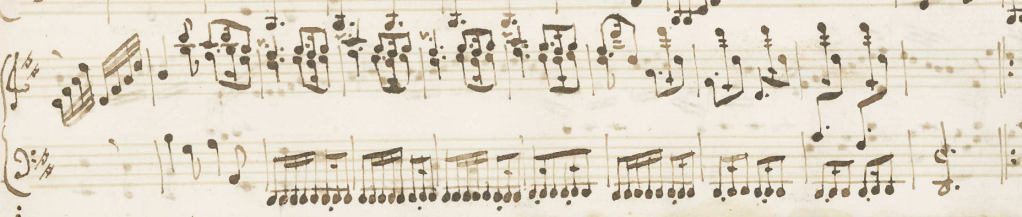
Like Scarlatti, thirds and broken octaves depict “completion”, and the jaunty descent from d1 through D through three octaves and in three mm., in reply to the prayer of the rising broken chords of the Andante, against the repeated bells of the high d2, depict the trinity having arrived on earth. Much less operatic than Scarlatti, the composer maintains the dotted 6/8 through the end. The rhythms of the repeated bass notes through the final eight mm. suggest a Spanish marching band and drum rolls disappearing into the distance:
There are at least eight compagne di natale by Scarlatti. Many of them were disunited during their archived state: K189•202, K213•214, K259•235, K331•273, K414•415, K462•446, K485•513.
Here are the compagne di Natale K259•235, 3/4 AndanteD-d3 • 3/8 Allegro – 6/8 AllegroC-d3 (M2:25•3:5/Z2:48•35/P53a:15•52d:20/V53b:24•53a:30/WQ15116:2 [=Laugier:28]•~|K259•235).
K259 and 260 are mismatches because both are in 3/4. Their first theme g e c …, four mm. in K259, eight in K235, restated in both; […]. mm. 9-16, reiterate at the beginning of the second half, mm. 39-47 depict the discordant soul by their displaced accents on the second and third beats. The plea for redemption, the “drawing down” occurs at mm. 23-26 and repeats, second half mm. 54-57, especially with the three repeated d2 in m. 55. Both halves conclude with “heaven-climbing” ascendant intervals in D and in G.
K259, mm. 1-4, theme g2-b1 (Z):

K235, mm. 1-8, extended theme, 4 mm. = 8 mm., identical appoggiature on e2 and c2 (Z):
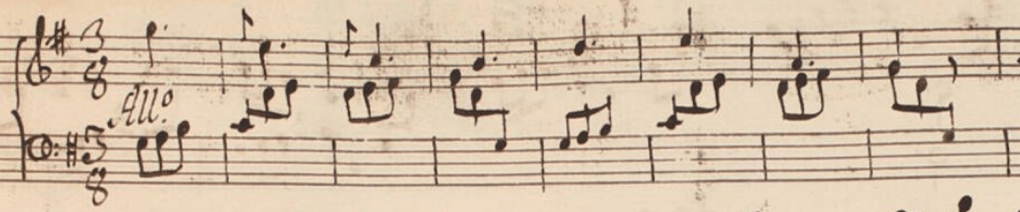
In K235 the melody g-e-c-b | d-e-a-g, with appoggiated e and c, unfolds bell-like on the first beat of the first eight mm. In K259 g-e-c-b also fall on the first beat, e and c also appoggiated, but they have no footing because the rhythmic accents fall on the second beat in mm. 1-3, on the third beat in m. 4. Where Bach depicts the lost soul in Cantata 105 by leaving the beautiful aria “Ihr zitternden Gedanken” without a bass, Scarlatti depicts the rueful discordant soul by displaced rhythmic accents, often in sixths, and with dissonances. In the yet “unredeemed” K259 the intervals d-e and a-g are rhythmically displaced. The tonalities of K259 and K235 are the same:
| K259, mm 1-4 (Gilbert): |   |
| K235, mm. 1-8 (M): |  |
In K259 the penitent, discordant soul is depicted by excursions through mostly minor tonalities, with unisons drifting apart to octaves, and displaced rhythmic accents, in the first half first through e and F♯, in the second half first through d and g. K259, first progression through e, mm. 9-12, shifting off-beat accents highlighted. The dissonant f♮ (original key of G) announces that sth. is amiss:
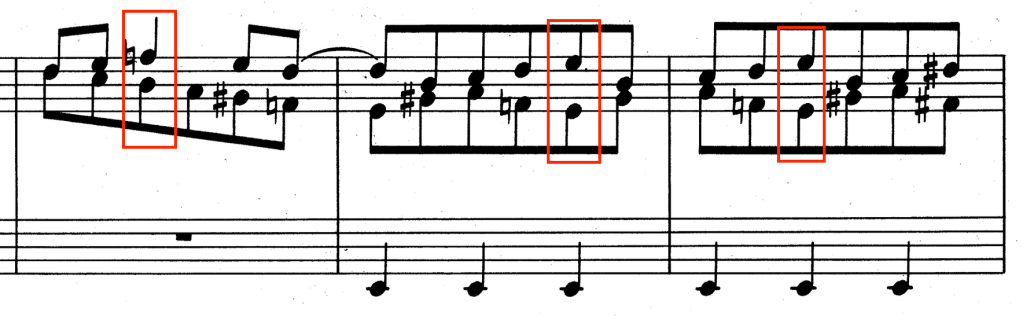
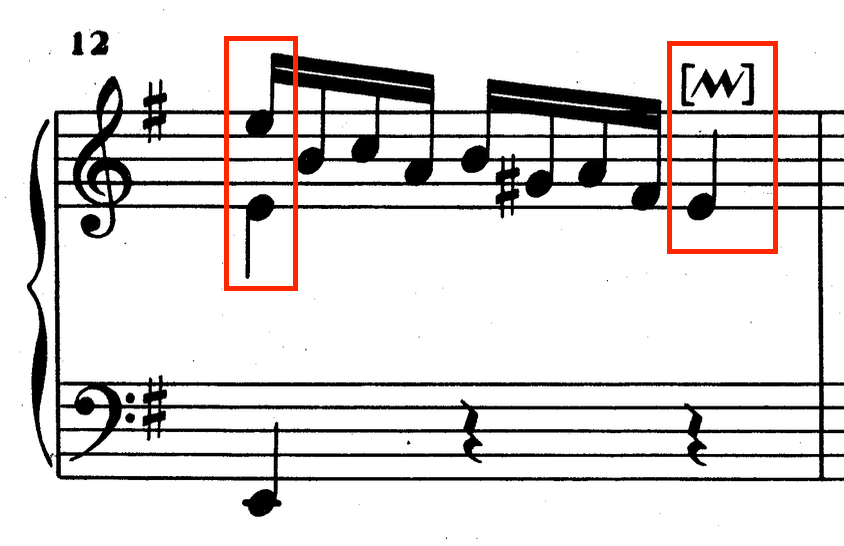
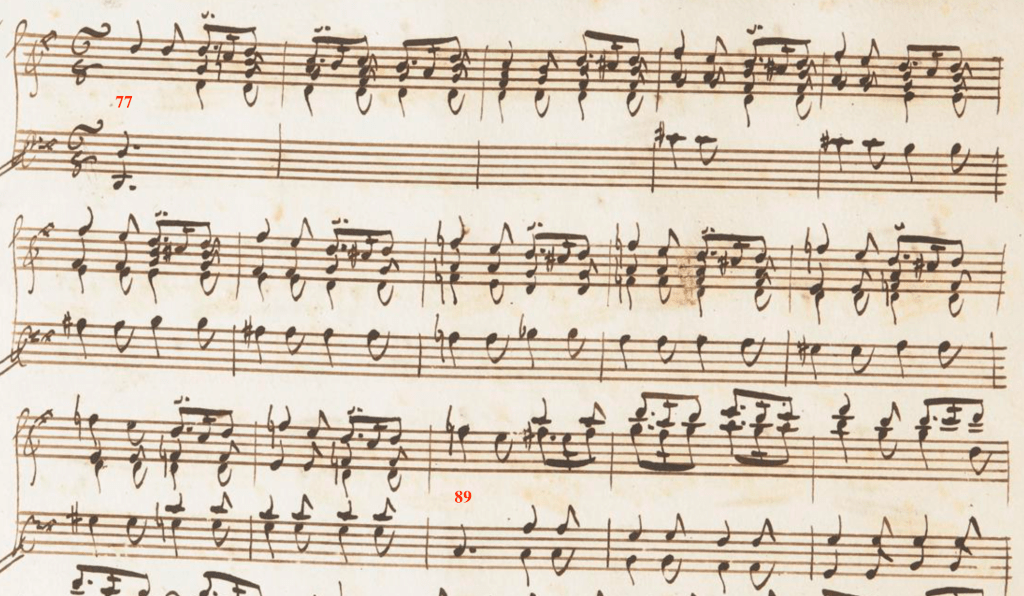
Scarlatti integrates most of the minor keys of his prime di Natale in the harmonic progressions of the modulations of the pastorale in the seconda. Thus the twelve mm. 77-89 of the pastorale of K235 – the number twelve reflecting the twelve days – pass through e, d, and g, as in mm. 77-89 (M):
Every prima di Natale depicts the hope for redemption by ascending to the highest note, here d3 in m. 55 of K259:
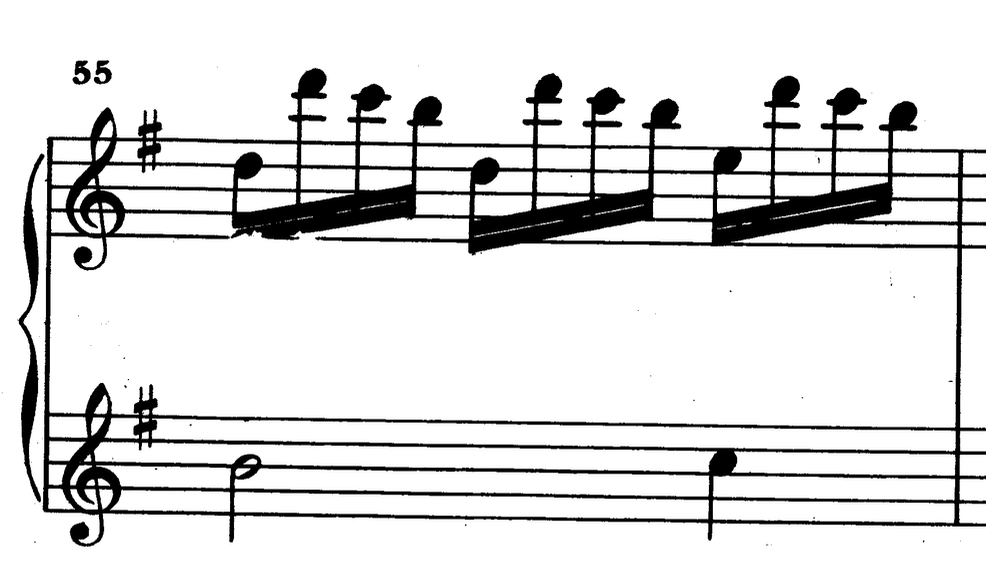
Ascending broken octaves, followed by a stepwise descent express the wish for redemption:
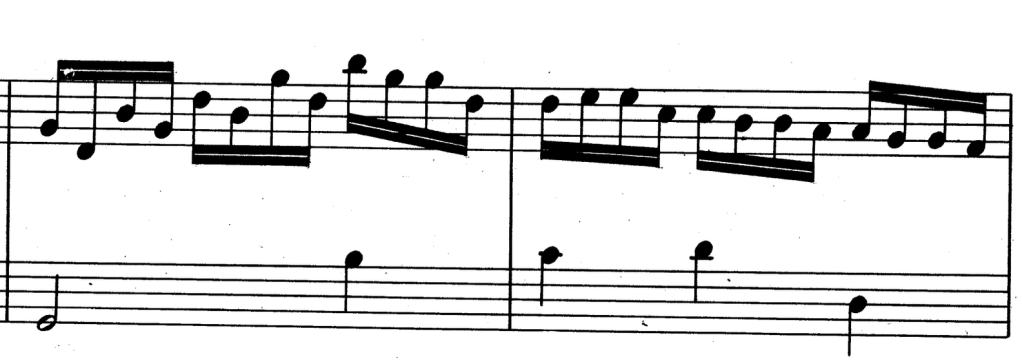
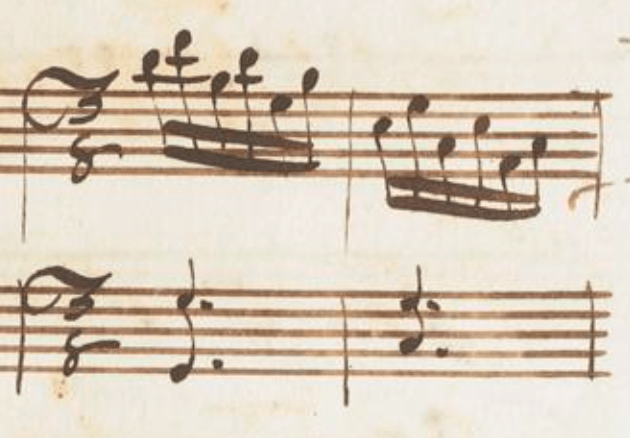
After the pastorale, they always receive a joyous reply in descent, here K235 mm. 101-102 (M):
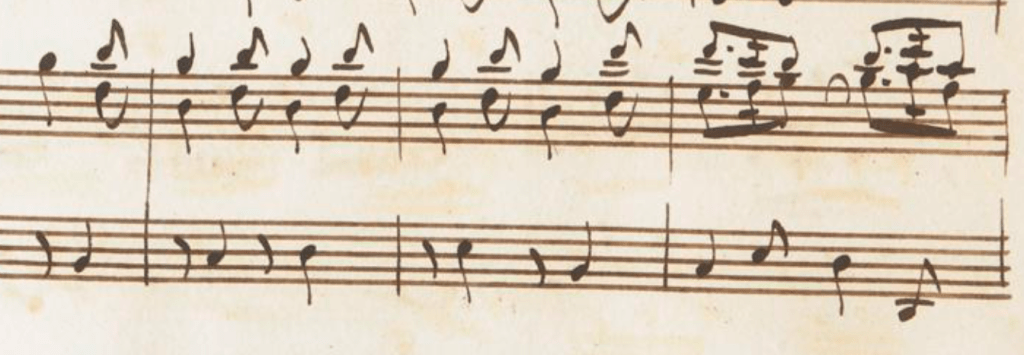
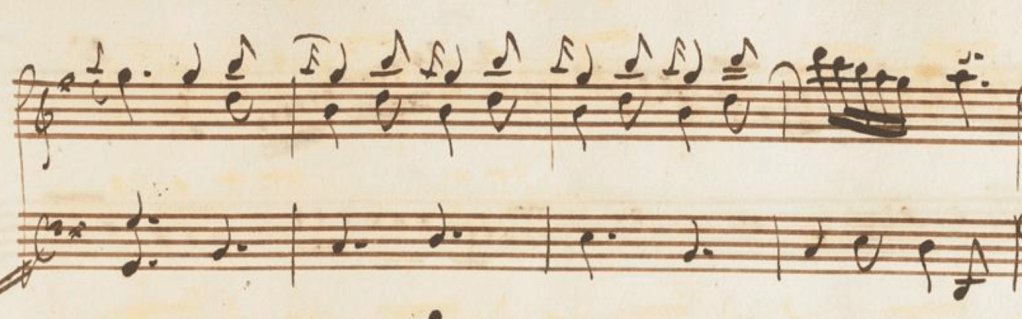
Before depicting these celebrations in 3/8, Scarlatti concludes every siciliano with the gradual departure of the players, clothed in warm major sixths, here the eight mm. 93-101 from K235 (M):
[1] Longo 1972, p. 96. Longo’s note identifying LS 3 as a pastorale is not yet present in his final, supplemental volume of his Scarlatti-edition of 1910, thus it either first appeared in his Domenico Scarlatti e la sua figura nella storia della musica, Napoli: Casa Editrice E. Bideri, 1913; or in his D. Scarlatti: Indice tematico (in ordine di tonalità e di ritmo) delle sonate per clavicembalo, Milan: G. Ricordi, 1937. Kirkpatrick and Boyd embellished Longo’s statement without providing any source: “the bagpipes of the zampognari” (Kirkpatrick, p. 129); “the Southern Italian zampognari with their droning basses and their lilting Christmas tunes, or the flutes of the pifferari […]” (Kirkpatrick, 203); “[…] drones and parallel movements in 3rds, in imitation of the pifferari – the Abruzzi peasant musicians who played their shawms and bagpipes in the streets of Italian cities at Christmastide.“ (Boyd, p. 172, also p. 288, fnn. 29, 30). Neither references Longo, nor states whether he actually witnessed such processions.
[2] Boyd 1986, p. 173. However, “K513 has a curious parallel in Bach’s Pastorale for organ BWV 590 […] which also breaks off the ‘Christmas’ movement prematurely (in this case in the mediant minor key) and never returns to it.” Boyd 1986, p. 288, fn. 30. BWV 590 does return, but Boyd did not know the three following sections.
María-Bárbara, Fernando, and Scarlatti were devout catholics, and Scarlatti contributed regularly to the musical celebration of the highest catholic holidays, Easter and Christmas. The compagne di Pasqua also have a triple rhythm or triplets at their core, and a triple structure. The core events depicted are the crucifixion, the lamentation, and the resurrection. In gentler pairs, the lamentation takes the place of the crucifixion. The most telling part of two Pasque is the beginning of the secunde: three groups of three notes in 6/8 rushing upwards, as in K163, K333, here K334 (P54a:2):
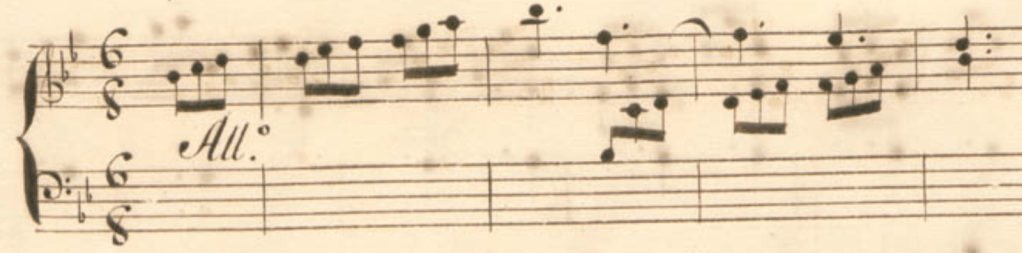
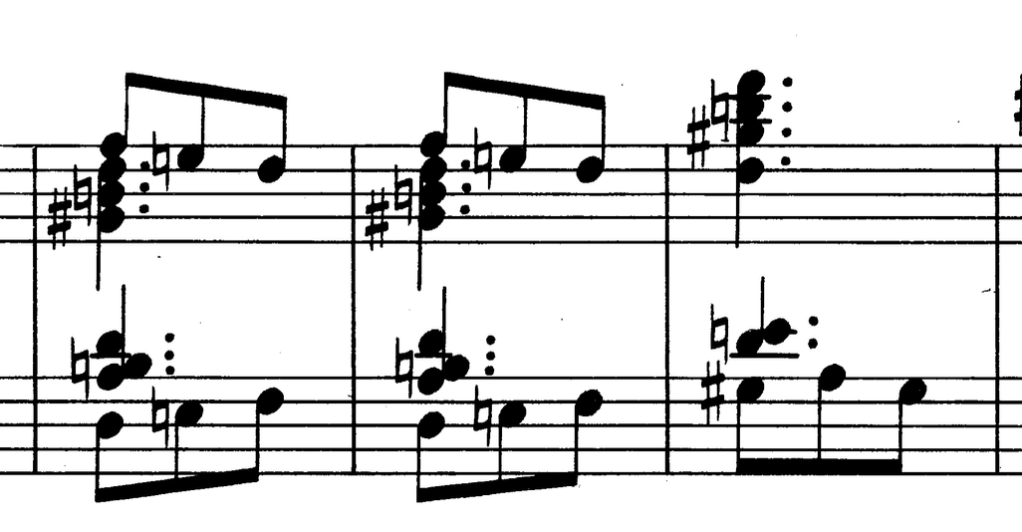
“Crucifixion”-chords K249, mm. 98-100, always three dissonant chords in a row, always repeated:
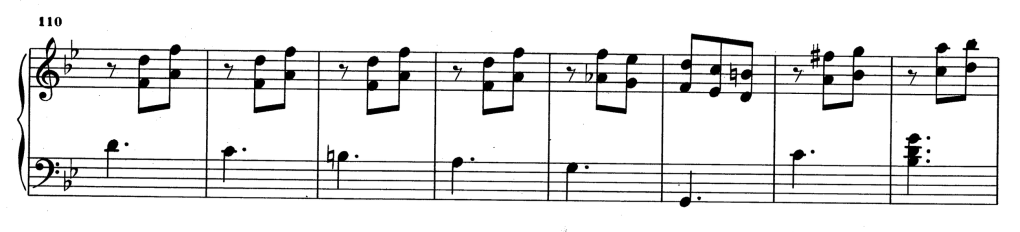
The lamentation from K249, often depicted with a descending bass splitting away from ascending sixths:
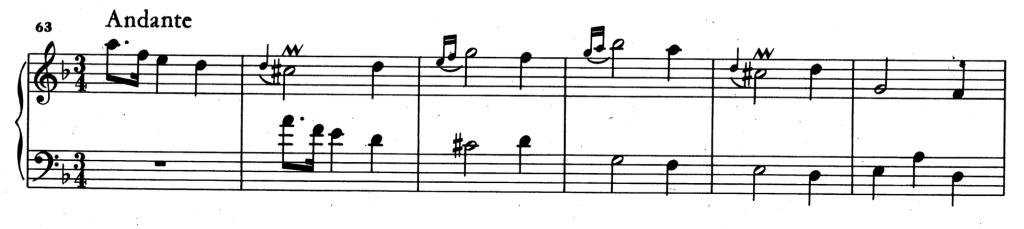
The most beautiful and most extensive Easter lamentation is found in K282:
[to be continued]
 restoringscarlatti.com
Leave a comment